

Think all SBA loans are the same? Think again.
One lets you tap flexible cash for payroll, inventory, or buying a business and closes faster.
The other is built to buy land, buildings, or long-lived equipment with long, mostly fixed payments and lower monthly costs.
Pick the wrong one and your cash flow gets pinched; pick the right one and you lock in predictable payments for years.
This post breaks down the real differences, what each covers, how fast money arrives, who pays what, and which fits your project.
Key Differences Overview for an SBA 7(a) Loan vs SBA 504 Loan Comparison
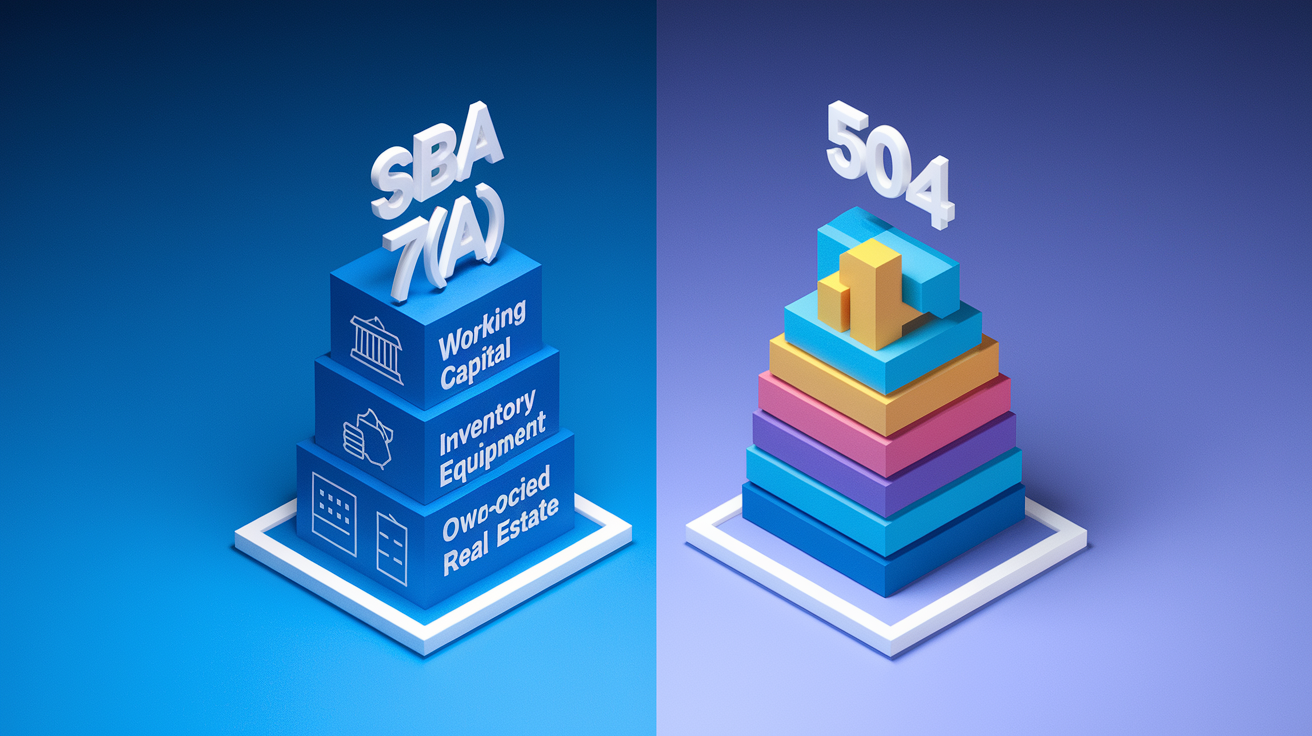
The SBA 7(a) loan is a flexible business loan that covers working capital, inventory, equipment, owner-occupied real estate, and buyouts. The SBA 504 is an asset-based long-term financing tool for fixed assets such as land, buildings, and long-term equipment. If you need general business funding or speed, you’re looking at a 7(a). If you’re buying commercial real estate or major equipment and want fixed rates, 504 is the path.
Both programs can go up to $5,000,000 in total loan size, but the structures are completely different. A 7(a) comes from a single lender and carries an SBA guaranty up to 85 percent for loans at or below $150,000 and 75 percent for anything larger (the maximum guaranty on a $5,000,000 loan is $3,750,000). A 504 splits the capital into three pieces: typically 50 percent from a conventional lender, 40 percent from a Certified Development Company backed by the SBA, and 10 percent from the borrower.
| Feature | SBA 7(a) | SBA 504 |
|---|---|---|
| Maximum Loan | $5,000,000 | $5,000,000 debenture ($5,500,000 for small manufacturers or energy projects) |
| Eligible Uses | Working capital, inventory, equipment, owner-occupied real estate, acquisitions, refinancing | Fixed assets only (land, buildings, construction, renovation, long-term machinery) |
| Down Payment | 10–20% (lender-dependent) | 10% (15% startup/special-purpose, 20% both) |
| Rate Type | Usually variable (Prime-based) | CDC portion fixed (3–6%); bank portion variable or fixed |
| Loan Terms | Up to 25 years real estate; 7–10 years working capital/equipment | 20–25 years real estate; 10 years equipment |
| Collateral | Liens on financed and existing assets; personal residence if needed | Liens on financed fixed assets |
| Personal Guarantees | Required for owners ≥ 20% | Required for owners ≥ 20% |
| Fees | SBA guaranty fee varies by size; lender packaging fees possible | CDC fees ~2–3% of debenture; upfront guaranty and annual service fees |
| Occupancy Rules | No strict SBA threshold | 51% existing building; 60% new construction rising to 80% over 10 years |
| Typical Timeline | 30–90 days | 60–120+ days |
Service businesses, retailers needing inventory cash, and buyers of existing companies generally fit the 7(a) because the program covers so many use cases and closes faster. Manufacturers, restaurants buying buildings, and medical practices purchasing facilities fit the 504 because the long-term fixed rates and lower initial equity make expensive real estate projects more workable.
SBA 7(a) Loan Features Explained for a Direct Comparison

The SBA 7(a) is the agency’s most versatile loan. You can use it for working capital to cover payroll during a slow season, inventory to stock shelves before a busy quarter, equipment from delivery vans to medical devices, and owner-occupied commercial real estate. You can also refinance existing business debt, buy another company, or fund tenant improvements in a leased space. If your need doesn’t fit neatly into one asset category or if you need money fast, the 7(a) is typically the right structure.
A lender originates the entire loan and the SBA provides a partial guaranty. For loans at or below $150,000, the guaranty reaches 85 percent. For anything larger, it drops to 75 percent, which means the maximum SBA guaranty on a $5,000,000 loan is $3,750,000. That guaranty lowers the lender’s risk and makes them more willing to approve deals with thinner collateral or shorter operating histories. Terms stretch up to 25 years for real estate, up to 10 years for equipment, and typically up to 7 years for working capital. Rates are usually variable and tied to Prime, with typical market ranges running 6 to 12 percent depending on your credit profile and collateral strength.
Most lenders require 10 to 20 percent equity from the borrower. Established businesses with strong cash flow often inject 10 percent. Startups or special-purpose properties may need 15 to 20 percent. Collateral requirements are standard: the lender places liens on the financed assets and may also reach for existing fixed assets or even your personal residence if the business collateral falls short. Personal guarantees are required from anyone owning 20 percent or more of the company.
Common uses include:
Working capital to smooth seasonal revenue swings or fund payroll before receivables convert to cash. Inventory purchases ahead of peak selling periods. Equipment from vehicles to manufacturing machinery. Owner-occupied commercial real estate when you want flexibility in other parts of the capital stack. Business acquisitions when the seller or deal structure doesn’t easily fit the 504 mold. Refinancing existing business debt to improve cash flow or extend amortization.
SBA 504 Loan Structure and Purpose for Comparison
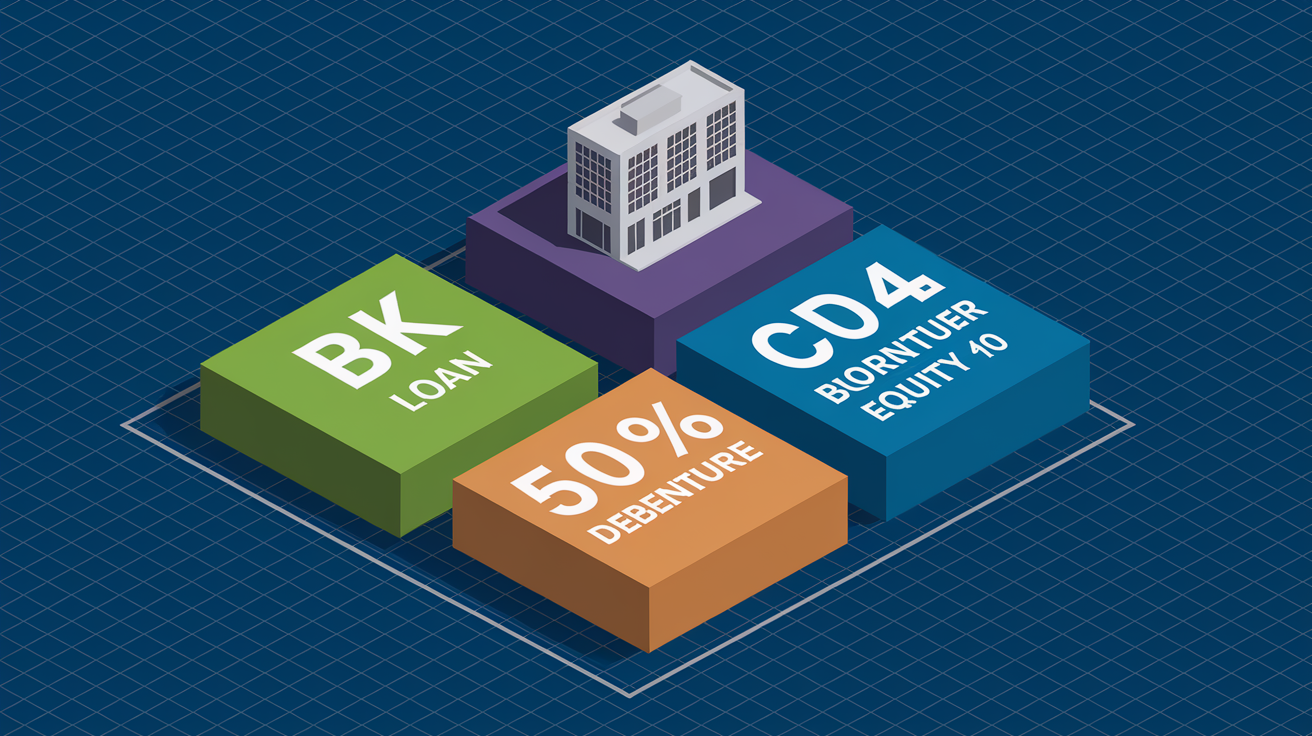
The SBA 504 is built for one thing: financing fixed assets that create jobs and support long-term economic development. The capital stack splits three ways. A conventional lender provides 50 percent of the project cost, a Certified Development Company issues a debenture for 40 percent backed by the SBA, and you bring the remaining 10 percent as a down payment. That 10 percent can rise to 15 percent if you’re a startup or buying a special-purpose property (a building designed for one specific use, such as a car wash). If you’re both a startup and buying special-purpose property, expect 20 percent down.
The CDC debenture typically goes up to $5,000,000, with certain small manufacturers and energy projects eligible up to $5,500,000. The CDC portion carries a fixed interest rate pegged to U.S. Treasury bond rates, historically ranging from 3 to 6 percent depending on the market when the bonds are sold. The bank’s 50 percent piece carries its own rate, which can be fixed or variable. Amortizations run 20 to 25 years for real estate and 10 years for equipment, making monthly payments lower than most other commercial structures.
Eligible uses are narrowly defined: land purchase, building purchase, new construction, building renovation, and long-term machinery or equipment. You can’t use a 504 for working capital, inventory, or short-lived assets. The program also comes with occupancy rules. If you buy an existing building, you must occupy at least 51 percent immediately. For new construction, you must occupy at least 60 percent when you move in and increase to 80 percent within 10 years. You also must meet job-creation or public-policy goals. The baseline rule is one job created or retained for every $90,000 the CDC lends. That ratio relaxes to $100,000 per job in certain empowerment zones and to $140,000 per job for small manufacturers.
Why the 504 structure works for certain projects:
Long-term fixed rate on the CDC portion gives predictable payments for 20 or 25 years. Lower initial equity requirement (10 percent standard) compared to conventional commercial mortgages. Specifically tailored for real estate and equipment purchases with favorable amortization. Job-creation metrics align borrowing with economic development, which helps underwriting when the project creates measurable employment.
Side by Side Cost and Term Insights Comparing SBA 7(a) vs SBA 504
Interest rates behave completely differently between these programs. The 7(a) typically carries a variable rate linked to Prime or another index, with market spreads pushing the all-in cost into the 6 to 12 percent range. Exact pricing depends on your credit score, time in business, collateral strength, and the lender’s appetite. The 504 fixes the CDC portion at the time the debenture is sold, and that rate tracks long-term Treasury bond yields. Recent historical ranges sit between 3 and 6 percent. The bank’s 50 percent slice will carry its own rate, often variable or sometimes fixed at the lender’s discretion, but the predictability of the CDC piece is a major advantage if you want stable long-term payments.
Amortization structures also differ. A 7(a) for owner-occupied real estate can stretch up to 25 years, equipment loans typically run up to 10 years, and working capital loans usually max out at 7 years. A 504 commonly offers 20 or 25 years for real estate and 10 years for equipment. The longer amortizations on the 504, combined with the lower fixed rate on the CDC portion, produce smaller monthly payments than a comparable 7(a) deal with a higher variable rate and shorter term.
| Cost Component | SBA 7(a) | SBA 504 |
|---|---|---|
| Rate Type | Variable (Prime-based) | CDC fixed (Treasury-based); bank portion variable or fixed |
| Rate Range | 6–12% typical | CDC 3–6%; bank portion market rate |
| Amortization | Up to 25 years real estate; 7–10 years WC/equipment | 20–25 years real estate; 10 years equipment |
| Upfront Fees | SBA guaranty fee varies by loan size; possible lender packaging fees | CDC fees ~2–3% of debenture; upfront SBA guaranty fee |
| Annual Fees | Minimal or none | Annual service fee on CDC portion |
| Payment Predictability | Low (variable rate risk) | High on CDC portion (fixed); depends on bank piece |
Over a 20-year hold, the 504’s fixed-rate advantage can save tens of thousands of dollars compared to a variable 7(a), especially if interest rates climb. The trade is time and complexity. The 504 takes longer to close and comes with more moving parts, but if you’re buying a building you plan to own for a decade or more, the cost savings and payment stability often justify the wait.
Eligibility Requirements for SBA 7(a) vs SBA 504 Loan Comparison
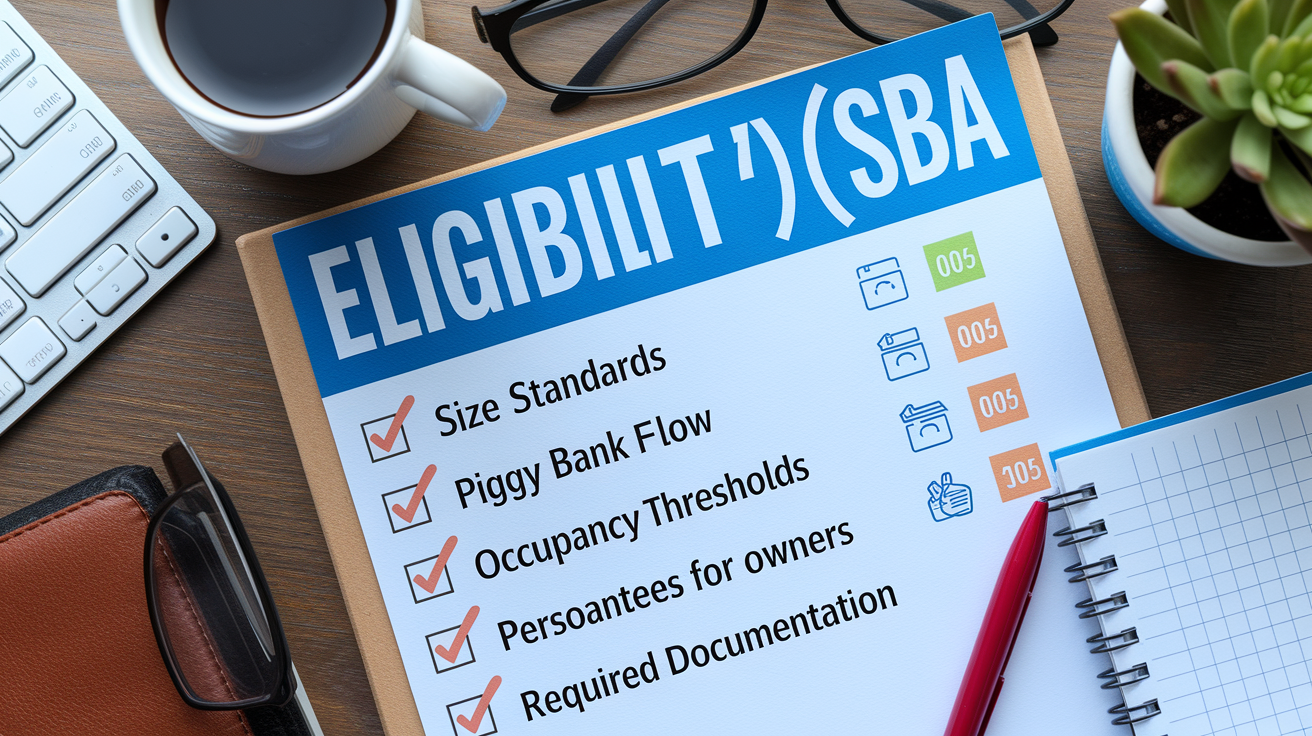
Both programs require your business to meet SBA size standards, which vary by industry and are based on either average annual receipts or number of employees. Most businesses qualify if net worth stays at or below $15,000,000 and average net income over the past two years is $5,000,000 or less. Personal guarantees are mandatory for any owner holding 20 percent or more equity in the company, regardless of which program you choose.
The 7(a) leans heavily on cash flow underwriting. Lenders look at your ability to service debt from operating income, so strong financials, consistent revenue, and manageable existing obligations improve approval odds. The 504 adds a second layer: the CDC must also approve the deal, and the project must satisfy job-creation or public-policy metrics. If your $800,000 CDC loan doesn’t generate at least nine jobs under the standard $90,000-per-job rule, the CDC will look for an alternative public-policy justification (such as revitalizing a distressed area or meeting energy-efficiency goals). You also have to meet occupancy thresholds. If the building you’re buying won’t be at least 51 percent owner-occupied immediately, the 504 won’t work.
Quick eligibility snapshot:
SBA size standards must be met for both programs. Personal guarantees required for all owners with 20 percent or greater stake. The 7(a) emphasizes cash flow and credit strength. Approval can happen with less collateral if income supports the payment. The 504 adds CDC approval and job-creation metrics (one job per $90,000 CDC funding, baseline). The 504 requires minimum occupancy: 51 percent for existing buildings, 60 percent initially for new construction rising to 80 percent within 10 years. Documentation for both includes business tax returns (typically last two to three years), personal tax returns, business plan, cash flow projections, and detailed ownership breakdown.
Application Process and Timeline Differences for 7(a) vs 504 Loans
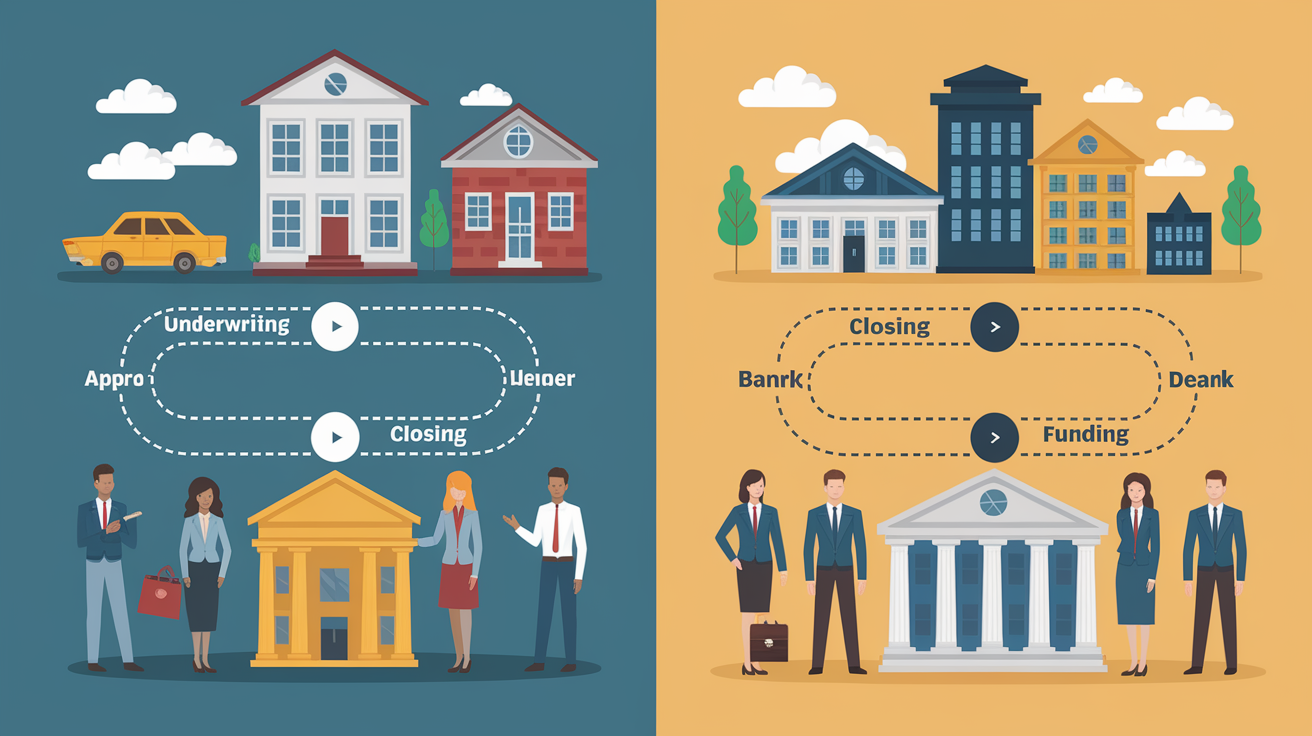
A 7(a) application runs through a single lender. You submit your business financials, personal tax returns, a brief narrative explaining use of funds, and projections showing how the loan will be repaid. The lender underwrites the deal, requests SBA approval if needed (or approves in-house if they hold Preferred Lender status), and closes the loan. Typical timeline is 30 to 90 days, depending on documentation quality and lender workload.
A 504 application splits between the conventional lender and the CDC. You work with both simultaneously. The bank underwrites its 50 percent piece, the CDC underwrites its 40 percent debenture, and both must approve before closing. The CDC also coordinates the bond sale that funds the debenture, which adds weeks to the process. Count on 60 to 120 days or longer if the project is complex or requires environmental reviews, appraisals, or construction permitting.
Step by step for both programs:
Gather core documents: business tax returns (last two to three years), personal tax returns, interim profit and loss statement, balance sheet, business plan, and cash flow projections. For 504, add detailed project cost breakdown and job-creation estimates.
For 7(a) only, submit application to one SBA-experienced lender. For 504, submit simultaneously to a conventional lender and a Certified Development Company in your region.
Lender underwrites credit, collateral, and cash flow. For 504, the CDC separately underwrites public-policy compliance and job metrics.
SBA reviews the guaranty request (7(a)) or the CDC packages the debenture for SBA backing (504). Preferred Lenders can streamline this step for 7(a) loans.
Closing: 7(a) closes in one transaction with the lender. 504 requires coordinated closings with the bank, CDC, and often title and escrow companies.
Funding: 7(a) funds immediately at closing. 504 bank portion funds at closing; CDC debenture funds after the bond sale, sometimes requiring interim financing or delayed disbursement.
Practical Use Case Examples Comparing SBA 7(a) vs SBA 504 Loans
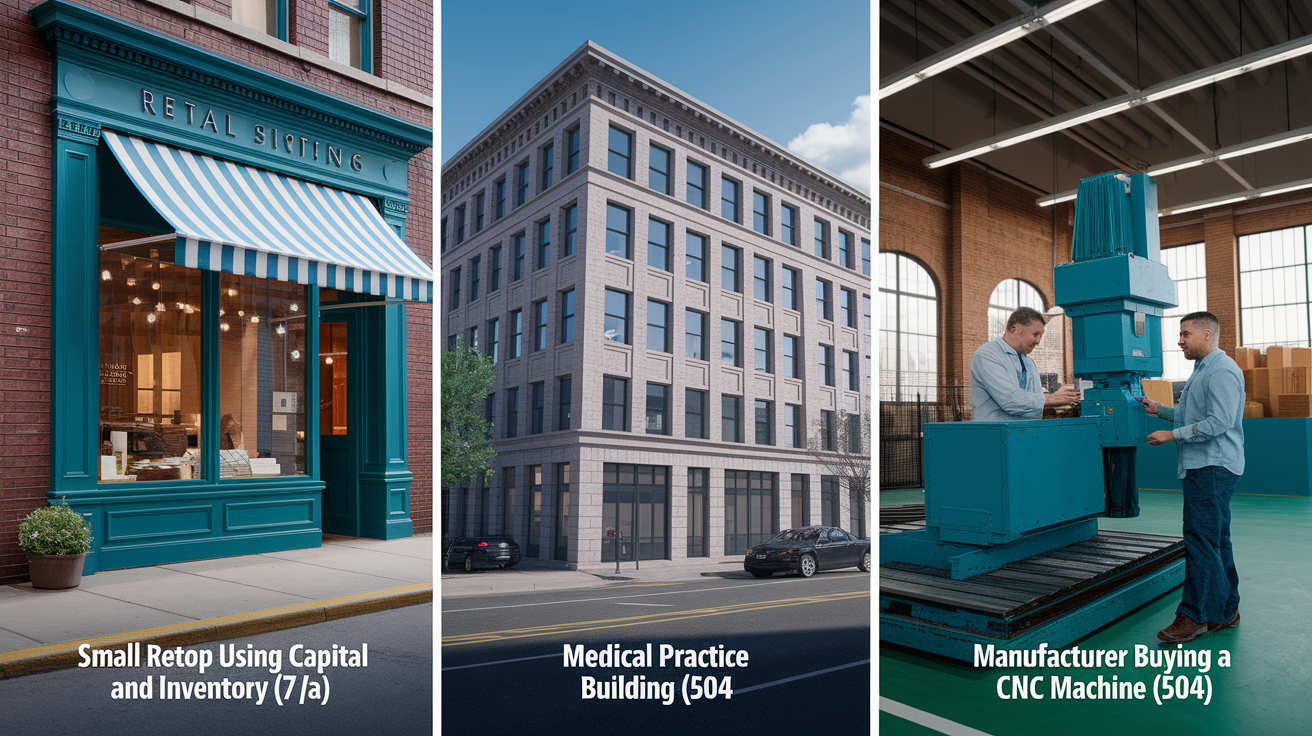
Example 1: A retail shop needs $150,000 for working capital and inventory to prepare for the holiday season. Revenue is steady but the business has been open only 18 months. A 7(a) loan is the clear fit. Working capital is an eligible use, and the lender can close in 45 to 60 days. The borrower injects $15,000 (10 percent), the lender funds $135,000, and the shop uses the cash to stock inventory and cover payroll through December. The loan amortizes over seven years at a variable rate tied to Prime plus 3 percent. The 504 can’t be used because inventory and working capital aren’t eligible fixed assets.
Example 2: A medical practice wants to buy a $1,200,000 building it currently leases. The practice has been operating for five years with strong cash flow and plans to occupy the entire building for the next 20 years. A 504 structure works perfectly. The capital stack splits as follows: conventional bank loan $600,000 (50 percent), CDC debenture $480,000 (40 percent), borrower down payment $120,000 (10 percent). The CDC debenture carries a fixed rate of 4.2 percent for 25 years. The bank portion is variable at Prime plus 1.5 percent. The combined blended payment is lower than a single 7(a) loan at a higher variable rate, and the fixed CDC piece protects against rate increases. The practice creates three new jobs over the first two years, satisfying the CDC job requirement of approximately five jobs for $480,000 ($480,000 ÷ $90,000 per job equals 5.3 jobs).
Example 3: A small manufacturer needs $400,000 to purchase a CNC machine that will expand capacity. The company has been profitable for eight years and the equipment has a 15-year useful life. Both programs are technically eligible, but the 504 offers better terms. A 7(a) would amortize the equipment over 10 years at a variable rate around 8 percent, resulting in a monthly payment near $4,850. A 504 structures the deal as $200,000 bank loan (50 percent), $160,000 CDC debenture (40 percent), and $40,000 borrower equity (10 percent). The CDC piece is fixed at 3.8 percent over 10 years, and the bank piece is variable at Prime plus 2 percent. The blended payment drops to roughly $4,200 per month, and the fixed CDC portion shields half the loan from rate risk.
The 7(a) wins when speed, flexibility, or non-fixed-asset needs drive the decision. The 504 wins when the project is real estate or major equipment, you want long-term rate certainty, and you can meet occupancy and job-creation rules.
Pros and Cons Comparison for SBA 7(a) vs SBA 504
SBA 7(a) Pros:
Broad eligible uses cover working capital, inventory, acquisitions, refinancing, and real estate. Single-lender structure simplifies coordination and speeds closing. Faster approval and funding, typically 30 to 90 days. Flexible for younger companies or deals with limited collateral when cash flow is strong. Can refinance existing business debt to lower payments or extend terms. Lower complexity and fewer parties involved compared to 504. Prepayment penalties often shorter or negotiable.
SBA 7(a) Cons:
Variable interest rates expose you to payment increases if benchmarks rise. Rates typically higher than 504 fixed CDC portion, often 6 to 12 percent range. Collateral requirements can reach personal assets if business collateral is insufficient. Equity injection may climb to 15 or 20 percent for startups or weaker credit profiles. Doesn’t offer the long-term fixed-rate stability of a 504 debenture. Amortizations for working capital and equipment are shorter, resulting in higher monthly payments. Less favorable for very large real estate purchases where rate certainty and low payments matter most.
SBA 504 Pros:
Long-term fixed rate on the CDC debenture (historically 3 to 6 percent) provides payment predictability for 20 or 25 years. Lower down payment (10 percent standard) compared to conventional commercial mortgages. Longer amortizations (20 to 25 years for real estate) produce smaller monthly payments. Specifically designed for owner-occupied real estate and long-term equipment, aligning structure with asset life. Job-creation and public-policy focus can open additional incentives or support from local development agencies. Blended rate between fixed CDC portion and bank portion often results in lower overall cost than a single variable 7(a). Ideal for businesses planning to hold property long-term and wanting protection from interest-rate volatility.
SBA 504 Cons:
Can’t be used for working capital, inventory, or short-lived assets. Longer approval and closing timeline, typically 60 to 120 days or more. More complex structure with three parties (borrower, bank, CDC) requiring coordinated underwriting and documentation. Job-creation requirement (one job per $90,000 CDC funding baseline) adds compliance burden. Occupancy rules restrict investment-only properties and require significant owner use (51 to 80 percent depending on scenario). Higher upfront fees (CDC processing and servicing fees typically 2 to 3 percent of debenture). CDC bond-sale timing can delay final funding or require interim financing arrangements.
Final Words
You’re in the middle of choosing speed and flexibility versus predictable, long-term cost. SBA 7(a) is the flexible route, up to $5,000,000, good for working capital, acquisitions, refinancing, and owner-occupied property, though rates often vary.
SBA 504 sits the other side: a bank/CDC/borrower split that’s built for real estate and big equipment, with a fixed CDC rate and lower down payment.
For a useful sba 7a loan vs sba 504 comparison, match the loan to how money flows in your business, and you’ll pick the right fit.
FAQ
Q: What are the main differences between an SBA 7(a) loan and an SBA 504 loan?
A: The main differences between an SBA 7(a) loan and an SBA 504 loan are uses, rate type, limits, and terms: 7(a) is flexible (up to $5M, variable ~6–12%), 504 funds fixed assets with CDC debentures ~$5–5.5M, fixed ~3–6%.
Q: What can I use an SBA 7(a) loan for vs a 504 loan?
A: You can use an SBA 7(a) for working capital, inventory, acquisitions, owner-occupied real estate, equipment, and refinance. An SBA 504 is for land, buildings, construction, renovations, and long-term machinery only.
Q: How much can I borrow with each program?
A: You can borrow up to $5,000,000 through 7(a). The 504’s CDC debenture typically goes up to $5,000,000–$5,500,000, with total project financing split 50% bank / 40% CDC / 10% borrower.
Q: How do interest rates and repayment terms compare between 7(a) and 504?
A: Interest rates for 7(a) are usually variable, often about 6–12% tied to Prime. The 504’s CDC portion is fixed, roughly 3–6%, giving more predictable long-term payments.
Q: What down payment or equity is required for 7(a) and 504 loans?
A: Down payment for 7(a) typically 10–20% equity injection. 504 usually requires about 10% borrower down payment; startups or special-purpose properties often need 15–20%.
Q: Who typically qualifies for each loan and what are key eligibility requirements?
A: Qualification depends on SBA size standards, cash-flow, credit, and documentation. 7(a) focuses on cash flow and lender underwriting; 504 needs bank plus CDC approval, and has job-creation and occupancy rules.
Q: How long does each application and closing process usually take?
A: 7(a) loans typically close in 30–90 days. 504 loans take longer—usually 60–120+ days—because CDC approval and bond funding add steps to the process.
Q: What fees and upfront costs should I expect with 7(a) vs 504?
A: Expect SBA guaranty fees on 7(a) varying by loan size and lender fees. 504 adds CDC debenture fees around 2–3% plus closing costs and typical bank fees.
Q: Which businesses are better suited for a 7(a) loan and which for a 504 loan?
A: Businesses needing working capital, inventory, or quick acquisitions usually fit 7(a). Companies buying owner-occupied real estate or long-term equipment fit 504 for lower fixed rates and low down payment.
Q: What are the pros and cons of choosing 7(a) versus 504?
A: The pros of 7(a) are flexibility and faster closings; cons are variable rates and sometimes higher equity. 504’s pros are low down payment and fixed long-term rates; cons are slower process and limited to fixed assets.
Q: How do collateral, guarantees, and occupancy/job rules differ between 7(a) and 504?
A: Collateral and guarantees differ: 7(a) requires collateral and personal guarantees for owners ≥20%, SBA guaranty 85% ≤$150k, 75% over, max $3.75M. 504 occupancy minimums 51% existing, 60% new (rising to 80%), CDC job metric ≈1 job per $90k funding.
Q: How should I choose between a 7(a) and a 504 loan?
A: You should choose between a 7(a) and a 504 based on use and cash flow: pick 7(a) for flexible needs and faster closings; pick 504 for real estate or equipment when you want lower down payment and fixed long-term rates.