


Think you can factor contractor invoices without paperwork?
Not quite.
This checklist lays out the exact documents most factors want: a completed application, invoice copies, proof the work is done, contracts or purchase orders, an A/R (accounts receivable) aging report, recent bank statements, business formation docs, and UCC (lien search) results, plus industry extras like lien waivers or bills of lading.
Bring this packet and you cut days off funding.
Missing items are the main reason advances stall, so get this right first.
Documents You Need Before Applying for Invoice Factoring (Quick Checklist)

When you apply for invoice factoring, you’re asking a lender to advance cash on work you’ve already done. The factoring company needs to verify three things: your business is real, the work is finished, and the customer can actually pay. How fast you pull that proof together decides how fast you get funded.
Most factoring companies ask for the same core packet. Some want extra detail if you’re in a regulated trade or working with government contracts, but this list covers what nearly every factor will request upfront.
- Completed factoring application. Basic business info, ownership details, and contact information.
- Accounts receivable aging report. A schedule of all unpaid invoices organized by 30/60/90 day buckets.
- Copies of unpaid invoices. Each invoice you want to factor, with invoice number, date, amount, payment terms, and customer name.
- Proof of completed work. Delivery receipts, signed work orders, bills of lading, or approved payment applications.
- Signed contracts or purchase orders. The original agreement or PO that authorized the work.
- Customer contact information. Company name, billing address, accounts payable contact name, email, and phone number.
- Business formation documents. Articles of incorporation or organization, business license, and EIN confirmation.
- Business bank account details. Routing and account number for ACH or wire transfer.
- Recent financial records. Profit and loss statement, balance sheet, A/R and A/P schedules, and 3 to 6 months of bank statements.
- UCC search results and lien documentation. Proof that receivables are free of existing liens, or subordination agreements if another lender has a claim.
Why Factoring Companies Require These Documents
Invoices and accounts receivable reports prove the asset the factor is buying. Without clear, verified receivables, there’s nothing to advance against. The aging report shows which invoices are still collectible and which have been sitting unpaid too long.
Customer contact information matters because factoring risk sits with your customer, not you. The factor will verify the invoice directly with your customer or check the customer’s credit. If your customer won’t confirm the invoice or has bad payment history, the factor won’t fund.
Business formation documents, tax ID, bank statements, and lien searches confirm your company is legitimate, operating, and legally able to sell its receivables. Existing liens on accounts receivable are a leading cause of delays. Factoring companies must make sure receivables are unencumbered or that another lender has agreed to subordinate its claim.
Contractor Eligibility and Documentation Standards

Factoring companies focus on your customers’ creditworthiness more than your own credit score or years in business. If you’ve completed verifiable work for clients who pay their bills, you can qualify even if your contractor business is new or your personal credit isn’t perfect.
That said, you still need to show that your business is real and operating. Factors want to see business formation paperwork, a tax ID, an active business bank account, and recent financials that match the invoices you’re submitting. If your revenue, bank deposits, and A/R aging don’t line up, expect questions.
Common eligibility criteria contractors must meet:
- Legitimate, registered business. Articles of incorporation or organization, business license, and EIN on file.
- Completed work tied to valid invoices. Invoices must reflect work already delivered, not future services.
- Creditworthy customers. The account debtor (your client) must have reasonable credit and payment history.
- No existing liens on receivables. UCC search must show receivables are free, or existing lender must provide subordination.
- No active bankruptcy. Contractors in bankruptcy typically can’t factor receivables.
- Verifiable customer contact information. Factor must be able to reach the customer’s AP department to confirm the invoice.
Formatting and Submission Requirements for Documentation

Factoring companies prefer clean, legible digital copies in PDF format. Scanned images are fine as long as text, signatures, and dollar amounts are readable. If a document requires an original signature or notarization, the factor will tell you upfront.
Every invoice you submit should include the invoice number, invoice date, customer name, job or contract number, line item amounts, payment terms, and due date. If the invoice references a purchase order or contract, note that number on the invoice. Missing fields slow down verification and can add days to funding.
Organize documents by invoice and customer. A single folder per invoice containing the invoice, the signed contract or PO, proof of delivery, and the customer AP contact makes underwriting faster. Many factors also ask for an index spreadsheet summarizing invoice amounts, dates, due dates, and PO numbers.
| Document Type | Required Format | Notes |
|---|---|---|
| Invoices | PDF or scanned image | Include invoice number, date, amount, terms, customer name, and PO number if applicable. |
| Contracts / Purchase Orders | PDF with all pages and signatures | Must show scope, payment terms, and authorized signatures. |
| Proof of Delivery / Work Completion | Signed receipts, bills of lading, or approved payment applications (PDF) | Signature, date, and description of work or goods delivered required. |
| A/R Aging Report | Spreadsheet (Excel or CSV) or PDF export from accounting software | Must show invoice level detail in 30/60/90 day buckets, not just totals. |
| Bank Statements | PDF of official statements (3 to 6 months) | Redact sensitive non-business account info if needed, but keep transaction detail visible. |
| Business Formation Docs | PDF of articles of incorporation/organization, EIN letter, business license | Must match the legal entity name on invoices and bank account. |
Timeline: When Each Document Is Needed During the Factoring Process
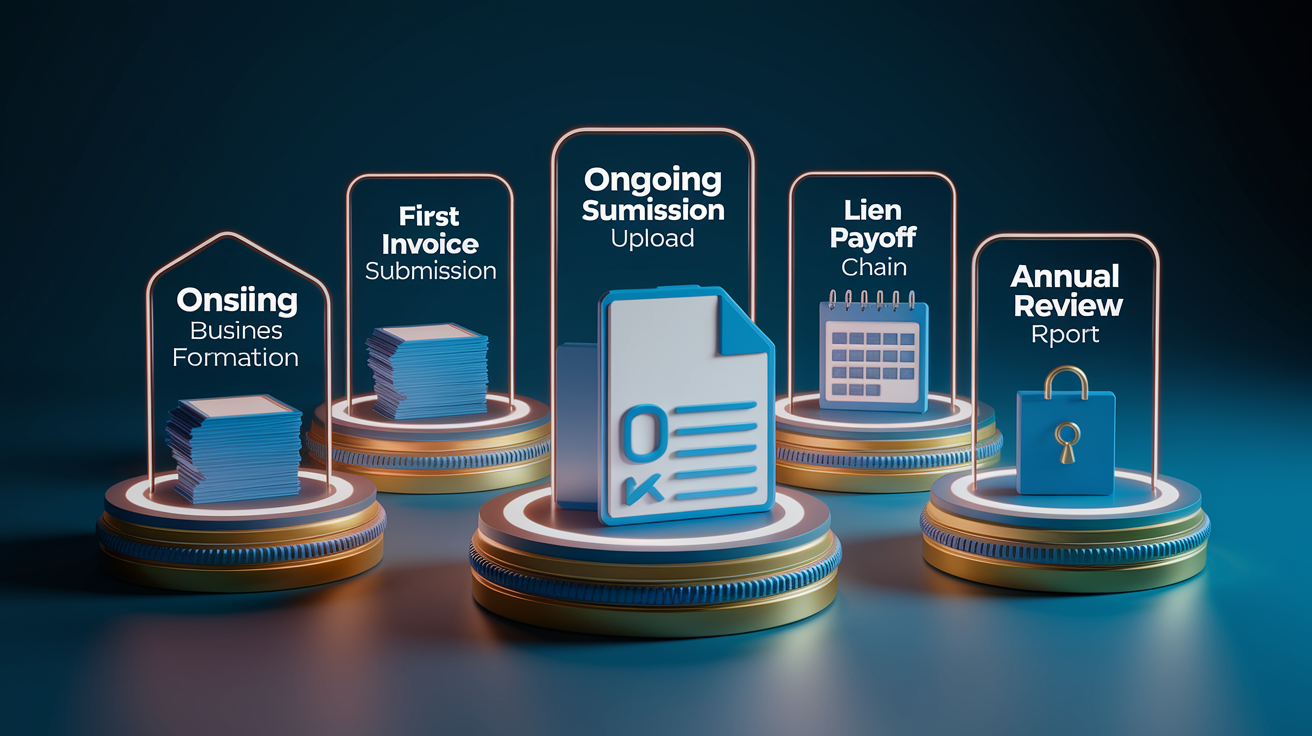
Initial onboarding documents are collected once when you open the factoring relationship. Business formation paperwork, EIN, ownership information, bank account details, and financial statements prove your business exists and establish your profile.
Each time you submit an invoice for factoring, you’ll provide the invoice itself, proof of completed work, the underlying contract or PO, and customer contact information. The factor uses these to verify the receivable and contact the customer for confirmation before advancing funds.
Documents required at different stages:
- Application and onboarding. Business formation docs, EIN, bank account routing and account number, ownership details, financial statements, UCC search results.
- First invoice submission. Copies of all outstanding invoices, A/R aging report, signed contracts or purchase orders, proof of delivery, customer contact list.
- Ongoing invoice submissions. Individual invoice, proof of work for that invoice, and updated customer contact info if it’s changed.
- Lien or payoff situations. UCC releases, subordination agreements, or payoff letters from existing lenders before first funding.
- Annual or periodic reviews. Updated financials, tax returns, or renewed business licenses as requested by the factor.
Industry Variations in Documentation Requirements

Construction contractors often need to provide AIA payment applications (G702 and G703 forms), lien waivers, schedules of values, and retainage documentation. Factoring companies want conditional or unconditional lien waivers that match invoice amounts, and they’ll ask for signed approvals from the general contractor or project owner showing the work was accepted.
Trucking and logistics contractors typically submit signed bills of lading, rate confirmations from the broker or shipper, proof of delivery signatures, and carrier agreements. Because trucking invoices can be disputed for late delivery or damaged freight, factors scrutinize delivery receipts and may require broker credit checks.
Staffing and temporary labor contractors must provide signed timesheets, client approved hours, and master staffing agreements. Many staffing factors also verify that workers were paid before advancing funds, and they may require payroll records or proof of workers’ comp coverage to reduce co-employment risk.
Industries and their specialized documentation needs:
- General contractors and subcontractors. AIA G702/G703, lien waivers, schedules of values, change orders, retainage detail.
- Trucking and freight. Bills of lading, rate confirmations, proof of delivery, carrier authority documentation.
- Staffing agencies. Signed timesheets, client approvals, staffing agreements, payroll records, workers’ comp certificates.
- Janitorial and facilities maintenance. Service agreements, signed work completion forms, recurring contract terms.
- Government contractors. Notice of Assignment under the Federal Assignment of Claims Act, contract award documentation, payment bond information.
- Equipment rental and suppliers. Delivery tickets, rental agreements, signed return receipts, customer purchase orders.
Tips for Organizing and Streamlining Your Factoring Paperwork

Keeping documents organized in a single digital folder cuts days off the approval process. Create subfolders for Invoices, Contracts, Delivery Proof, Bank Statements, Formation Docs, and Lien Docs. Use consistent file names like [Customer][Invoice#][Date].pdf.
Pre-run a UCC search on your own business and gather lien release or subordination language early if you have existing financing. Factors won’t advance funds until lien issues are resolved, and waiting for your bank or previous lender to respond can stretch onboarding by weeks.
Practical steps to stay ready:
- Export an A/R aging report from your accounting software monthly. Keep it current so you can submit it the day you apply.
- Attach proof of delivery to each invoice immediately after job completion. Don’t wait until you need funding to hunt down signed receipts.
- Maintain a customer contact spreadsheet. List company name, AP contact name, email, phone number, and billing address for every client.
- Keep 3 to 6 months of bank statements in a ready folder. Update it each month so you’re never scrambling.
- Store signed contracts and POs in a searchable system. Tag them by customer and job number for quick retrieval.
- Resolve small invoice disputes before submitting for factoring. Credit memos, backcharges, or unsigned change orders will delay funding.
- Confirm your business formation docs and EIN letter are on file. If you can’t find your EIN confirmation letter, request a new copy from the IRS before you apply.
Final Words
You’ve got the quick checklist, why each paper matters, who usually qualifies, how to format files, when to hand them over, industry quirks, and simple ways to stay organized.
Keep the required documentation for contractor invoice factoring ready and clean. That alone cuts funding delays and raises approval odds.
Start by gathering the 10 checklist items, scan them clearly, and match the format your factor wants. Do that and unpaid invoices turn into predictable cash — doable and totally worth it.
FAQ
Q: What documents are needed for factoring and what information does a factoring company need?
A: The documents and information a factoring company needs are business ID and formation papers, signed contracts, recent invoices, proof work completed, A/R aging, client contact and credit info, bank statements, and ID.
Q: What needs to be on a contractor invoice?
A: A contractor invoice needs an invoice number, issue and due dates, client and contractor names, clear work description, quantities or hours and rates, total amount, payment details, and any contract or PO reference.
Q: What needs to be on a CIS invoice?
A: A CIS invoice needs an invoice number and date, subcontractor and contractor names, description of work, gross amount, CIS deduction and net payable (if deducted), and the subcontractor’s UTR or tax reference and payment details.