


Which will cost you more: a fast lump sum that pulls money out of your daily sales, or a slower credit reserve you pay interest on?
Short answer: a merchant cash advance sells a slice of future card sales for a lump sum and repays itself via daily or weekly holdbacks, while a business line of credit gives revolving access you draw, repay, and reuse with monthly interest.
This post lays out the key differences, repayment, true cost, speed, and who can qualify, so you can pick the right fit for your cash needs.
Core Comparison: Understanding Merchant Cash Advance vs Business Line of Credit

A merchant cash advance gives you a lump sum today in exchange for a slice of your future card sales or daily receipts. You’re not borrowing. You’re selling future revenue at a discount. Repayment happens automatically through daily or weekly holdbacks from your deposit account or card processor, and the faster your sales, the faster you pay it back.
A business line of credit works like a reserve credit card for your business. You get approved for a maximum limit (say $100,000) and you only borrow what you need, when you need it. Interest accrues only on the amount you draw, and as you repay, that capacity becomes available again. It’s revolving credit, not a one-time deal.
The biggest practical difference shows up in how repayment affects your cash. With an MCA, you’re sending 5% to 20% of daily card receipts out the door before the money hits your account. Before you saw strong Monday receipts, the holdback already took $800 off your $8,000 in card sales. With a line of credit, you make scheduled interest or minimum payments monthly, and the rest of the money stays in your account for operations.
That flexibility makes LOCs cheaper over time, but they demand stronger credit and documented revenue to qualify. MCAs fund faster and approve businesses that wouldn’t clear traditional underwriting, but the cost reflects the lender’s risk. Factor rates commonly range from 1.10 to 1.50, translating to effective annual percentage rates that can reach 40% to 350%. Line of credit APRs typically run from single digits up to about 20–30% depending on your credit.
| Feature | Merchant Cash Advance | Business Line of Credit |
|---|---|---|
| Repayment Method | Daily/weekly holdback on card sales or receipts | Scheduled monthly interest + principal payments |
| Typical Cost | Factor rates 1.10–1.50; effective APRs 40–350% | APRs from low single digits to ~20–30% |
| Funding Speed | Same day to 72 hours | 24–72 hours, longer if complex underwriting |
| Credit Requirements | Often available with poor credit; ≥$10k monthly sales | Typically FICO ~650+ and revenue ~$100k+ |
| Structure | Lump sum advance; fixed total repayment | Revolving access; borrow and repay repeatedly |
| Best Use-Case | Urgent short-term need with strong daily card sales | Ongoing or seasonal working capital with stable revenue |
Detailed Mechanics of How Merchant Cash Advances Work

When you apply for a merchant cash advance, the provider looks at your monthly card sales or bank deposits (not your personal credit report) and offers you a lump sum. Let’s say you get $50,000 at a factor rate of 1.4. That means you agree to repay $50,000 × 1.4 = $70,000 total. The lender then takes a fixed percentage of your daily or weekly receipts until that $70,000 is collected.
The holdback percentage (often called the retrieval rate) usually sits between 5% and 20% of your gross card sales. If your business processes $10,000 in cards this week and your agreement says 10%, the lender pulls $1,000 from your deposit. When sales spike, you repay faster. When sales dip, repayment slows. That sounds flexible, but faster repayment actually pushes the effective annual percentage rate higher because you’re paying the same fixed $20,000 in fees over a shorter calendar period.
Most MCAs clear in 3 to 18 months, and funding usually arrives within 24 to 72 hours of approval. Sometimes same day.
How repayment works in practice:
Automatic daily or weekly ACH withdrawals pull the agreed percentage from your checking account or card processor before you see it.
Holdback percentages range from 5% to 20%, set at contract signing and fixed for the term.
Factor rates typically run 1.10 to 1.50, meaning you repay $1.10 to $1.50 for every dollar advanced.
Revenue fluctuations change repayment timing but not total cost. Slow sales stretch the term; fast sales compress it and increase effective APR.
Early payoff rarely saves much, because you still owe the full factor rate amount, though some providers discount a small portion if you pay weeks ahead of schedule.
How Business Lines of Credit Operate and When They Fit Best

A business line of credit gives you a credit limit (let’s say $100,000) and you draw only what you need, whenever you need it. If you take $25,000 in March for inventory and $15,000 in June for a marketing push, you pay interest only on those amounts for the time you carry them. Once you repay the $25,000, that capacity opens back up. It’s a revolving tool, not a one and done loan.
Lenders price lines of credit with annual percentage rates, commonly ranging from low single digits at banks for established businesses up to around 20% to 30% through alternative lenders. Rates vary by your credit score, revenue history, and whether you pledge collateral. Some lines include maintenance fees or charge a small fee on unused capacity, so read the terms.
Typical underwriting wants a FICO around 650 or higher, stable monthly revenue (often $100,000 or more annually), and recent bank statements showing consistent deposits. Approval may take a bit longer than a merchant cash advance, since lenders analyze credit and cash flow patterns, but funding can still land in 24 to 72 hours once approved.
Lines of credit work best when you face recurring or seasonal cash flow gaps but don’t want to pay interest on money you’re not using. Retail businesses restocking for holiday seasons, service companies covering payroll between invoices, or e-commerce sellers pre-buying inventory for a product launch all benefit from the flexibility. You borrow $30,000 this month, repay $20,000 next month when receivables come in, and still have $90,000 available if another opportunity hits. That reuse and pay as you go model keeps costs manageable compared to locked repayment on a lump sum advance.
Comparing Costs: Factor Rates vs Interest Rates in MCA vs LOC

Merchant cash advances hide their true cost behind factor rates instead of annual percentage rates. A factor rate of 1.25 sounds modest until you realize it means paying $62,500 total on a $50,000 advance (a $12,500 fee), and if you repay that in six months through daily remittances, the effective APR climbs past 50%. The faster your sales, the shorter the term and the higher the annualized rate, even though the dollar fee stays the same.
Lines of credit show you an APR up front (say 18%) and you pay interest only on the balance you carry each month. Draw $25,000 for three months at 18% APR, and your interest runs about $1,125 total if you pay it off at the end of the quarter. The difference in total cost can be dramatic when you run the numbers side by side.
How to compare total cost using factor rate vs APR:
Calculate the total repayment on the MCA: multiply the advance by the factor rate (example: $50,000 × 1.4 = $70,000).
Subtract the advance from total repayment to find the fee: $70,000 − $50,000 = $20,000 in fees.
Estimate how many months you’ll repay based on your sales volume: if you process $100,000 monthly in cards with a 10% holdback, you send $10,000/month, so $70,000 ÷ $10,000 = 7 months.
Convert the fee to an approximate annualized rate: ($20,000 fee ÷ $50,000 advance) ÷ (7 months ÷ 12 months) ≈ 69% effective APR.
Compare that APR to the line of credit rate and fees: if the LOC charges 18% APR plus a $200 annual maintenance fee, the all in cost on a $50,000 draw held for seven months is roughly $5,250 in interest plus the fee. Far less than the MCA.
Approval Requirements and Eligibility Differences in MCA vs LOC
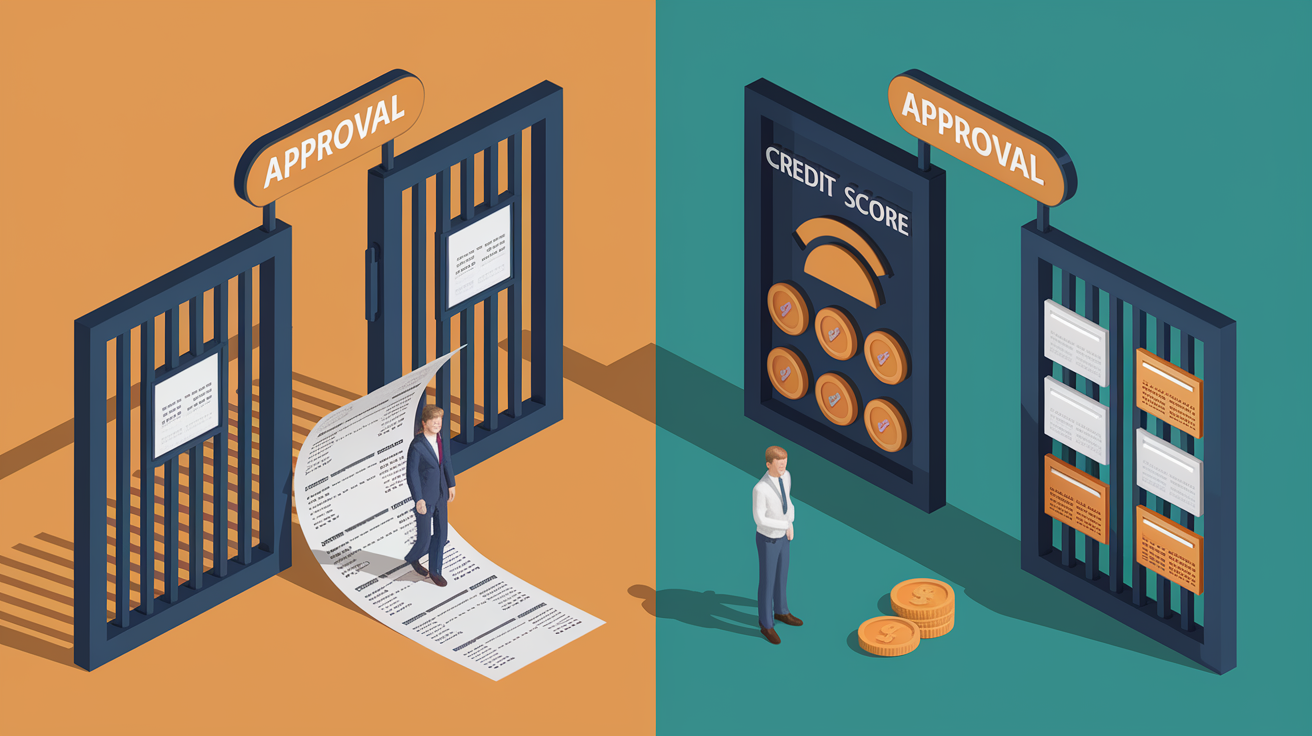
Merchant cash advances focus almost entirely on your card sales or daily deposit volume. Providers want to see at least $10,000 in monthly sales (often through your card processor statements or recent bank deposits) and they’ll approve businesses that have been operating for just a few months. Personal credit matters less, because the lender is buying your future receivables and can start withholding payments immediately. That makes MCAs accessible to startups, owners rebuilding credit, or businesses in industries that banks consider high risk.
Business lines of credit require stronger underwriting. Lenders typically want a FICO score around 650 or higher, annual revenue of $100,000 or more, and at least six to twelve months of bank statements showing stable deposits. They may ask for tax returns, profit and loss statements, and a clear explanation of how you’ll use the credit. Some traditional banks also require collateral (business assets or a blanket lien) and the application process involves more documentation and longer review than a cash advance.
The gap in approval standards explains the cost difference. An MCA provider takes on higher risk by approving businesses that wouldn’t qualify elsewhere, so they charge factor rates that translate to triple digit effective APRs. A line of credit lender underwrites to lower risk and prices accordingly, knowing the borrower has proven revenue, manageable debt, and a track record. If your credit and revenue fit the LOC profile, you save substantially on financing cost. If they don’t, the MCA may be the only option that funds in time, but you pay a premium for that access.
Funding Speed and Application Process Differences

Both merchant cash advances and business lines of credit can move quickly once you submit the necessary documents, but the paths look different. Many providers offer online prequalification that takes minutes. You enter basic revenue and time in business details, and the system estimates an offer range. Decisions can come back as fast as 24 hours for either product, and funds get deposited directly to your business checking account.
Merchant cash advances usually require the least paperwork. Expect to provide recent credit card processing statements or three to six months of bank statements showing deposit patterns, and possibly a voided check or bank account authorization so the lender can set up automatic ACH remittances. Because underwriting centers on daily sales volume, not creditworthiness, the review moves fast. Often same day or within 72 hours from application to funding. You won’t spend time compiling tax returns or answering questions about your balance sheet.
The general application flow for both products:
Prequalify online by entering monthly revenue, time in business, and rough credit range; get an estimated offer or range in minutes.
Submit documentation. For MCAs, card processor reports or bank statements; for LOCs, add tax returns, P&L, and possibly personal credit authorization.
Underwriting review. MCA providers analyze daily sales trends and set holdback percentage; LOC lenders pull credit, verify revenue stability, and assess repayment capacity.
Receive funds. MCAs often fund within 24–72 hours; LOCs may take an extra day or two if the lender requests additional documents or needs to finalize credit limits and terms.
Lines of credit can also fund quickly if you meet the profile cleanly: strong credit, clear financials, and straightforward use case. But if underwriting flags something (uneven deposits, recent credit inquiries, or industry risk), the process stretches. That delay matters when you need cash for an immediate inventory buy or to cover payroll on Friday. In those moments, the MCA’s speed justifies the higher cost for some businesses, even though a line of credit would save money if you had two weeks to wait.
Pros and Cons Breakdown for Merchant Cash Advance vs Business Line of Credit
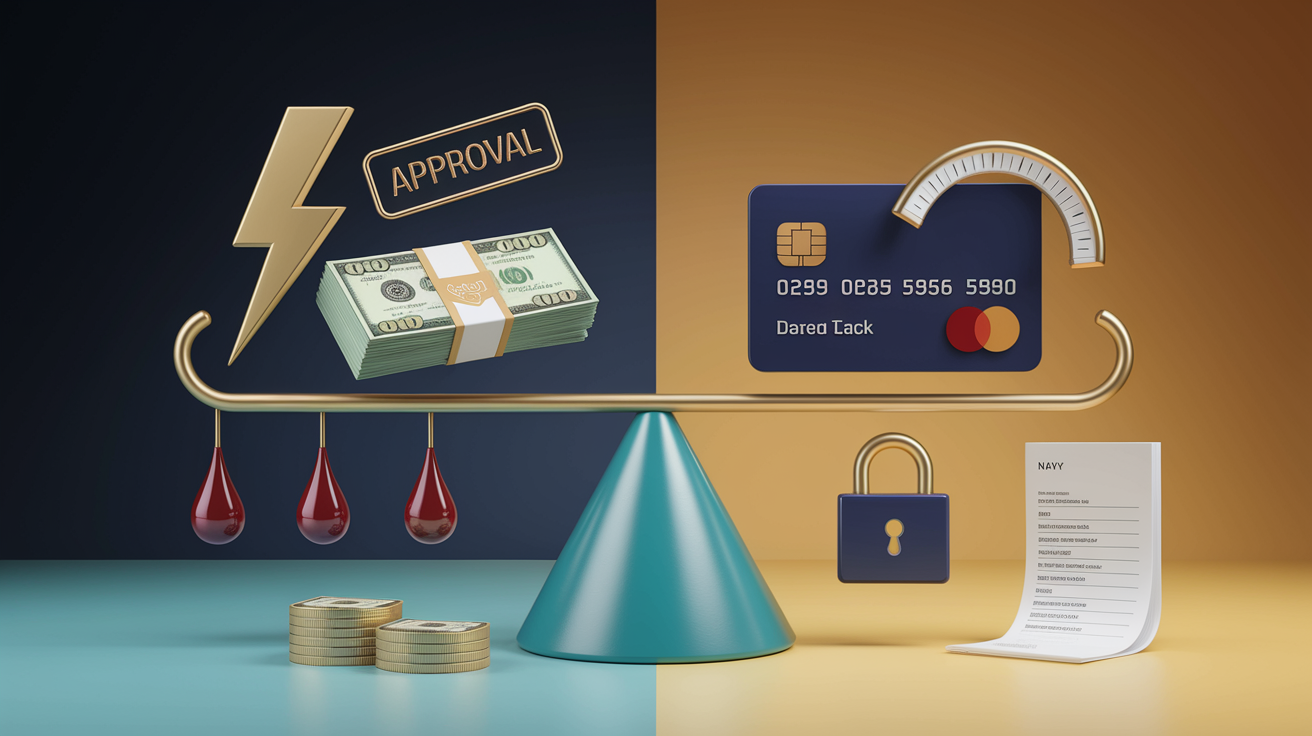
Merchant cash advances deliver speed and accessibility, but they come at a steep price and put daily pressure on your cash flow. Lines of credit offer lower cost and flexibility, but they demand stronger qualifications and may include fees that eat into the savings if you don’t use the line actively.
Merchant Cash Advance – Pros:
Funds can arrive same day to within 72 hours, making MCAs one of the fastest capital sources available.
Approval focuses on daily sales, not personal credit, so businesses with FICO scores below 600 often qualify.
No fixed monthly payment. Remittances flex with revenue, which can ease strain during slow weeks.
Minimal collateral requirements; the advance is secured by future receivables, not physical assets.
Merchant Cash Advance – Cons:
Effective APRs commonly range from 40% to over 300%, making this the most expensive form of business financing.
Daily or weekly holdbacks reduce available cash before you can use it for payroll, rent, or inventory, tightening working capital.
Short repayment terms (typically 3 to 18 months) mean you’re clearing the balance fast, and if sales dip, the holdback percentage stays fixed, creating squeeze.
Contracts often omit APR disclosures and use confusing factor rate language, and MCAs aren’t federally regulated the way loans are, increasing the risk of predatory terms.
Business Line of Credit – Pros:
Interest rates run significantly lower, often 8% to 30% APR depending on credit, saving thousands compared to MCAs.
You borrow only what you need and repay on a schedule, keeping more cash in the business for day to day operations.
Revolving access means once you repay, the credit becomes available again without reapplying.
Predictable monthly payments make budgeting easier than variable daily remittances.
Business Line of Credit – Cons:
Stricter credit and revenue requirements (typically FICO 650+ and $100,000+ in annual sales) exclude newer or credit challenged businesses.
Some lines charge maintenance fees or unused capacity fees, which add cost if you don’t draw much.
Approval and funding can take longer than MCAs, especially if the lender requests additional documentation or collateral.
Lines may be capped by state regulations or lender policies, limiting access for certain industries or geographies.
Real World Numerical Scenarios Comparing MCA vs LOC Outcomes

Let’s put numbers to two common situations. A retail shop needs $30,000 to restock inventory before a seasonal rush, and the owner’s credit score sits around 580. The only offer that approves in time is a merchant cash advance with a factor rate of 1.25. Total repayment: $30,000 × 1.25 = $37,500. The lender sets a 12% daily holdback on card sales. If the shop processes $8,000 in cards per day, the lender takes $960 daily, and the advance clears in roughly 39 business days, just over six weeks. That $7,500 in fees over six weeks translates to an effective APR north of 200%.
Cash flow gets tight because nearly $1,000 a day leaves the account before the owner pays suppliers or payroll, but the shop restocks in time and captures the seasonal spike.
Now take a services business with steady monthly revenue of $150,000, a 680 FICO, and two years of clean financials. They secure a $100,000 business line of credit at 12% APR with no maintenance fee. They draw $25,000 in March to hire temporary staff and cover a marketing campaign, then repay $15,000 in May and the final $10,000 in June. Interest on $25,000 for two months at 12% APR runs about $500, and interest on the remaining $10,000 for one month adds roughly $100. Total cost: $600.
The unused $75,000 stays available all year for another project, with zero cost unless drawn.
| Scenario | Loan Type | Total Cost | Payment Style |
|---|---|---|---|
| $30,000 short-term inventory buy, low credit | Merchant Cash Advance | $7,500 fee (factor 1.25) over ~6 weeks | 12% daily holdback on card sales; effective APR >200% |
| $25,000 draw for staff + marketing, strong credit | Line of Credit | ~$600 interest over 3 months at 12% APR | Monthly interest payments; revolving access for future needs |
Choosing Between Merchant Cash Advance and Line of Credit: Decision Framework

Start with your credit score and documented revenue. If you’re above FICO 650 and your business brings in at least $100,000 a year with stable bank deposits, a business line of credit will almost always cost you less. The interest rate alone (typically under 30% APR and often much lower) saves you compared to an MCA’s effective rate, which can hit triple digits. The revolving structure also means you’re not locked into a lump sum repayment; you draw what you need, repay, and draw again without reapplying.
That flexibility suits businesses with seasonal swings or ongoing working capital needs, where predictable monthly payments are easier to budget than variable daily holdbacks.
If your credit score is below 650, your business is newer than six months, or your revenue is under $100,000 annually, traditional line of credit lenders may decline you or offer terms so restricted they’re not useful. That’s when a merchant cash advance makes sense. Not because it’s cheap, but because it’s available and fast. MCAs approve on the strength of your card sales or daily receipts, not your personal credit history, so if you process $15,000 a month in cards and need $30,000 by Friday to cover an urgent equipment repair or restock before a rush, the MCA funds in time. The cost is steep, but missing the opportunity costs more.
Urgency matters, too. Both products can move quickly. Business line of credit providers that serve alternative borrowers often approve in 24 to 48 hours, but merchant cash advances consistently hit same day or next day funding because they skip credit underwriting and focus only on revenue. If you’re comparing offers with time to spare, calculate the total cost of each using the formulas above and pick the one that fits your cash flow pattern. If you’re out of time and need cash today, the MCA’s speed may be the deciding factor, even though you’ll pay more for it.
Final Words
We compared a merchant cash advance, a lump sum repaid from card sales, with a business line of credit, a revolving account you draw and only pay interest on. You saw how MCAs fund fast but cost more, and LOCs cost less but need stronger credit and give reusable access.
Match the product to your cash coming in and going out. If you pick the right fit, the merchant cash advance vs business line of credit choice becomes a tool, not a trap.
FAQ
Q: What is the difference between a merchant cash advance and a business loan? Is cash advance the same as a line of credit?
A: The difference is repayment and cost. An MCA is a fast lump sum repaid from future sales using a factor rate (often costly). A line of credit is revolving; interest is charged only on amounts drawn.
Q: Is merchant cash advance a good idea? What are the risks of a merchant cash advance?
A: A merchant cash advance can be a good idea for urgent, short-term needs if you can absorb daily or weekly remittances. Risks include high factor rates (very high effective APR), cash-flow strain, and trouble if sales drop.