


Think a merchant cash advance is just an easier, cheaper loan? Think again.
A factor rate is a one-time multiplier that fixes your total payback, while APR is an annualized rate that spreads interest over time and drops if you pay early.
This post shows how the same factor rate can look harmless but turn into triple-digit annual costs depending on repayment speed, and it walks you through converting factor rates to APR so you can compare offers fairly.
If you need fast money, know the true cost first.
Quick Verdict on Factor Rate vs APR for Small Business Financing

A factor rate is a one-time decimal multiplier (think 1.25 or 1.30) that gets applied to whatever you borrow to lock in what you’ll pay back total. APR is an annualized percentage that spreads interest and fees across a set loan term and accounts for how the balance shrinks over time. The big difference? Factor rates lock you into a fixed dollar payback no matter how fast you repay, while APR-based loans let you save on interest when you pay early because there’s less principal sitting there accruing charges.
Factor rates can translate to annualized costs anywhere from roughly 40% APR to north of 300% APR, depending on repayment speed. Borrow $50,000 at a 1.3 factor and pay it back in 270 days, you’re looking at around 47.3% APR. Same 1.3 factor repaid in 90 days? You’re past 120% APR. A 1.25 factor over six months can hit 50% APR on paper, but once you factor in daily or weekly payments the effective APR often lands between 90% and 150%.
Most traditional loans (term loans, SBA financing, equipment loans, lines of credit) quote APR in the low single digits to low twenties. Merchant cash advances and certain short-term alternative products lean on factor rates because they’re structured as purchases of future receivables, and payments flex with daily sales.
Best-fit scenarios at a glance:
- Go with factor-rate financing when you need funds in 24 to 72 hours, have uneven revenue that makes fixed payments risky, or can put the capital to work on a short-term project with returns high enough to cover the steep cost.
- Go with APR-based financing for any longer-term need (equipment, expansion, multi-year working capital) where your time in business, credit score, and steady revenue get you single-digit or low-double-digit rates.
- Convert factor rates to APR before you compare offers. The multiplier alone hides what you’re really paying annualized.
- Don’t stack factor-rate products. Repeated reliance on high-cost advances creates a cycle that squeezes cash flow and leaves less room to actually grow.
Core Definitions: Factor Rate Explained vs APR Defined
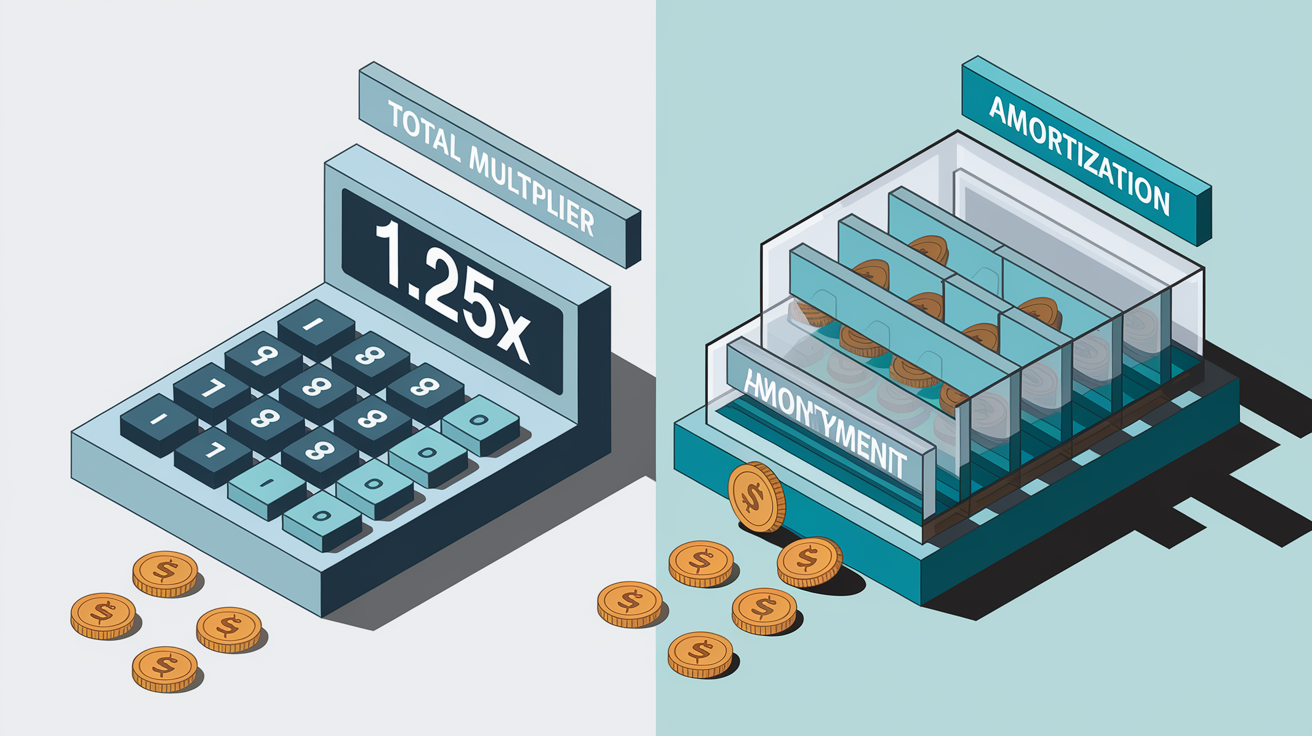
A factor rate shows up as a decimal (1.15, 1.25, 1.35) and tells you exactly what total repayment looks like the second you sign. Multiply your advance by the factor rate and you’ve got the full payback number. No variable interest, no compounding, no amortization schedule. Borrow $40,000 at a 1.30 factor, you owe $52,000 total. Done.
APR stands for annual percentage rate and shows the yearly cost of borrowing when you roll in interest and certain fees and spread them over a defined term. APR assumes you’re making periodic payments that chip away at the outstanding principal over time, so each payment knocks down a bit of principal and covers a bit of interest. Early in a traditional loan most of your payment goes to interest. Later, more goes to principal. That amortization behavior is baked into the APR number.
The key difference in behavior is this: factor-rate repayment is a flat total that doesn’t shrink if you pay early, while APR-based loans let you cut interest cost by paying ahead of schedule. Factor rates also don’t specify a term in months or years. Repayment speed ties to your sales volume or a fixed daily/weekly remittance, which means the same factor rate can produce wildly different annualized costs depending on how long repayment actually takes.
| Pricing Method | How It’s Quoted | Total Repayment Behavior |
|---|---|---|
| Factor Rate | Decimal multiplier (e.g., 1.25) | Fixed total; doesn’t decrease with early payoff unless buyout discount offered |
| APR | Annualized percentage (e.g., 12% APR) | Amortizes over term; early payoff reduces total interest paid |
Cost Impact of Repayment Speed and Term Length
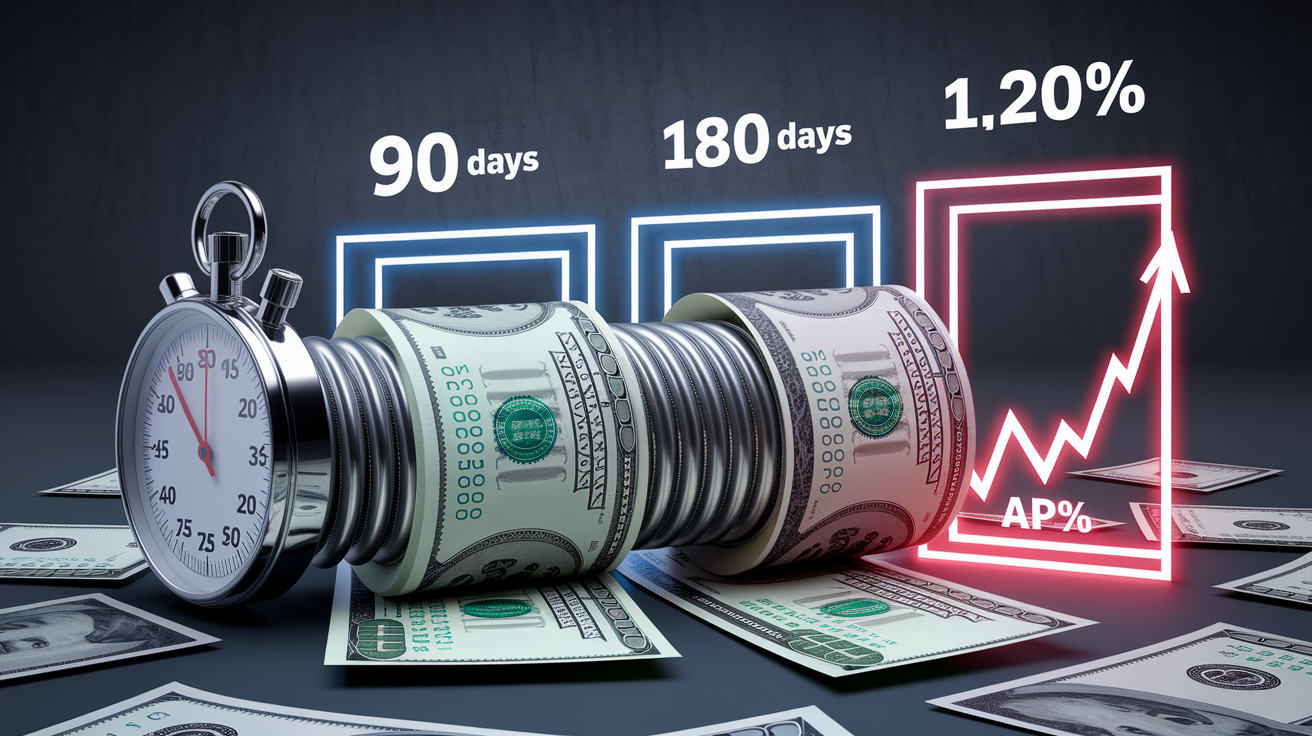
Factor rates lock in a fixed dollar cost the instant you sign, but they hide wildly different annualized expenses depending on repayment speed. Take $50,000 at a 1.30 factor rate. Total repayment is $65,000, so the financing cost is $15,000 (30% of the advance). Repay that $65,000 over 270 days and you’re paying about $129.63 per day in financing cost, which annualizes to roughly 47.3% APR. Same deal, same factor rate, but repay in 90 days instead of 270 and the annualized cost jumps past 120% APR because you’re paying the same $15,000 in one-third the time.
The math gets steeper at shorter terms. A 1.2 factor rate looks modest (20% cost over the life of the advance), but if you repay in three months that 20% annualizes to about 160% APR. Stretch that same 1.2 factor rate over twelve months and the APR drops to around 40%. A 1.15 factor rate repaid in 90 days produces an APR near 61%. Over 180 days it halves. The pattern holds: the faster the payback, the higher the annualized rate, because the same dollar cost is compressed into fewer days.
Real-world scenarios show this compression clearly. A restaurant takes a $30,000 merchant cash advance at a 1.25 factor rate with a 10% daily holdback. Expected repayment is 75 days. Total repayment is $37,500, cost is $7,500, and the APR converts to roughly 122%. A retailer borrows $25,000 at a 1.15 factor for seasonal inventory, expecting to repay over 90 days. Total cost is $3,750 and the APR sits near 61%. If that same retailer stretched repayment to 180 days, the APR would drop below 31%, but the total dollar cost stays $3,750 either way. On the flip side, a construction company needing $150,000 for equipment compares a 1.3 factor-rate advance (repaid in 12 months, total cost roughly $45,000) against a traditional equipment loan at 9% APR over five years (total interest about $35,000). The factor-rate option costs $10,000 more in absolute dollars and carries an annualized rate five times higher.
Key cost behaviors to remember:
- Factor rates fix total repayment. The advance amount times the factor rate equals what you pay back, regardless of speed.
- Shorter repayment windows turn modest-looking factor rates into triple-digit APRs. A 1.2 factor over three months annualizes near 160%, while the same factor over a year drops to 40%.
- Total dollar cost stays constant but annualized rate swings dramatically with term length. $15,000 in fees over 90 days is expensive per day, while $15,000 over 270 days is less painful annually.
- APR-based loans amortize, so early payoff saves interest. Factor-rate products don’t discount for early repayment unless a buyout is contractually defined upfront.
- Real examples span from 61% APR (1.15 factor, 90 days) to over 133% APR (1.4 factor, six months), and these calculations often understate true APR when daily or weekly remittances accelerate effective cost further.
Repayment Structure Differences

Merchant cash advances tie repayment to revenue through a holdback percentage, commonly around 10% of daily credit-card sales or gross receipts. Each business day, the provider automatically withdraws that percentage until the fixed total repayment is complete. Sales spike? Repayment accelerates and you pay the same total dollar amount in fewer days, which raises the effective APR. Sales slow? Repayment stretches out and the annualized rate drops slightly, but the total owed never changes.
Traditional APR-based loans use fixed periodic payments (monthly, bi-weekly, or weekly) set at the outset based on the loan amount, interest rate, and term. Each payment applies part to interest and part to principal, gradually reducing the balance. Because principal shrinks over time, the interest portion of each payment decreases and the principal portion grows. Paying extra or paying early cuts the total interest you’ll pay because less principal remains outstanding to accrue interest.
The cash-flow impact differs sharply. Daily remittance means smaller, frequent withdrawals that automatically adjust to your revenue, which can feel less burdensome during slow periods but also drains working capital every single day. Fixed monthly payments are predictable and easier to budget around, but they don’t flex with sales swings. For businesses with lumpy or seasonal revenue, daily holdbacks can be safer than a large monthly obligation you might miss. For stable, predictable cash flow, fixed payments typically cost less in total interest and let you plan better.
| Repayment Type | Frequency | Amount Calculation | Effect on Total Cost |
|---|---|---|---|
| Factor Rate (MCA) | Daily or weekly | Percentage of sales (holdback) or fixed remittance | Total cost fixed; faster repayment raises APR |
| APR Loan | Monthly, bi-weekly, weekly | Fixed payment amount | Amortized; early payoff lowers total interest |
| Revenue Flexibility | Varies with MCA | Payments shrink/grow with sales | APR unchanged; repayment speed varies |
| Predictability | Fixed with APR loan | Same dollar amount each period | Budget certainty; no flex for slow weeks |
How to Convert Factor Rate to APR

Converting a factor rate to an approximate APR takes three steps and requires an estimate of repayment days. First, calculate total interest cost by subtracting one from the factor rate and multiplying by the advance amount. Second, divide that total interest cost by the number of repayment days to get daily cost. Third, multiply daily cost by 365 and divide by the advance amount to arrive at the annualized percentage.
Here’s the formula written out: Total Interest Cost = (Factor Rate − 1) × Advance Amount. Then Daily Cost = Total Interest Cost ÷ Repayment Days. Finally, APR ≈ (Daily Cost ÷ Advance Amount) × 365.
For a more precise calculation that matches what regulators expect, use the internal rate of return (IRR) method. List the advance as a positive cash flow on day zero and each scheduled payment as a negative cash flow on its respective date. Solve for the discount rate that makes the net present value of all those flows equal zero, then annualize that rate. If repayments are weekly, solve for the weekly IRR and multiply by 52 to get nominal APR, or compound it over 52 periods to get effective annual rate.
A worked example shows the difference: borrow $50,000 at a 1.30 factor rate, total repayment $65,000, spread over 26 equal weekly payments of $2,500 each. The simple daily-cost formula assumes you pay the full $65,000 at the end and produces an APR around 47% if you use 182 days. But the IRR calculation that accounts for weekly cash flows yields a weekly rate near 1.8%, which annualizes to about 93.6% nominal APR and an effective annual rate around 152.8%. The IRR method always produces a higher number than the simple formula because it reflects the reality that you’re paying back principal throughout the term, not all at once at the end.
| Advance Amount | Factor Rate | Total Repayment | Repayment Period | Simple APR Approx | IRR-Based APR (if weekly) |
|---|---|---|---|---|---|
| $50,000 | 1.30 | $65,000 | 270 days | ~47.3% | Not applicable (daily example) |
| $50,000 | 1.30 | $65,000 | 26 weeks (182 days) | ~50% | ~93.6% nominal, ~152.8% effective |
| $40,000 | 1.30 | $52,000 | 180 days | ~60% | ~100%+ if daily remittance |
Product Mapping: Which Uses Factor Rates vs APR

Merchant cash advances and a subset of short-term alternative lenders use factor rates. The structure is legally categorized as a purchase of future receivables rather than a traditional loan, so there’s no interest rate in the conventional sense. Repayment is revenue-linked, usually a daily or weekly holdback on credit-card receipts or bank deposits, and the total payback amount is set at the outset by multiplying the advance by the factor rate.
Traditional term loans, SBA-backed loans, equipment financing, business lines of credit, and business credit cards all quote APR. These products have defined loan terms, fixed or variable interest rates, and amortization schedules. SBA 7(a) loans typically range from about 6% to 13% APR depending on the prime rate and lender markup. Bank term loans for established businesses might sit between 8% and 18% APR. Equipment loans often land between 6% and 12% APR because the equipment serves as collateral. Business lines of credit usually run 10% to 25% APR, and business credit cards average around 21% APR, similar to consumer cards but with higher limits.
Product categories by pricing method:
- Factor-rate products: Merchant cash advances, certain invoice-based advances structured as receivables purchases, ultra-short-term working-capital products from alternative lenders.
- APR-based term loans: SBA 7(a) and 504 loans, conventional bank term loans, online installment loans with fixed monthly payments.
- APR-based revolving credit: Business lines of credit, business credit cards (variable APR, often tied to prime rate plus margin).
- APR-based asset financing: Equipment loans and leases, commercial vehicle financing, real-estate-backed loans, all with interest rates and amortization.
- Hybrid and invoice factoring: True invoice factoring charges a discount rate per invoice and is neither factor-rate nor APR. Invoice financing (where invoices are collateral for a loan) usually quotes APR.
Which Businesses Should Choose Factor Rates vs APR Loans

Factor-rate financing makes sense when speed trumps cost and the capital will generate returns fast enough to cover the expense. Merchant cash advances fund in 24 to 72 hours, require minimal documentation (often just a few months of bank statements and processor reports), and don’t demand stellar credit scores or years in business. Need $30,000 by Friday to cover payroll or to buy inventory for an unexpected contract, and you can turn that inventory into cash within 60 to 90 days? A factor-rate advance can keep the business running even though the annualized cost is steep.
APR-based loans suit any scenario where the financing need spans more than a few months or where the cost of capital materially impacts profitability. Equipment purchases, facility expansions, multi-year working-capital needs, and hiring campaigns all benefit from lower interest rates and longer terms. If your business has been operating for two-plus years, shows consistent revenue, and has a credit score above 650, you’ll almost always qualify for APR-priced products that cost a fraction of factor-rate financing. Repeated reliance on merchant cash advances risks creating an expensive cycle where each new advance is needed to cover the prior one, steadily eroding margins.
Selection criteria summary:
- Choose factor-rate financing if you need funds within days, have uneven or seasonal cash flow that makes fixed monthly payments risky, lack the credit or time-in-business for traditional loans, and can deploy the capital for a short-term, high-return project.
- Choose APR-based financing for any long-term investment, stable monthly cash flow, equipment or real-estate purchases, and when you qualify for rates below 20% APR.
- Convert to APR-based products as soon as your financials allow. Building a repayment history with a factor-rate advance can improve creditworthiness enough to access term loans on the next cycle.
- Evaluate total dollar cost and cash-flow impact more than just the factor rate or APR number. A 60% APR paid over three months might cost less in absolute dollars than a 15% APR over five years if the principal is small.
- Avoid stacking advances unless revenue can comfortably support overlapping daily holdbacks. Multiple concurrent MCAs can claim 20% to 30% of daily sales and choke working capital.
- Compare alternatives like invoice financing, equipment leasing, or a business line of credit before defaulting to a merchant cash advance. These options often provide similar speed with lower effective APR.
Decision Framework for Comparing Merchant Cash Advance Factor Rate vs APR

Start by computing total dollar cost. Multiply the advance amount by the factor rate to get total repayment, then subtract the advance to find the fee in dollars. Request a detailed payment schedule from the lender showing the exact amount and frequency of each remittance or installment, along with the expected number of days or weeks to full repayment. Plug those cash flows into a spreadsheet and use the XIRR or IRR function to calculate the effective APR. Compare that APR and the total dollar cost side-by-side with quotes from APR-based lenders.
Evaluate your cash-flow tolerance by modeling daily or weekly holdback percentages against your actual deposit patterns. If a 10% daily holdback on credit-card sales means $500 leaves your account every morning, confirm that you can cover rent, payroll, inventory purchases, and operating expenses with the remaining 90%. Factor in sales variability (slow weeks or seasonal dips) and make sure the holdback won’t force you to take another advance just to make ends meet. Confirm all upfront fees, ACH or processing fees, and any renewal or extension clauses that could add cost or lock you into another cycle. If the contract mentions an early-payoff discount, get the exact buyout formula in writing. Most factor-rate contracts don’t discount for early payment unless explicitly stated.
| Cost Metric | Why It Matters | What to Ask Lender |
|---|---|---|
| Total Dollar Cost | Shows absolute expense regardless of term | Exact total repayment amount and all fees |
| Effective APR (IRR-based) | Allows apples-to-apples comparison with APR loans | Payment schedule with dates and amounts; request APR disclosure if available |
| Cash-Flow Impact | Determines whether daily remittances fit operations | Holdback percentage, estimated repayment days, what happens if sales drop |
Seven-step actionable checklist:
- Calculate total repayment: Advance Amount × Factor Rate = Total Repayment. Subtract the advance to find total fees.
- Request payment schedule: Get the number of payments, frequency (daily/weekly/monthly), and dollar amount of each payment.
- Compute IRR-based APR: Use a financial calculator or spreadsheet (XIRR function) with the advance as a positive cash flow and each payment as a negative cash flow. Annualize the result.
- Compare APR and total cost to at least two APR-based alternatives (term loan, line of credit, or equipment financing) using the same advance amount and similar term.
- Model cash-flow impact: Subtract the daily or weekly holdback from your typical deposits and confirm you can cover all operating expenses with what remains.
- Confirm all fees and clauses: Ask for origination fees, ACH fees, prepayment terms, personal-guarantee requirements, and any automatic-renewal language in writing before signing.
- Verify early-payoff terms: If the contract includes a buyout discount for early repayment, get the exact discount formula and eligibility window in the agreement. If it’s silent, assume no discount and factor that into your decision.
Final Words
You now know the core difference: factor rate is a one-time multiplier that sets total payback, and APR is an annualized rate that spreads cost over time. That’s why repayment speed changes the math.
Pick an MCA (factor rate) when you need cash fast or have a short, high-return use. Expect higher annualized cost if repayment is quick. Choose an APR loan for longer purchases and steadier payments to lower yearly cost.
When you weigh merchant cash advance factor rate vs APR, run the numbers—total dollars, schedule, and daily cash flow—and pick the fit that won’t squeeze your business.
FAQ
Q: What is the factor rate for merchant cash advance?
A: The factor rate for a merchant cash advance is a one‑time multiplier, commonly between 1.10 and 1.50, applied to the advance. For example, $50,000 at 1.30 means you repay $65,000 total.
Q: What is the difference between APR and factor rate?
A: The difference is that a factor rate is a flat multiplier giving total repayment, while APR (annual percentage rate) expresses the yearly cost of borrowing and depends on repayment timing and term length.
Q: Is merchant cash advance the same as factoring?
A: Merchant cash advance is not the same as factoring. MCAs buy future card sales and use a holdback on daily sales; factoring buys unpaid invoices and transfers collection responsibility.
Q: What is the 20% rule for SBA?
A: The 20% rule for SBA generally refers to lenders expecting roughly a 10–20% owner cash injection or down payment on some deals. Exact requirements depend on the SBA program and lender.