


Fast funding often comes with a price.
This post compares merchant cash advances, where funders buy future card sales and take a daily percentage, with short term working capital loans that give a lump sum and fixed payments.
If you need money in 24 to 48 hours and can handle variable daily debits, an MCA can unlock cash.
If you can wait, meet credit and documentation rules, and want predictable payments and lower total cost, a working capital loan will usually save you thousands.
Comparison Overview of Merchant Cash Advances and Short Term Working Capital Loans

A merchant cash advance gives you a lump sum by buying a slice of your future credit card sales. You pay it back through a fixed percentage of your daily or weekly card transactions until you hit the agreed total. When sales are good, you pay more. When things slow down, you pay less. MCAs don’t work like traditional loans at all. They use factor rates (usually 1.15 to 1.50) to figure out what you owe. Approvals happen fast because underwriters look at your card processing history and deposit patterns instead of credit scores or stacks of financial statements.
Short term working capital loans are actual loans with real interest rates (APRs usually between 8% and 50%) and fixed repayment schedules. You get a lump sum and pay it back in weekly, biweekly, or monthly installments over a set term, typically six to twenty four months. Payment amounts stay the same no matter what your revenue does, which makes it easier to forecast cash flow. Qualification depends on credit scores, time in business, documented revenue, and clean bank statements. Underwriting takes longer but often costs you way less than an MCA.
The quickest, most important differences:
Cost structure: MCAs use factor rates that create effective APRs between 50% and 200%. Working capital loans state APRs directly, typically 8% to 50%.
Repayment method: MCAs pull a daily or weekly percentage of card sales. Loans charge fixed periodic debits.
Approval speed: MCAs can fund in 24 to 48 hours. Loans take one to fourteen days depending on the lender and documentation.
Qualification: MCAs accept FICO scores as low as 500 and three months of operating history. Loans prefer 580+ FICO and six months minimum.
Use cases: MCAs fit urgent needs and businesses with fluctuating revenue. Loans suit planned projects and operators who want predictable payments.
Risk: MCAs impose higher total cost and daily cash flow pressure. Loans carry lower cost but stricter default remedies.
The main point is simple. If you need cash immediately, can handle variable daily debits, and only qualify for alternative finance, an MCA can unlock capital. If you’ve got time to apply, meet credit and revenue thresholds, and want to minimize total cost, a working capital loan will usually save you thousands of dollars over the life of the deal.
Definitions of Key Financing Options

A merchant cash advance is a financing deal where a provider buys part of your future credit card receivables in exchange for an upfront lump sum. You don’t pay interest in the traditional sense. Instead, you repay a fixed total determined by multiplying your advance amount by a factor rate. For example, $50,000 at a 1.30 factor equals $65,000 total repayment. That $65,000 gets collected through a daily or weekly holdback on your card sales until the obligation is satisfied. Because the advance is structured as a purchase of receivables rather than a debt instrument, MCAs don’t carry APRs or amortization schedules, and they aren’t governed by usury laws in most places.
A short term working capital loan is a formal loan product with a stated principal, interest rate (expressed as APR), and repayment term. The lender gives you a lump sum, and you repay it in fixed installments (weekly, biweekly, or monthly) over a period that usually runs six to twenty four months. Interest builds on the outstanding balance, and the total cost depends on the APR, origination fees, and whether you prepay. Loans fall under lending regulations, Truth in Lending Act (TILA) disclosures, and usury caps in some states, giving borrowers clearer cost transparency and legal protections.
Key differences in structure:
Interest versus factor rates: Loans charge APR and reduce interest when paid early. MCAs fix total repayment at signing and rarely adjust for early payoff.
Repayment triggers: MCAs tie debits to card sales volume. Loans debit fixed amounts regardless of revenue.
Contract structure: MCAs are receivables purchase agreements. Loans are promissory notes with personal guarantees.
Risk profile: Loans can trigger default judgments and credit bureau reporting. MCAs often use Notice of Assignment and confession of judgment clauses where enforceable.
Side‑by‑Side Comparison Table

| Feature | Merchant Cash Advance | Short Term Working Capital Loan |
|---|---|---|
| Cost structure | Factor rate 1.15–1.50; effective APR often 50%–200%+ | Stated APR 8%–50% depending on credit and term |
| Repayment method | Daily or weekly percentage holdback on card sales | Fixed weekly, biweekly, or monthly ACH installments |
| Approval speed | Typically 24–48 hours to funding | 1–14 days depending on lender and documentation |
| Qualification criteria | 500+ FICO accepted; 3+ months operating; strong card volume | 580+ FICO preferred; 6+ months operating; clean bank statements |
| Funding amount ranges | $5,000–$500,000 (most deals $10,000–$100,000) | $10,000–$500,000 (strong files up to $1,000,000+) |
| Risk level | High cost; daily cash drain; cross-default risk when stacking | Lower cost; fixed payments; stricter default remedies and credit impact |
The table makes it pretty clear that MCAs trade speed and accessibility for higher cost and variable cash flow impact. Working capital loans offer more predictable payments and lower effective interest, but they require better credit and more documentation, and they take longer to close.
Eligibility Requirements for Each Option

Merchant cash advance providers focus almost entirely on sales volume and deposit consistency. Most want at least $10,000 to $25,000 in average monthly revenue, with a big chunk coming through credit card processing. FICO scores as low as 500 are acceptable at many funders, though sub 580 scores push factor rates toward 1.40 or higher. Time in business can be as short as three to six months if card sales history is strong. Documentation usually includes three to six months of bank statements, credit card processing statements showing transaction volume, a business tax ID, and proof of citizenship or legal residency. NSF history and existing advance balances matter more than credit scores. Providers want steady deposits at least eighteen to twenty two days per month and fewer than three recent NSF events.
Working capital loans set stricter thresholds because underwriters evaluate creditworthiness and long term repayment capacity. Most lenders prefer a personal FICO score of at least 580, with better rates available at 600 or higher. Businesses should have at least six months of operating history, though twelve months is more common for approval. Monthly revenue minimums range from $10,000 to $25,000 depending on the loan size, and lenders want to see gross profit margins that support fixed payments. Documentation requirements include six to twelve months of business bank statements, profit and loss statements or tax returns for the most recent year, a business credit report, lease or mortgage documents if the business owns real estate, and an employer identification number (EIN). Lenders look hard at credit utilization (preferring under 30%), current liabilities, and any existing debt service.
Key requirement differences:
Credit score floor: MCAs accept 500+. Loans typically start at 580 and reward 600+.
Time in business: MCAs can approve files as young as three months. Loans want six to twelve months minimum.
Revenue documentation: MCAs rely on bank and processor statements. Loans require tax returns or audited financials for larger amounts.
Collateral and guarantees: MCAs rarely require collateral but often file UCC liens. Loans use personal guarantees and may require asset pledges on deals above $100,000.
Existing debt tolerance: MCAs tolerate stacked advances if cash flow supports multiple daily debits. Loans disqualify most applicants carrying active MCA balances.
Cost Structure and Interest Differences

Merchant cash advances charge factor rates instead of interest rates. A factor rate is a multiplier applied to the advance amount to determine total repayment. Common factor rates range from 1.15 to 1.50, meaning you repay $115 to $150 for every $100 advanced. For example, a $50,000 advance at a 1.30 factor requires you to repay $65,000 total. That’s $50,000 principal plus $15,000 in cost. That $65,000 is a fixed obligation no matter how quickly you pay it back, so prepaying an MCA doesn’t reduce the total dollars you owe. The effective APR depends entirely on how fast the advance gets repaid. A 1.30 factor translates to roughly 96% effective APR if repaid in six months, 70% at eight months, 48% at twelve months, and 32% at eighteen months.
Working capital loans state an annual percentage rate (APR) that includes interest and any origination or administrative fees. Typical APRs for short term online loans range from 14% to 50%, with bank grade products offering 8% to 18% for strong credit profiles. Interest builds on the outstanding principal and is spread over the loan term, so early repayment reduces total interest paid if the lender allows it without prepayment penalties. For example, a $50,000 loan at 32% APR over twelve months yields approximately $58,500 in total repayment. That’s $50,000 principal plus roughly $8,500 in interest and fees. If you pay off that loan in six months instead of twelve, you save part of the interest, bringing total cost closer to $55,000 depending on the lender’s prepayment structure.
To compare costs directly, consider the same $50,000 funding need:
| Cost Element | MCA (1.30 Factor, 12-Month Payback) | Working Capital Loan (32% APR, 12 Months) |
|---|---|---|
| Total repayment | $65,000 | $58,500 |
| Total cost above principal | $15,000 | $8,500 |
| Effective APR (approximate) | ~48% at 12 months | 32% stated APR |
| Early-payoff benefit | None (factor is fixed) | Interest savings if lender allows |
The loan saves approximately $6,500 in this scenario, and that gap gets bigger as factor rates rise or payback speeds up.
Approval and Funding Speed

Merchant cash advances are built for speed. Most providers can issue conditional approval within hours of receiving a complete application, and funding often happens within twenty four to forty eight hours. Same day funding is possible for small, clean deals under $100,000 submitted early in the business day. Underwriting focuses on recent bank statements and credit card processing reports, so there are no tax returns to review, no lengthy credit analyses, and no collateral appraisals. The trade off is higher cost. Speed comes at a premium because the provider assumes higher risk with minimal documentation.
Short term working capital loans require more thorough underwriting, which stretches the timeline. Online fintech lenders with automated platforms can approve and fund deals in one to five business days for straightforward files. Traditional banks and credit unions typically take seven to twenty one days because they conduct detailed financial reviews, verify business licenses, and run personal and business credit reports. Larger loan amounts, complex financial structures, or requests for equipment backed financing add time. The benefit of this longer process is lower cost and clearer legal protections, but it means working capital loans are rarely the solution for same day or next day emergencies.
What impacts speed the most:
Completeness of application: Missing bank statements or tax returns delay loan approvals. MCAs need fewer documents and move faster.
Deal size and complexity: Loans under $50,000 with clean credit clear faster than $200,000 requests requiring collateral review.
Lender technology: Fintech platforms can fund loans in twenty four to seventy two hours. Traditional banks take weeks.
Existing relationships: Businesses with existing accounts or prior loans at a bank often get faster approvals than first time applicants.
Repayment Structure and Terms

Merchant cash advances pull funds daily or weekly as a percentage of your credit card sales. The percentage holdback gets agreed upon at signing. Common ranges are 10% to 20% of daily card volume. If your business processes $2,000 in card sales on a given day and the holdback is 10%, the provider debits $200 that day. On slower days with $800 in sales, the debit drops to $80. This variable structure can ease cash flow pressure during slow periods, but it also means repayment speeds up when sales spike, shortening the effective term and increasing the annualized cost. Most MCAs get repaid within six to nine months in practice, though the contract may allow up to eighteen months if sales stay weak. Daily ACH debits hit your account before most other obligations, reducing available cash every business day.
Working capital loans use fixed periodic payments that stay constant regardless of revenue. A $75,000 loan at 32% APR over twelve months might require weekly debits of approximately $1,670 or monthly installments of roughly $7,200. These amounts don’t change if sales drop or surge, which makes budgeting and cash flow forecasting more predictable. Terms for short term loans usually run six to twenty four months, with some bank lines extending to thirty six months. Longer terms reduce the size of each payment but increase total interest paid. Because the payment is fixed, businesses need to make sure they can consistently generate enough cash to cover the debit even during slow months.
Payment stability has a direct impact on cash flow and planning. The fixed schedule of a loan lets you model your cash position twelve weeks out with confidence, plan inventory purchases around known obligations, and avoid the daily cash drain that MCAs create. Daily MCA debits can trigger a second advance spiral. That’s when an operator borrows again to cover the cash shortfall caused by the first advance’s daily remittance. Fixed loan payments reduce that risk but offer no flexibility if revenue falls sharply. A missed loan payment triggers late fees, default notices, and potential acceleration of the full balance.
Pros and Cons of Each Financing Option
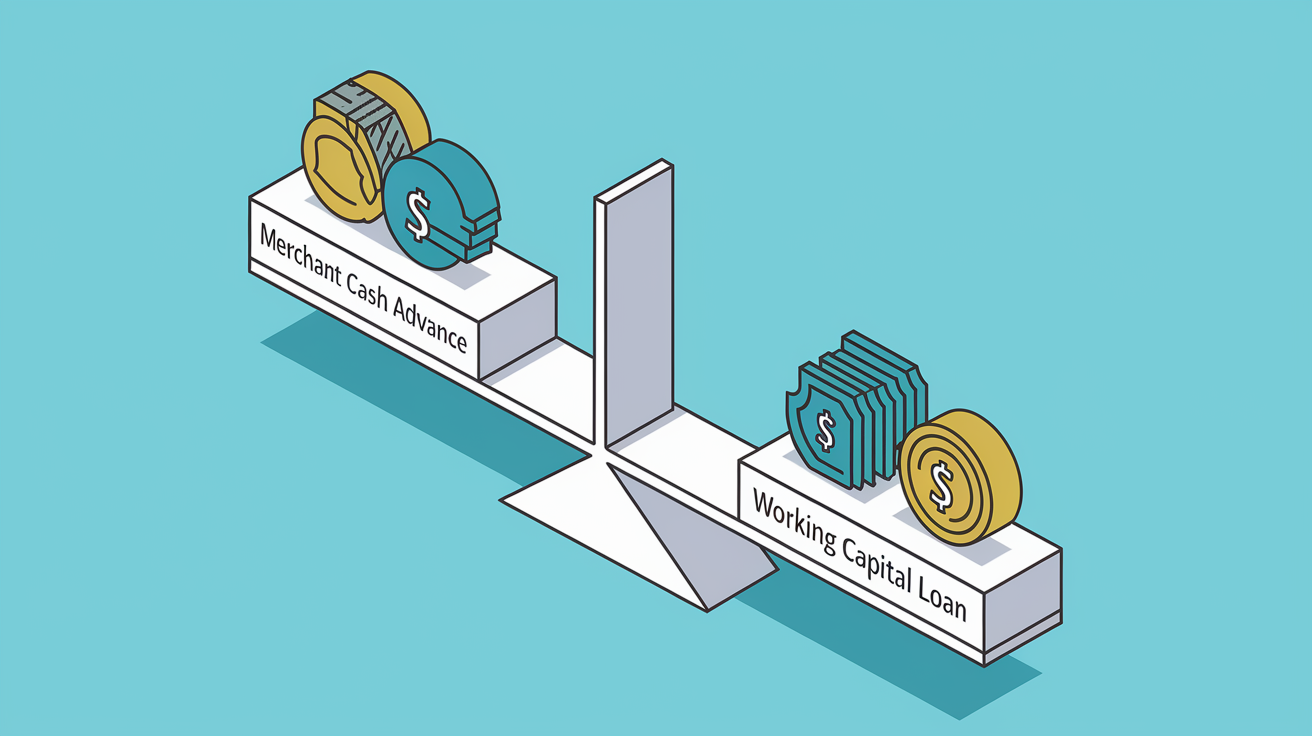
Merchant Cash Advance Pros:
Funding in twenty four to forty eight hours, solving urgent cash flow gaps.
Minimal credit score emphasis. FICO as low as 500 accepted by many providers.
Repayment tied to revenue, so debits shrink when sales slow.
Simple documentation. Bank and processor statements, no tax returns or audited financials.
Merchant Cash Advance Cons:
Very high effective cost, often 50% to 200% APR depending on payback speed.
Daily cash debits reduce available working capital every business day.
No interest savings for early payoff. Factor rate fixes total repayment at signing.
Stacking multiple advances can produce unsustainable combined holdbacks and cross default clauses.
Working Capital Loan Pros:
Lower total cost, with APRs typically between 8% and 50% for qualified borrowers.
Fixed payment amounts make cash flow forecasting and budgeting simpler.
Early repayment often reduces total interest paid, depending on lender prepayment terms.
Builds business credit when lenders report to commercial credit bureaus.
Working Capital Loan Cons:
Stricter qualification. Credit scores, time in business, and financial documentation required.
Longer approval and funding timeline. One to fourteen days or more.
Fixed debits don’t adjust for revenue drops, risking NSF fees and default.
Personal guarantees and UCC filings expose owners to judgment risk and asset seizure.
The core trade off is speed and accessibility versus cost and stability. An MCA will approve a file that no bank would touch and deliver capital the same week, but the price is steep and the daily cash drain is relentless. A working capital loan asks for better credit and more patience but rewards you with predictable payments and thousands of dollars in savings over the life of the financing.
Best‑Fit Scenarios for Businesses

Merchant cash advances suit businesses with strong, consistent credit card sales and urgent capital needs that can’t wait a week. Retail shops processing $30,000 or more in monthly card volume, restaurants with daily card transactions, salons, and service businesses that run most revenue through point of sale systems fit the MCA profile. If you need $25,000 to cover payroll in forty eight hours and your FICO is 540 with only four months in operation, an MCA is often the only realistic door. The variable repayment structure also works for seasonal operators. Think ski resorts, beach vendors, or holiday retailers who can absorb larger debits during peak months and smaller debits during the off season.
Working capital loans are the better choice for businesses seeking structured, lower cost financing over a planned timeline. If you need $75,000 to purchase inventory ahead of a predictable sales cycle and you have six months of operating history, a 620 FICO, and clean bank statements, a short term loan at 22% APR will cost you way less than a 1.30 factor MCA. Loans work well for professional service firms, contractors, distributors, and any business with steady monthly revenue that can support fixed weekly or monthly debits. If your goal is to build business credit, a loan is better because many lenders report to Dun & Bradstreet and Experian Business, whereas most MCA providers don’t.
Several factors influence which option makes sense. First, look at your credit profile and operating history. If you fall below 580 FICO or have fewer than six months in business, MCAs dominate your available options. Second, calculate how quickly you need funds. Same day or next day requirements push you toward MCAs. One week or two week timelines open the door to loans. Third, evaluate your revenue pattern. Businesses with daily card sales and steady deposits absorb MCA holdbacks more easily than businesses with lumpy receivables or long payment cycles. Fourth, run a twelve week cash flow forecast with each repayment structure to see which one leaves you enough operating cash after debits. Fifth, compare total dollars repaid, not just monthly payment amounts. A $500 weekly loan payment may cost $10,000 less over the term than a $300 daily MCA debit.
Decision criteria in order of importance:
Can you qualify for a loan based on credit score, time in business, and financial documentation?
How urgent is the funding need? Hours, days, or weeks?
Does your revenue pattern support daily debits, or do you need the stability of fixed payments?
What’s the total cost difference, and can you afford to pay the premium for speed?
Are you willing to risk cross default and daily cash drain, or do you prefer clear default remedies and credit bureau visibility?
Final Recommendation Framework
Choose a merchant cash advance when speed is the deciding factor and traditional loans are out of reach. If your FICO sits below 580, you’ve been operating for fewer than six months, or you carry active advance balances that disqualify you from bank products, an MCA can deliver capital in twenty four to forty eight hours and keep your business running through an emergency. Accept that you’ll pay way more in total cost and that daily debits will reduce your available cash every week. Use MCAs sparingly, avoid stacking multiple advances, and plan an exit strategy. Either pay off the advance as quickly as revenue allows or refinance into a lower cost loan once your credit and operating history improve.
Choose a short term working capital loan when you meet the credit and revenue thresholds and cost control matters more than same day funding. If you can wait one to seven days for approval, provide the required documentation, and absorb fixed weekly or monthly payments, a loan will save you thousands of dollars and give you predictable cash flow planning. Loans are the smarter long term choice for any operator who qualifies, and they become even more attractive on larger deals where the absolute dollar savings compound. If you’re uncertain whether you qualify, apply to both a loan and an MCA at the same time, compare the total repayment amounts, and choose the option that leaves your cash flow intact after twelve weeks of payments.
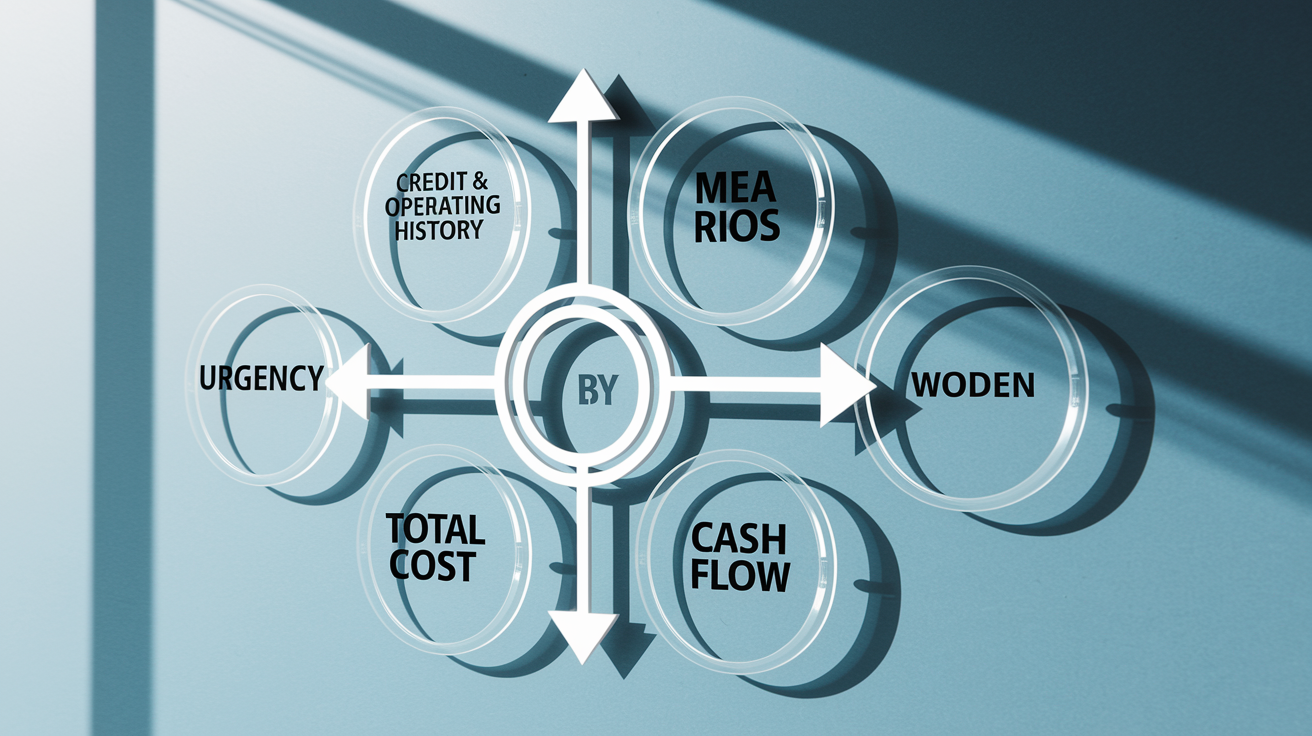
The final decision factors:
Credit and operating history: Loans require stronger profiles. MCAs accept weaker files.
Urgency: MCAs fund in hours. Loans take days to weeks.
Total cost tolerance: MCAs cost 50% to 200%+ effective APR. Loans range 8% to 50%.
Cash flow pattern: Daily card sales fit MCAs. Steady monthly revenue fits fixed loan payments.
Final Words
You jumped into a straight comparison of speed, repayment, cost, and qualification. MCAs trade speed for higher cost, while short-term working capital loans trade predictability for stricter approval.
We broke down factor rates vs APR, repayment timing, approval speed, and best-fit use cases so you can match funding to how cash comes in and goes out.
Need cash fast with steady card sales? MCA. Want predictable, lower-cost payments? Short-term loan. Use merchant cash advance vs short term working capital loan to pick the fit and keep your business moving.
FAQ
Q: What is the difference between a loan and a merchant cash advance?
A: The difference between a loan and a merchant cash advance is that a loan has fixed payments and APR, while an MCA is an advance on future sales repaid as a daily percentage or factor rate.
Q: What is the difference between a short-term loan and a working capital loan?
A: The difference between a short-term loan and a working capital loan is that “short-term” describes the loan’s length (often months), while a working capital loan is for day-to-day cash needs; some working capital loans are short-term.
Q: Is a merchant cash advance a good idea? Why are Merchant cash advances bad?
A: A merchant cash advance can be a good idea for urgent cash and strong card sales, but they are often expensive: high factor rates, daily remittances, and little benefit for early payoff make them risky if sales fall.