

Which is smarter for keeping payroll and suppliers paid: selling invoices for fast cash, or having a line of credit to draw from when you need it?
Invoice financing turns unpaid customer invoices into money now, and it scales with your sales.
A business line of credit gives a borrowing cushion you control, but it’s a fixed limit and depends on your credit.
This post breaks down speed, cost, repayment, and eligibility so you can pick the option that fits your cash flow.
A Concise Overview of Invoice Financing vs a Business Line of Credit

Invoice financing turns your outstanding customer invoices into cash right now. A factor or lender gives you somewhere between 70% and 95% of the invoice value upfront, holding the rest as reserve. When your customer pays, the lender releases what’s left after taking their fee. You’re not borrowing. You’re selling or pledging receivables to speed up cash flow.
A business line of credit is revolving access to funds. The lender approves a credit limit, and you draw what you need when you need it. You pay interest only on what you’ve drawn and can repay and borrow again without starting over. The difference: invoice financing converts specific receivables into cash, while a line of credit gives you a borrowing cushion backed by your creditworthiness and sometimes collateral.
| Category | Invoice Financing | Business Line of Credit |
|---|---|---|
| Structure | Sale or advance against accounts receivable | Revolving credit facility with approved limit |
| Collateral Basis | Outstanding customer invoices | Business creditworthiness, cash flow, or collateral |
| How Access to Funds is Determined | Scales with invoice volume and value | Fixed borrowing cap set at approval |
How Invoice Financing Works Within the Invoice Financing vs Line of Credit Decision

Invoice financing starts when you submit eligible invoices to a factor or receivables lender. The lender advances most of it upfront, usually 80% to 90%. The rest sits in reserve until your customer pays. Once payment arrives, the lender deducts their fee and sends you what’s left. You get working capital now instead of waiting 30, 60, maybe 90 days for customer payment.
Approval depends on your customers’ credit, not yours. The lender checks whether your customers can and will pay, reviews invoice aging, and might set a minimum invoice size, often $500 to $5,000 per invoice, plus a monthly volume floor around $20,000 to $50,000. That focus on customer credit makes factoring accessible even if you’re new or rebuilding.
Factoring changes how collections happen. In most setups, the factor contacts your customers directly to collect payment. Your invoices may carry a notice of assignment, and customers send payment to the factor’s lockbox. Want to keep collections in house? Ask about invoice discounting or “non-notification” structures, though those can carry higher fees or stricter criteria.
Recourse versus nonrecourse is where risk gets divided. With recourse factoring, you buy back any invoice the factor can’t collect within an agreed period. Nonrecourse shifts credit risk to the factor. If your customer doesn’t pay due to insolvency, you’re off the hook, but fees are higher because the factor eats the loss.
Typical Invoice Financing Steps:
- Submit invoices and supporting docs (customer contracts, delivery proof).
- Lender verifies invoice authenticity, customer credit, and aging.
- Receive advance, 80% to 90% of invoice value, within one to three business days.
- Factor collects payment directly from your customer.
- Lender remits reserve balance minus factoring fees once payment clears.
Understanding a Business Line of Credit in the Invoice Financing vs Line of Credit Comparison

A business line of credit gives you a borrowing limit you can tap when you need short-term cash. Once approved, you draw funds up to your limit, pay interest on what you’ve drawn, and repay to restore available credit. It’s revolving. Borrow, repay, and borrow again without filling out a new application each time. Interest rates usually range from 7% to 30% APR for unsecured online lenders and 5% to 12% APR for secured or bank lines when your credit is strong.
Approval focuses on your business, not your customers. Lenders look at owner personal credit scores, often 620 minimum for online lenders, 700 or higher for the best bank terms, business revenue (usually $100,000 annual or more), time in business (six to 24 months), cash flow statements, and sometimes collateral. Banks take their time, anywhere from two to eight weeks for underwriting and closing, while online lenders can approve and fund in 48 hours to seven days.
Repayment revolves around interest and principal. Many lines let you pay interest only while the balance is outstanding, and you repay principal to free up capacity. Some lenders set a monthly minimum draw or payment, and most require a minimum initial draw, often $1,000, when you first activate the line.
Common LOC Fees and Costs:
- Origination fees: 0.5% to 3% of the credit limit.
- Unused-line fees: 0.25% to 1% annually on the portion you don’t draw.
- Draw fees: $10 to $50 per withdrawal at some lenders.
- Variable-rate interest indexed to prime plus a margin, rates adjust with market changes.
Core Differences: Invoice Financing vs Business Line of Credit Explained in Detail

| Feature | Invoice Financing | Line of Credit |
|---|---|---|
| Funding Trigger | Tied to each invoice; scales automatically with sales | Fixed credit limit set at approval; does not grow with revenue |
| Repayment Timing | Repayment occurs when customer pays invoice; no monthly principal schedule | Monthly interest payment required; principal repaid on your schedule |
| Approval Driver | Customer creditworthiness and invoice quality | Business revenue, owner credit score, and cash flow |
| Customer Notification | Usually yes; factor handles collections (unless non-notification) | No; you manage customer relationships and collections |
| Debt on Balance Sheet | No new debt; receivables are sold or pledged | Creates a liability; borrowed amounts must be repaid with interest |
| Cost Structure | Fee-based; typically 0.5% to 5% per 30 days | Interest-based; 5% to 30% APR plus fees |
Invoice financing adjusts to your sales cycle. When invoices pile up and customers stretch payment terms, funding automatically increases. A line of credit sits at a fixed cap. If your revenue doubles, your borrowing limit doesn’t, unless you apply for an increase and go through underwriting again.
Repayment works differently. Factoring repays itself when your customer settles the invoice, so there’s no monthly principal payment you have to budget for. A line of credit requires you to service interest monthly and eventually pay down principal to free capacity. That makes factoring smoother for businesses with lumpy or unpredictable cash flows. A line of credit works best when you can predict monthly payments and want control over how much you borrow and when you repay it.
Cost Breakdown in the Invoice Financing vs Business Line of Credit Choice

Invoice financing charges a percentage fee for each invoice period. Typical factoring fees run 0.5% to 5% per 30 days, with most transactions in the 1% to 3% range. The fee depends on your customer’s credit, invoice size, and how long payment is expected to take. If you factor $100,000 in invoices at an 85% advance rate and a 2% fee, you receive $85,000 right away. The factor holds a 15% reserve, $15,000, until your customer pays. When payment clears, the factor deducts the $2,000 fee and remits $13,000. Your total cost for 30 days of liquidity is $2,000, which translates to about 24% APR if you annualize it.
A business line of credit charges interest on the amount you draw. If you borrow $85,000 from a $100,000 line at 14% APR and repay it in 90 days, you’ll pay roughly $2,975 in interest. Many online lenders also add a draw fee of $10 to $50 per transaction, plus origination fees of 0.5% to 3% of the credit limit. Some charge unused-line fees, 0.25% to 1% annually, on the portion you don’t tap. If you pay down quickly and only draw what you need, a line of credit can be cheaper than factoring. Carry a balance or draw repeatedly, and costs add up.
| Scenario | Cost Structure | Total Cost (30 days) | Total Cost (90 days) |
|---|---|---|---|
| $100k invoices, 85% advance, 2% factoring fee | Fee-based: 2% per 30 days | $2,000 | $6,000 (if invoices take 90 days and fees stack) |
| $85k LOC draw at 14% APR | Interest-based: 14% annual rate | ~$993 interest | ~$2,975 interest |
| $100k invoices, 90% advance, 1% factoring fee | Fee-based: 1% per 30 days | $1,000 | $3,000 (if payment stretches) |
| $85k LOC draw at 8% APR (bank line, strong credit) | Interest-based: 8% annual rate | ~$567 interest | ~$1,700 interest |
Eligibility Differences Between Invoice Financing vs Business Line of Credit

Invoice financing approves you based on your customers, not your balance sheet. The lender underwrites each customer’s credit score, payment history, and industry risk. That makes factoring accessible for startups, businesses rebuilding credit, or companies with thin financial docs. You typically need a minimum monthly accounts receivable volume, often $20,000 to $50,000, and invoices large enough to justify the lender’s processing costs, usually $500 to $5,000 per invoice. Some factors exclude certain industries. Construction with lien-heavy contracts, consumer-facing businesses with high dispute rates. A few states have regulatory restrictions that limit availability.
A business line of credit requires stronger personal and business credentials. Online lenders commonly set a floor of 620 FICO for the owner, $100,000 in annual revenue, and six to 24 months in business. Bank lines demand higher thresholds: 700-plus credit scores, verified monthly revenue, audited financials, and sometimes a lien on business assets or inventory. If your books are messy or your owner credit is under 650, most bank lines are off the table.
Documentation loads differ too. Factoring asks for customer invoices, contracts, proof of delivery, and an aging report. The lender may pull credit on your top customers but rarely requires your tax returns or detailed P&L statements. A line of credit application typically wants two years of business tax returns, three to six months of bank statements, a current balance sheet and income statement, and often a personal financial statement from the owner. If collateral is involved, you’ll also provide UCC filings, asset appraisals, and a business continuity plan.
Scenario-Based Guidance: When to Choose Invoice Financing vs a Business Line of Credit

A B2B manufacturer ships $150,000 worth of product on net-60 terms and needs to cover payroll in 10 days. The business is 18 months old, the owner’s credit score is 580, but customers include Fortune 500 companies with strong payment histories. Invoice financing fits. Factor the receivables at an 85% advance rate, receive $127,500 right away, pay a 2.5% fee ($3,750) when customers settle in 60 days, and keep operations running without waiting two months for cash or failing a bank credit check.
A seasonal retailer wants to buy $80,000 in holiday inventory in September but won’t see revenue until November. The business has been operating for three years, annual revenue is $600,000, and the owner has a 710 credit score. A business line of credit works here. Draw $80,000 at 10% APR, pay interest only for three months (about $2,000), then repay principal from holiday sales. The retailer keeps control of customer collections and pays less in total interest than factoring fees would cost over the same period.
A staffing agency lands a new contract requiring $50,000 in weekly payroll but won’t receive client payments for 45 days. The agency is six months old with limited credit history but invoices a hospital system with excellent credit. Invoice financing scales right away. Submit weekly invoices, receive 90% advances within two days, and let the factor handle collections. Funding grows automatically as the contract expands, which a fixed-limit line of credit can’t do.
An established wholesaler occasionally needs $25,000 to take advantage of supplier early-payment discounts. The business has strong cash flow, a 740 owner credit score, and predictable revenue. A small bank line of credit at 7% APR costs less than factoring and offers flexible access. Draw only when the discount opportunity appears, repay from normal receivables within 30 days, and avoid the higher fees and customer-notification overhead of factoring.
Pros and Cons List for Invoice Financing vs Business Line of Credit
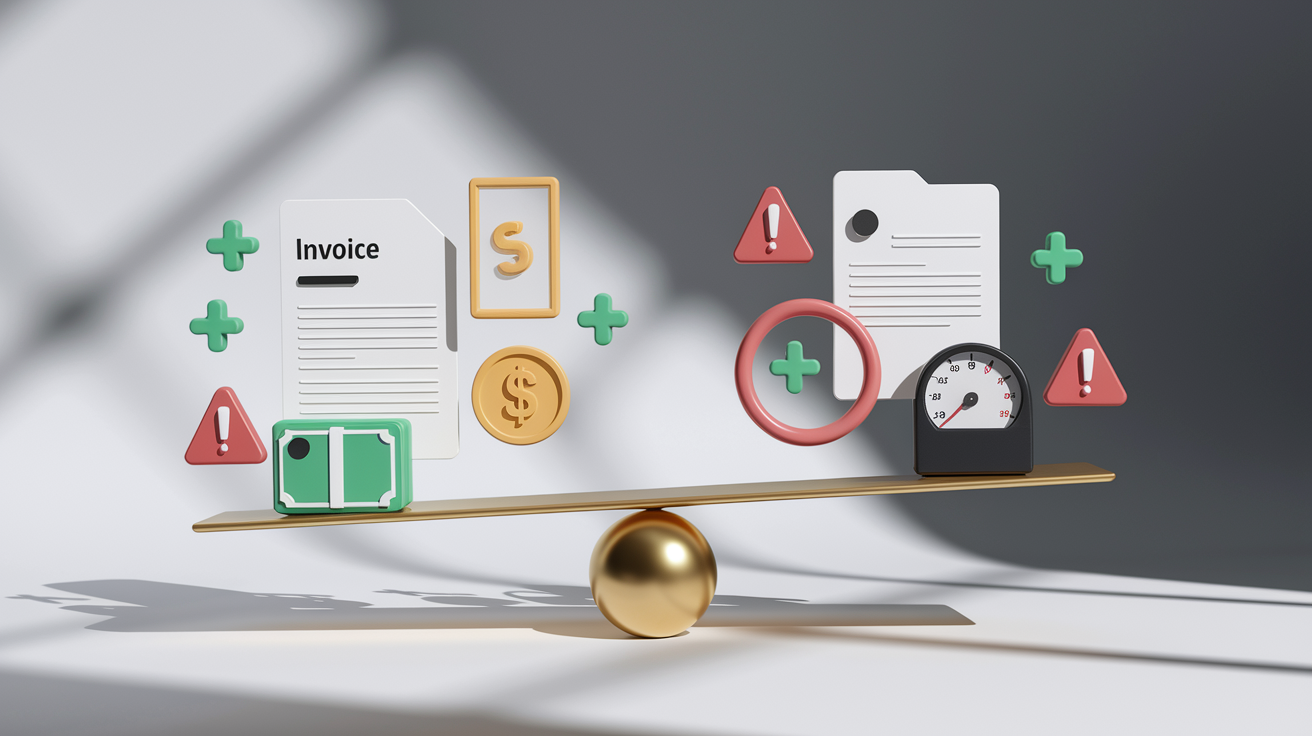
Invoice Financing Pros:
- Fast approval and funding, often 24 hours to seven days for initial setup, one to three days per invoice after that.
- Scales automatically with sales. More invoices mean more available cash without reapplying.
- Accessible for businesses with weak owner credit as long as customers are creditworthy.
- No monthly principal payments. Repayment tied to customer payment date.
- Doesn’t add debt to your balance sheet. Receivables are sold or pledged.
Invoice Financing Cons:
- Higher cost than many credit products. Fees of 1% to 3% per 30 days can annualize to 12% to 36% APR or more.
- Customers are notified in most factoring arrangements. Third-party collections can affect relationships.
- Minimum invoice volume and size requirements limit eligibility for smaller or B2C businesses.
- Recourse exposure. You may have to buy back unpaid invoices if the arrangement is recourse-based.
- Reserve holdbacks delay full access to invoice value until customer payment clears.
Business Line of Credit Pros:
- Flexible revolving access. Draw only what you need and repay to restore capacity.
- Interest charged only on drawn amounts. Unused credit costs little or nothing (unless unused-line fees apply).
- Control over customer relationships and collections stays in-house.
- Can help build business credit history with on-time payments.
- Lower cost than factoring if you repay quickly and qualify for competitive rates.
Business Line of Credit Cons:
- Tougher approval. Requires strong owner credit (620 to 700+), verified revenue, and financial documentation.
- Fixed borrowing cap doesn’t grow with sales. You must reapply and requalify to increase the limit.
- Monthly interest payments required. Risk of accumulating debt if cash flow is unpredictable.
- Unused-line fees and origination charges add to the total cost.
- Banks can reduce or nonrenew your line if business performance dips or market conditions tighten.
FAQs About Invoice Financing vs Business Line of Credit

Does invoice financing show up as debt on my balance sheet? No. Invoice financing is structured as a sale or advance against receivables, not a loan. The transaction converts accounts receivable into cash, so it doesn’t add a liability line. A business line of credit does create debt. Any drawn amount appears as a liability you must repay with interest.
Will factoring hurt my customer relationships? It can, especially in visible factoring arrangements where the factor sends collection notices and customers remit to a third-party lockbox. If maintaining direct customer contact matters, ask about invoice discounting or non-notification structures. Those keep collections in-house but may require stronger financials and higher fees.
Do lines of credit require a personal guarantee or UCC filing? Most do. Lenders typically file a UCC-1 lien on business assets (inventory, equipment, receivables) and ask the owner to sign a personal guarantee. That means if the business defaults, the lender can pursue personal assets. Some unsecured online lines skip the UCC but charge higher interest to offset the risk.
Can I use both invoice financing and a line of credit at the same time? Sometimes. Lenders often restrict “double-dipping” on the same collateral. If you’ve pledged receivables to a factor, a line-of-credit lender may not accept those same invoices as security. Check subordination agreements and lender covenants before stacking facilities. A hybrid approach (factoring for large B2B invoices and a small LOC for opportunistic buys) can work if structured correctly.
Does repayment performance on a line of credit report to business credit bureaus? Often, yes. Many online and bank lenders report payment history to Dun & Bradstreet, Experian Business, and Equifax Business. On-time payments can strengthen your business credit profile over time. Invoice financing typically doesn’t report to credit bureaus because it’s a receivables transaction, not a credit facility, though some factors may report defaults if you fail to buy back recourse invoices.
Final Words
You’re weighing invoice financing vs a business line of credit: invoice financing turns unpaid invoices into cash by advancing most of each invoice, while a line of credit gives a set borrowing limit you tap and repay.
Pick invoice financing when receivables are strong and you need quick cash that scales with sales. Choose a line when you want flexible access and can handle monthly interest and approval rules.
Compare true cost, repayment rhythm, and fit for your cash coming in and going out. The choice between invoice financing vs business line of credit can support your next move.
FAQ
Q: What are the disadvantages of invoice financing?
A: The disadvantages of invoice financing are higher fees than loans, holdbacks that delay final cash, possible customer contact, and recourse risk (you may repay unpaid invoices). It can also affect customer relationships.
Q: What is the difference between invoice factoring and line of credit?
A: The difference between invoice factoring and a line of credit is factoring sells or pledges invoices for advances, while a line of credit is a revolving loan you draw, repay, and reuse; factoring scales with sales, LOC has a fixed limit.
Q: How quickly can I get funds with invoice financing?
A: You can get funds with invoice financing in 24–48 hours for approved invoices; typical timelines range from same day to a few days, depending on verification speed, invoice size, and lender requirements.
Q: Is invoice finance a good idea?
A: Invoice finance is a good idea when you need fast cash, sell B2B on net terms, and your customers have strong credit; avoid it if margins are thin, invoices are often disputed, or customer relationships would be harmed.