


Is your business line of credit quietly costing you more than a fixed loan?
If you’ve carried a high balance for months or need steady monthly payments to budget, converting the line into a term loan gives you predictable payments and a clear payoff date.
This post explains when converting makes sense, the step-by-step process lenders use, the costs and tradeoffs, and how to negotiate better terms.
Think of it as trading a gas gauge that jumps around for one that reads steady, easier to plan and less risky.
Can You Convert a Business Line of Credit Into a Term Loan? (Quick Answer)

Yes. Plenty of lenders will refinance what you owe on a business line of credit into a fixed-payment term loan, especially if you’ve been carrying that balance long enough that the revolving structure doesn’t make sense anymore.
Lenders approve these conversions when you ask for predictable payments, when your line’s been maxed out for months straight, or when they tighten credit terms and want to lock you into a set repayment plan. Some call it “terming out” the balance. You’re paying off the line and swapping it for an installment note that amortizes over a fixed period, usually one to ten years depending on how much you owe and your credit.
Your payments shift from fluctuating, interest-only draws to regular installments covering both principal and interest. You get a clear payoff date and eliminate the risk that your lender cuts your limit before you’ve paid down the balance. The downside? You lose the ability to borrow, repay, and draw again within the same facility.
Best Timing for Converting a Business Line of Credit

The right time to convert is when the line doesn’t match your cash flow anymore. If you’ve carried a high balance for six months or longer without meaningful paydown, you’re basically using it like a term loan already. That’s your clearest signal.
Interest rate shifts also matter. When rates drop and your line has a variable rate tied to Prime, locking in a lower fixed rate through a term loan can save real money over the next couple of years. And if your lender sends a notice about raising your rate or cutting your limit, converting lets you lock in access to capital before the change hits.
Common timing triggers include:
- Carrying 70% or more of your line balance for six straight months.
- Getting a notice about limit reductions, annual review, or non-renewal from your lender.
- Needing fixed payment amounts so you can budget without guessing.
- Expecting rates to climb and wanting to lock something in now.
- Shifting from short-term working capital to funding a longer-term project or asset.
Step‑by‑Step Process for Converting a Business Line of Credit Into a Term Loan

The process looks a lot like applying for a new loan, but your lender already knows your payment history and how your business operates. If you’ve paid on time and kept your financials clean, that existing relationship can speed things up.
1. Request conversion from your current lender. Reach out to your account officer and ask if they offer an in-house conversion or “term out” option for what you owe. Ask about the minimum balance they’ll convert and whether they waive application fees for existing customers.
2. Submit updated financial statements. Most want profit and loss statements, balance sheets, and bank statements covering the last 6 to 12 months, plus your most recent business tax return.
3. Complete underwriting review. The lender reassesses your credit score, debt service coverage ratio, revenue consistency, and collateral. They might ask for personal financial statements or a personal guarantee if you didn’t provide one when you opened the line.
4. Receive and review the term loan offer. You’ll get an APR, term length (typically one to ten years), payment amount, origination fee, collateral requirement, and prepayment terms. Compare this to what you’re paying now on the line.
5. Sign the new term loan agreement. Once you accept, they issue a promissory note and security agreement. This replaces your revolving line documents.
6. Pay off the business line of credit. The lender uses the new term loan to zero out the line balance, then closes or freezes the line account. Your new payment schedule starts the following month.
Most lenders finish the full process in two to four weeks if you send documentation quickly and your financials look good. Faster lenders can approve and close in five to ten business days, especially if the conversion is under $100,000 and you have strong credit.
Requirements and Documentation Lenders Typically Request

Lenders treat conversions like new loan applications, so expect fresh underwriting. They want to confirm your revenue can handle fixed installment payments and that your business hasn’t weakened since the line was opened.
Credit and cash flow come first. Most want a personal credit score of at least 600 and a debt service coverage ratio above 1.25, meaning your monthly operating income exceeds your total monthly debt payments by at least 25%. If your line usage jumped because revenue dropped, the lender might decline conversion or offer shorter terms and higher rates.
| Document | Purpose |
|---|---|
| Business profit and loss statement (last 12 months) | Verify revenue stability and operating margin |
| Balance sheet and debt schedule | Assess existing liabilities and collateral available |
| Business tax returns (prior 2 to 3 years) | Confirm reported income and tax compliance |
| Bank statements (last 6 to 12 months) | Evaluate cash flow patterns, deposits, and reserves |
Pros and Cons of Converting a Business Line of Credit Into a Term Loan

Conversion gives you predictability. Instead of guessing your monthly interest based on how much you’ve drawn, you know exactly what you’ll pay every month for the next 12, 24, or 36 months. That makes budgeting and cash flow forecasting simpler, and many lenders offer fixed rates on term loans that beat the variable rates on lines of credit.
Locking in a term loan also protects you if the lender reduces or pulls the line. Once the term loan is funded, they can’t call the balance as long as you make payments on time. But you give up flexibility. If you need extra cash for a seasonal spike or an unexpected expense, you can’t just draw more without applying for a new loan or line. And some term loans carry prepayment penalties, so paying off the balance early to save interest could cost you a percentage of the unpaid interest.
Pros:
- Predictable monthly payments make budgeting and cash management easier.
- Potential fixed interest rate protects you from variable rate increases.
- Turns revolving debt into a structured payoff schedule with a clear end date.
- Can improve credit profile by shifting high revolving utilization to installment debt.
Cons:
- Wipes out reusable borrowing capacity. You can’t re-borrow after paydown.
- May require collateral or a personal guarantee if you didn’t need one on the original line.
- Possible origination fees, closing costs, or prepayment penalties.
- Longer amortization can increase total interest paid compared to paying down the line aggressively.
Negotiation Strategies for Securing Favorable Term Loan Conditions

Bring proof your business is stable or growing. Updated financials showing consistent or rising revenue give you leverage to request lower rates and waived fees. If your payment history on the line has been spotless, mention it. Clean payment records can justify rate discounts or elimination of origination fees, especially if the lender wants to keep you instead of losing you to a competitor.
Ask for quotes on different term lengths. A 24-month loan will carry higher monthly payments but lower total interest than a 60-month loan. Request amortization tables so you can compare total cost side by side. If the lender only offers a 36-month term, ask what rate or fee reduction they’ll give if you accept a shorter 24-month term and commit to higher payments.
Six negotiation techniques:
- Show revenue and bank statement trends proving stability or growth to justify a rate cut.
- Offer business assets or real estate as collateral to lock in a lower APR.
- Ask the lender to waive or reduce origination fees for existing customers with strong payment history.
- Compare rate quotes from at least two other lenders and share them to push for better pricing.
- Ask if the lender will allow prepayment without penalty, or cap the prepayment interest at a lower percentage.
- Negotiate the personal guarantee requirement. Some lenders will limit it to a partial guarantee if collateral coverage is strong.
Alternatives If a Lender Will Not Convert Your Business Line of Credit
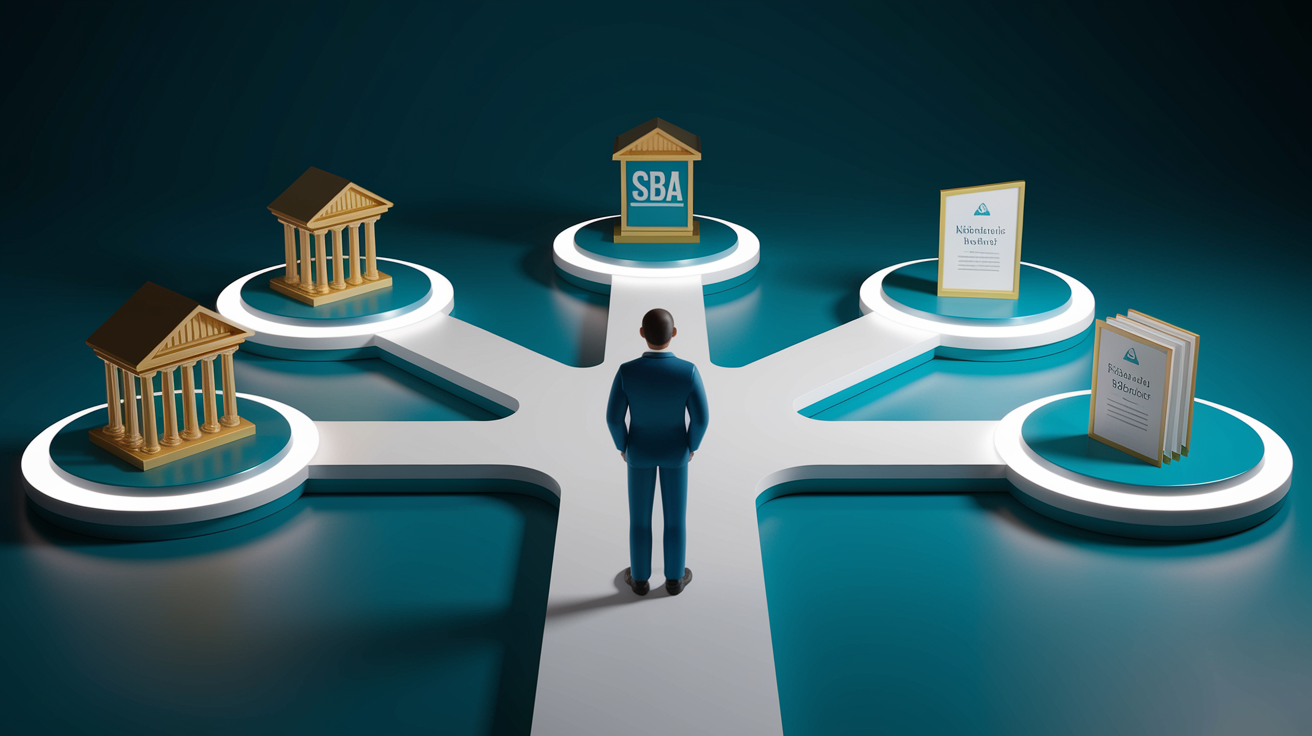
If your current lender declines conversion or offers terms that don’t work, you can refinance with a different lender. Plenty of online lenders, credit unions, and Community Development Financial Institutions handle debt consolidation and will pay off your line directly as part of the new loan close.
Another option is applying for a separate term loan and using the proceeds to zero out the line yourself. That opens you up to more lender choices and potentially better rates, especially if you qualify for SBA 7(a) or SBA Express products that cap rates and offer longer terms. Invoice factoring or equipment financing can also generate cash to pay down the line without requiring a full refinance.
Five alternative solutions:
- Refinance with another lender offering better rates, longer terms, or easier approval standards.
- SBA 7(a) or SBA Express loan for lower cost, longer term debt with government guarantee reducing lender risk.
- Equipment financing if part of your line balance funded equipment purchases. Lets you match term to asset life.
- Invoice factoring or accounts receivable financing to generate immediate cash and reduce reliance on the line.
- Partial paydown plus line extension. Negotiate an extended maturity date or lower interest rate on the existing line instead of full conversion.
Realistic Examples of When Conversion Makes Sense
Conversion works best when your cash flow and borrowing needs have fundamentally changed. Three common situations make the decision obvious.
Example 1: A seasonal contractor drew $80,000 on a $100,000 line to buy materials in March, expecting to repay by August. Sales fell short, and the balance sat at $75,000 for nine months. Monthly interest on the variable rate line averaged $950. The contractor converted the $75,000 into a 36-month term loan at 9.5% APR with a fixed $2,400 monthly payment. Total interest over 36 months will be $11,400, versus continuing to carry the balance on the line at $950 per month (potentially $34,200 over three years if never paid down).
Example 2: A retail store kept a $50,000 line for inventory but consistently carried a $45,000 balance for over a year. The lender sent notice they were cutting the limit to $30,000 at renewal. The owner converted the $45,000 balance into a five year term loan, locking in a 7.8% fixed rate and eliminating the risk of a forced paydown when the line renewed.
Example 3: A professional services firm used a line to cover payroll gaps while waiting on client payments. Revenue stabilized, and the firm didn’t need revolving access anymore. They converted the $60,000 outstanding balance into a 24-month term loan to simplify accounting and ensure the debt was fully paid off within two years, matching their contract pipeline visibility.
Final Words
In the action, this post showed that many lenders will let you convert a revolving business line of credit into a fixed-term loan when long balances or the need for predictable payments make sense.
We covered best timing, the exact steps, what docs lenders want, pros and cons, negotiation tactics, and practical alternatives.
Use the checklist and timing triggers so payments fit your cash coming in and going out. If you want clarity on when and how to convert a business line of credit into a term loan, follow steps here and you’ll have a clearer path forward.
FAQ
Q: What is the monthly payment on a $50,000 business loan?
A: The monthly payment on a $50,000 business loan depends on the interest rate and term. For example, at 7% APR over 5 years you’d pay about $990 per month.
Q: Is a term loan better than a line of credit for a business?
A: A term loan is better for one-time purchases and predictable payments; a line of credit is better for ongoing or irregular cash needs since you draw, repay, and reuse funds.
Q: What is the 20% rule for SBA?
A: The 20% rule for SBA generally means owners should plan to contribute about 10 to 20% equity or down payment; the exact requirement depends on the loan program, lender, and financials.
Q: How is a $50,000 home equity loan different from a $50,000 home equity line of credit?
A: A $50,000 home equity loan is a fixed-rate lump sum with fixed monthly payments; a $50,000 HELOC is a revolving line with variable rates, flexible draws, and possible interest-only payments during the draw period.