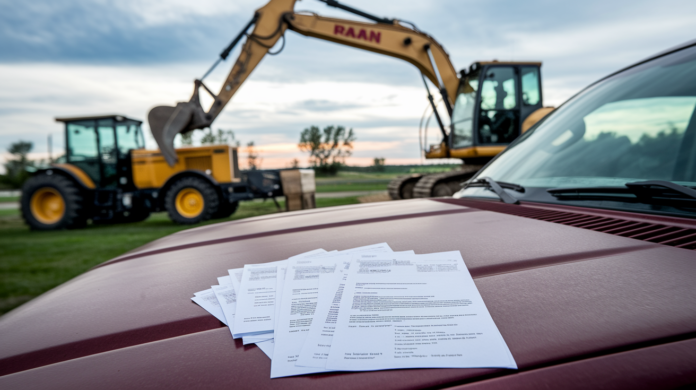

Think a 600 credit score can’t buy a $150,000 excavator?
Not necessarily.
Required scores depend on the lender: banks usually want 680+, credit unions start around 640-660, alternative lenders often approve 600-650, and specialty equipment funders sometimes go as low as 520-590.
Lower scores come with higher rates, bigger down payments, and shorter terms.
This post breaks down the score tiers, how each lender underwrites, and the real cost impact, so you can choose the funding route that fits your cash flow and timeline.
Core Credit Score Requirements for Agricultural and Construction Machinery Loans
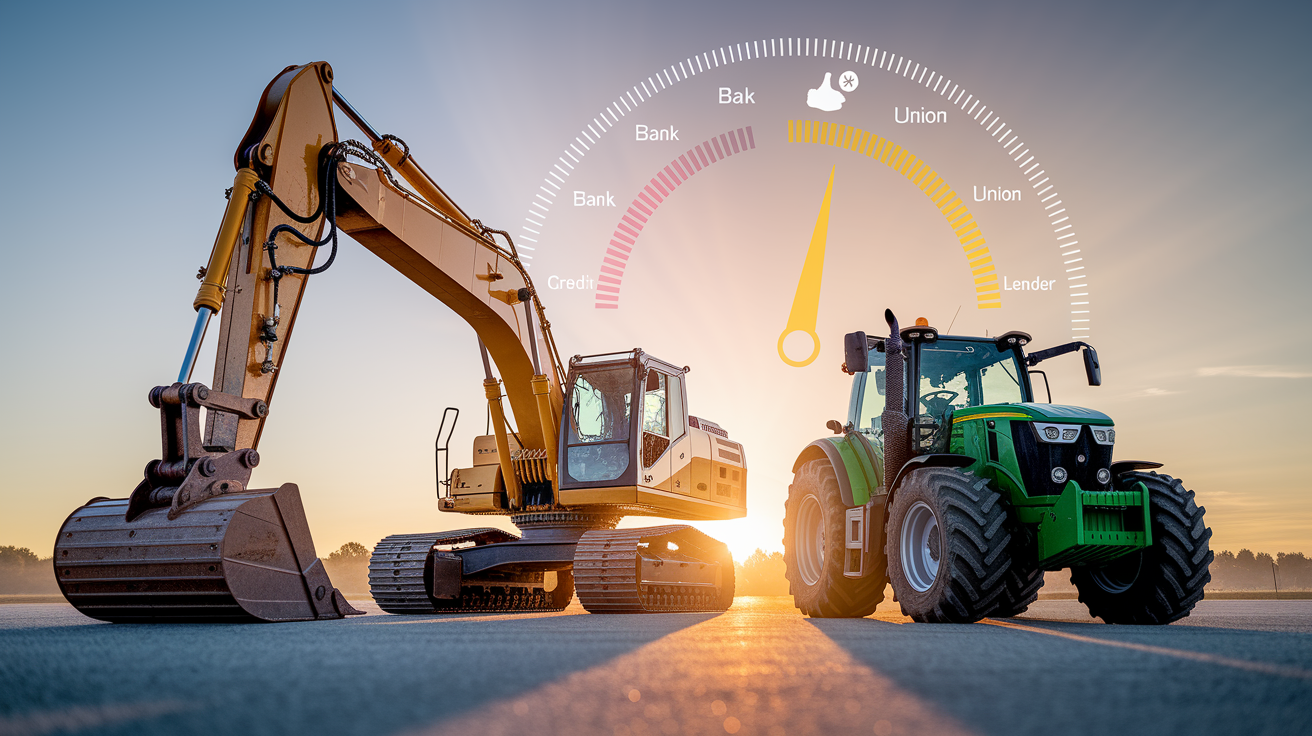
Banks usually want 680 or higher for ag and construction equipment financing. Credit unions start around 640–660. Alternative lenders routinely approve scores between 600 and 650, and specialty heavy equipment lenders sometimes go as low as 520–590, though you’ll pay for it with higher rates, bigger down payments, and tighter terms.
The gap between lender types comes down to how they underwrite. Banks use hard cutoffs and lean on FICO during automated screening. If you’re at 675, you might clear the threshold. At 630, you’re looking at an instant decline. Credit unions take a relationship approach and manually review files when scores fall between 640 and 680, especially if you’ve banked with them or can show strong cash flow. Alternative lenders look at the full business picture (revenue, contracts, equipment value, time in operation) and put less weight on the three-digit number.
Specialty equipment finance companies that focus on construction or ag have seen it all. They know a 590 doesn’t tell the whole story if you’ve got two years of steady receivables, a solid trade-in, and equipment that holds resale value. These lenders price for risk instead of declining outright.
Key score categories:
- 680+ qualifies for traditional bank financing with competitive rates and standard down payments
- 640–679 opens credit union and some alternative lender programs with moderate rate bumps
- 600–639 requires alternative or specialty lenders. Expect 12–15% rates and 20–25% down
- Below 600 limits options to subprime specialty lenders, co-signed loans, or heavy down payment structures
How Credit Scores Shape Machinery Loan Rates and Terms
Your score controls your rate, which drives your monthly payment and total cost over the loan’s life. Lenders use tiered pricing. Borrowers above 720 typically see 7% to 9%. Scores from 680 to 719 pay 9–11%. The 640 to 679 range pushes into 11–13%, and borrowers with 600–639 credit generally face 12–15%. Below 600, expect 15% or higher if you can find approval at all.
The monthly payment gap adds up. On a $150,000 excavator financed over five years, an excellent-credit borrower at 8% pays about $3,041 per month and $32,460 in total interest. A borrower at 600 credit paying 13% sees a monthly payment around $3,410 and total interest near $54,600. That’s an extra $369 every month and $22,140 more paid over the term, just from the score difference.
| Credit Tier | Rate Range | Example Monthly Payment Difference (vs 720+ score) |
|---|---|---|
| 720+ | 7–9% | Baseline ($3,041/month at 8%) |
| 680–719 | 9–11% | +$147/month (10% rate = $3,188/month) |
| 640–679 | 11–13% | +$300/month (12% rate = $3,341/month) |
| 600–639 | 12–15% | +$369/month (13% rate = $3,410/month) |
Term length also tightens when credit drops. Banks and credit unions commonly offer five-year terms for strong credit, but alternative lenders may cap you at three or four years if your score sits in the low 600s. Shorter terms mean higher monthly payments even if the rate’s similar, which strains cash flow. If the equipment generates enough revenue to cover the payment and you need it now, the shorter term works. If cash flow’s already tight, a higher monthly obligation can turn profitable equipment into a problem.
Down Payment Expectations and Loan-to-Value Standards for Equipment Loans
Lenders set down payment requirements based on credit score and the equipment’s resale risk. Borrowers with 720+ credit typically put down 10–15%. Those in the 680–719 range face 15–20%. Scores from 640 to 679 generally require 20–25%, and borrowers with 600–639 credit are usually asked for 20–25% as well, sometimes more depending on equipment age and type. Below 600, expect 25–30% or higher. In some cases lenders want one-third down to approve the deal.
Down payment size affects more than approval. It also influences your rate. On a $120,000 piece of equipment, putting down 20% ($24,000) might get you approved at 14%. Increasing the down payment to 25% ($30,000) can drop the rate to 13%. Pushing to 30% ($36,000) may bring it down to 12%. The extra cash upfront reduces the lender’s exposure and signals commitment.
Trade-ins work as down payment credit. If you’re buying a $180,000 excavator and trading in a machine worth $40,000, the lender applies that 22% equity toward the purchase and finances the remaining $140,000. The trade value must be supported by an appraisal or resale comps, and the lender will discount heavily if the trade-in’s old, high-hours, or hard to move. Clean, maintained equipment from major brands gives you the most leverage.
Five ways to meet or reduce down payment requirements:
- Trade in existing equipment and apply the appraised value directly to the purchase price
- Offer additional business assets as collateral (real estate, inventory, or other paid-off machinery)
- Bring in a co-investor or partner who contributes capital in exchange for equipment use or revenue share
- Use a business savings reserve or retained earnings set aside specifically for equipment purchases
- Finance the down payment separately through a business line of credit, then pay it down quickly to avoid stacking debt
Documentation and Financial Requirements for Agricultural and Construction Equipment Loans
Lenders evaluate more than your score. They want proof your business generates enough cash to cover the new equipment payment while meeting existing obligations. Most lenders require two years of business tax returns to verify income trends, year-to-date profit and loss statements to confirm current performance, and six months of business bank statements to see actual cash coming in and going out. You’ll also submit a personal financial statement showing assets and liabilities, and accounts receivable aging reports if you bill customers on terms.
Optional documents can strengthen your file. If you have signed contracts or purchase orders showing equipment will be used on paying jobs, include them. Maintenance records prove the trade-in or current fleet is well cared for. Customer references or a simple business plan explaining how the equipment generates revenue can move a marginal approval into a yes, especially with alternative lenders who manually review files.
| Documentation | Purpose for Lender |
|---|---|
| 2 years business tax returns | Verify revenue trends and profitability over time |
| Year-to-date financial statements | Confirm current cash flow and seasonal patterns |
| 6 months business bank statements | Validate actual deposits and check for NSF or overdrafts |
| Personal financial statement | Assess owner’s liquidity and personal guarantee capacity |
| AR aging and contracts | Show committed work and collectible receivables |
Lenders calculate debt service coverage ratio to measure cash flow cushion. DSCR divides your net operating income by total debt obligations, including the proposed equipment payment. A minimum acceptable DSCR is 1.15:1, meaning your income is 115% of your debt payments. Preferred is 1.25:1 or higher. Strong approvals sit at 1.5:1 and above. For example, if your net operating income is $180,000 annually, existing debt payments total $60,000, and the proposed equipment payment is $48,000, your total obligations are $108,000. Your DSCR is $180,000 ÷ $108,000 = 1.67:1.
Many lenders also set minimum revenue thresholds. A common floor is $250,000 in annual revenue, though some specialty lenders will work with businesses doing $96,000 or more if the equipment purchase makes clear financial sense. For larger loans above $100,000, lenders prefer to see revenue above $500,000 to ensure the payment fits comfortably into cash flow.
Lender Categories and Their Approval Behaviors for Machinery Financing
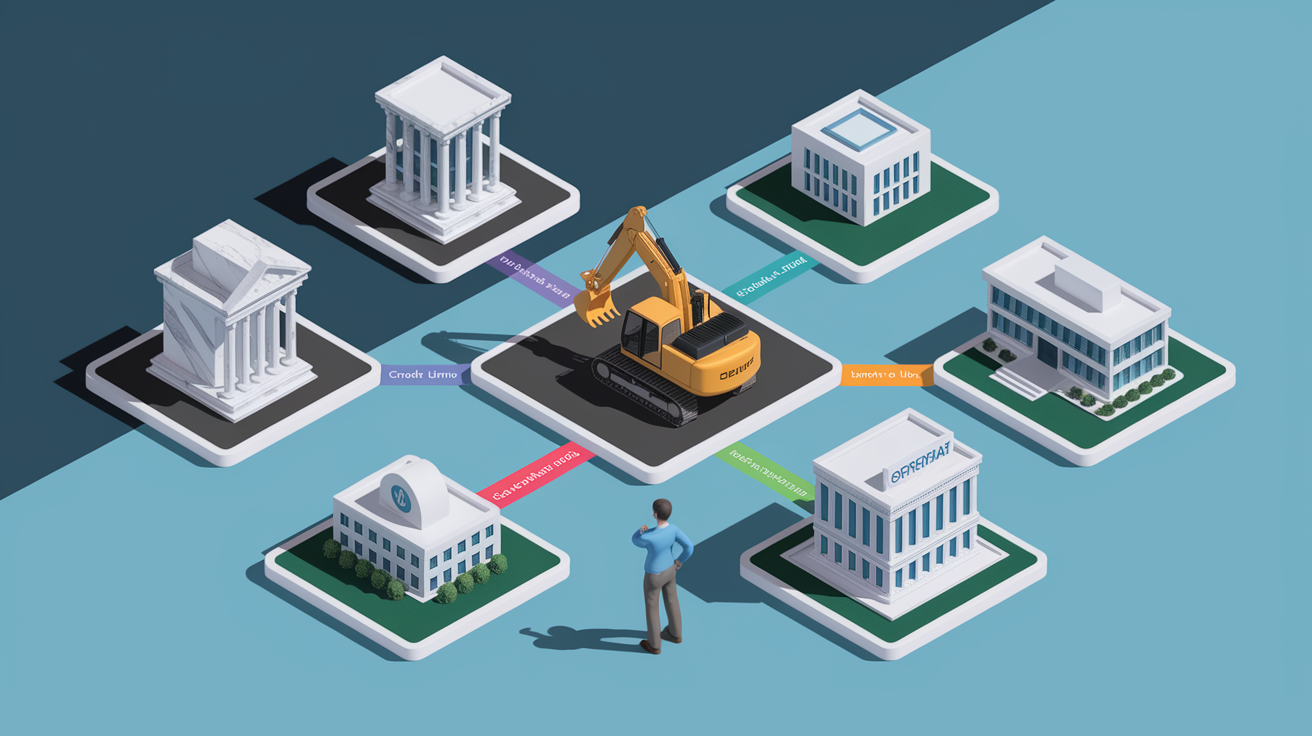
Traditional banks process equipment loans in 30 to 90 days and rely on rigid underwriting checklists. They assign little discretion to loan officers and rarely make exceptions for borrowers who fall outside credit or revenue parameters. The tradeoff is lower rates if you qualify cleanly, but the decline rate is high for anyone with credit in the 600s or inconsistent financials.
Credit unions move faster and take a relationship-focused approach. If you’ve been a member for years, keep deposits there, and can sit down with a loan officer, they’ll often manually review a file that a bank would auto-decline. The catch is membership requirements and sometimes geographic restrictions. Rates typically fall between bank pricing and alternative lender pricing, and approvals can happen in one to three weeks if your documentation’s complete.
Alternative lenders specialize in speed and flexibility. Many provide conditional approvals in 48 to 72 hours and full approvals within two to seven business days. They evaluate the full business profile (revenue consistency, equipment resale value, contracts in hand, owner experience) and weigh credit score as one factor among many. These lenders are often the best fit for borrowers with credit in the 600–650 range who need equipment fast and can afford a moderately higher rate in exchange for certainty and speed.
Specialty equipment finance companies focus exclusively on construction, agriculture, or trucking and understand the industries deeply. They know which brands hold value, what maintenance schedules look like, and how seasonal revenue works. Because of that expertise, they can approve deals that generalist lenders decline. They also offer structures like seasonal payments or skip-payment options during slow months, which banks won’t touch.
SBA-backed equipment loans sit in a separate category. The Small Business Administration guarantees 75% to 85% of the loan (85% for loans up to $150,000, 75% above that), which reduces lender risk and makes approval easier for marginal credit. The downside is more paperwork and longer processing times, often 45 to 90 days. Interest rates include an SBA add-on that varies by loan size: up to 6.5% for loans under $50,000, down to 3% for loans over $350,000.
Key traits by lender type:
- Banks offer the lowest rates but use hard credit cutoffs and slow timelines, best for 680+ scores
- Credit unions provide relationship-based underwriting and manual review, ideal for long-term members with 640+ credit
- Alternative lenders deliver fast approvals and flexible structures, often the only option for 600–650 credit
- Specialty equipment lenders understand industry-specific risks and offer seasonal payment plans or other customizations
- SBA programs reduce lender risk through guarantees but add documentation requirements and processing time
Agricultural vs Construction Equipment Credit Criteria Compared
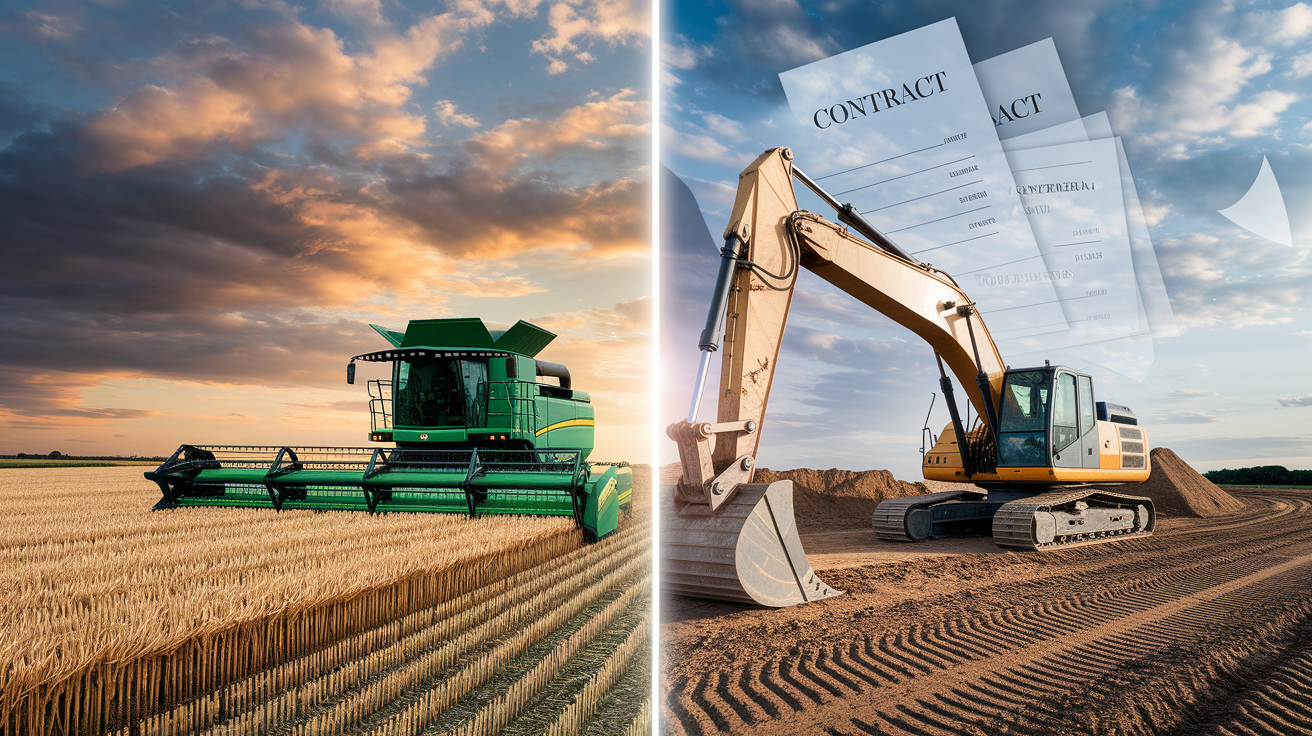
Ag lenders account for seasonal income cycles when reviewing cash flow. A farm operation may show zero revenue for three months, then generate most of its annual income during harvest. Lenders experienced in agriculture adjust DSCR calculations and payment schedules accordingly, sometimes offering skip payments during off-seasons or structuring loans around crop insurance and government program payments. Construction lenders focus on job pipelines, contract backlog, and equipment utilization rates. They want to see signed work that justifies the equipment purchase and customer references that confirm you complete jobs and get paid.
Equipment condition and resale value carry different weight by sector. Ag equipment (tractors, combines, planters) from major manufacturers like John Deere or Case IH holds strong resale value even when used, so lenders accept older equipment with lower down payments. Construction equipment varies more. A five-year-old excavator from Caterpillar or Komatsu finances easily, but a ten-year-old off-brand machine may require 30% down and a shorter term because the lender knows resale will be slow if they have to repossess.
| Sector | Key Credit Factors | Typical Adjustments |
|---|---|---|
| Agricultural | Seasonal income, crop insurance, government program eligibility, equipment brand strength | Seasonal payment schedules, acceptance of equipment over 5 years old, FSA loan options |
| Construction | Job contracts, equipment ROI, utilization rate, customer payment history | Preference for equipment under 5 years, focus on resale brands, shorter terms for used machinery |
Lenders in both sectors prefer equipment that’s newer than five years, properly maintained, and from brands with broad dealer networks and parts availability. Older equipment isn’t automatically disqualified, but expect the lender to ask for maintenance records, an independent appraisal, and possibly a larger down payment to offset depreciation risk.
Options for Low Credit Scores: Alternative, Subprime, and Government-Backed Machinery Financing
Borrowers with credit scores between 520 and 590 can still access equipment financing, but the terms reflect the higher risk. Subprime specialty lenders may approve loans in this range with interest rates of 15% or more and down payments starting at 25% and often reaching 30%. The loan-to-value ratio tightens, terms shorten to three or four years, and you’ll almost certainly sign a personal guarantee making you fully liable if the business defaults.
SBA equipment loan programs provide a government guarantee of 75% to 85% of the loan amount, which encourages lenders to approve borrowers they would otherwise decline. The guarantee doesn’t eliminate credit review, but it shifts focus toward business viability and collateral value. Interest rates include an add-on based on loan size: loans up to $50,000 add up to 6.5% above the base rate, loans from $50,001 to $250,000 add 6%, loans from $250,001 to $350,000 add 4.5%, and loans above $350,000 add 3%. The SBA route takes longer (often 45 to 90 days) but it opens doors when conventional financing won’t.
Leasing reduces the upfront credit burden because you’re not financing the full purchase price. Lease payments primarily cover depreciation and the lessor’s cost of capital, which typically results in lower monthly payments than a loan. At lease end, you can return the equipment, purchase it for residual value, or upgrade to newer machinery. Leasing works well if your credit’s below 600 and you need lower payments to fit cash flow, but you give up ownership and may face mileage or condition penalties when you return the equipment.
Co-signers with strong credit and stable income can unlock approvals that wouldn’t happen on your business profile alone. Lenders prefer co-signers with credit scores of 680 or higher (ideally 700+), along with significant personal assets and income that can cover the payment if your business can’t. The co-signer becomes equally liable for the debt, so this option works best with a business partner, family member, or investor who understands the equipment’s role in your operation and trusts your ability to repay.
Paths to approval with low credit:
- Alternative and specialty lenders that use full-profile underwriting and accept 600–650 scores with higher rates and down payments
- SBA-guaranteed loans that shift risk to the government and allow lenders to approve marginal credit with added documentation
- Equipment leasing that lowers monthly payments and removes ownership risk from the lender’s side
- Co-signers with 680–700+ credit who guarantee the loan and bring their financial strength into the approval equation
- Larger down payments of 25–30% or more to reduce lender exposure and improve rate pricing
- Trade-ins or additional business collateral such as real estate or paid-off equipment to strengthen the credit package
How to Improve Credit Score Before Applying for Machinery Financing
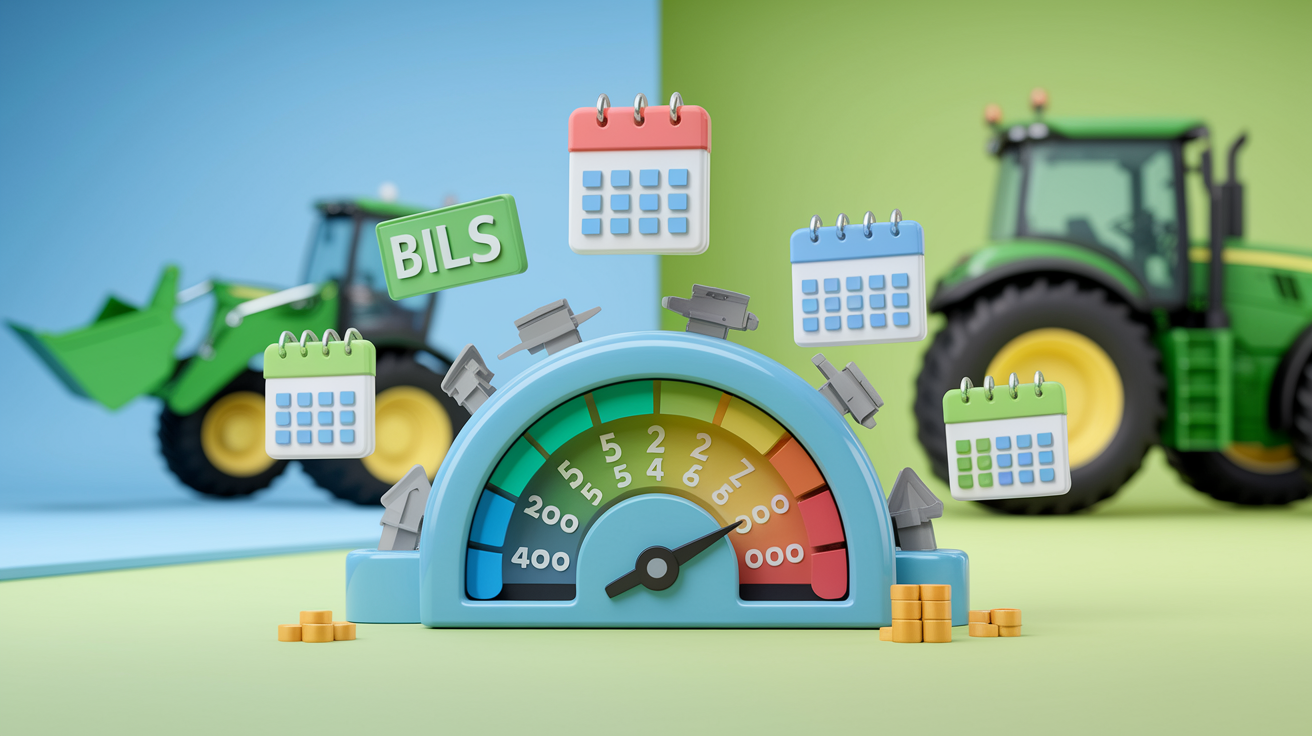
Quick credit improvements can happen in 30 to 60 days if you focus on payment history and credit utilization, which together make up 65% of your FICO score. Payment history counts for 35%, so making all business and personal payments on time for two consecutive months can start moving your score up by 20 to 30 points. Credit utilization accounts for 30%, and paying down credit card balances below 30% of your total available credit (ideally below 10%) can add another 10 to 20 points in the same window.
Longer improvement timelines of 60 to 90 days can yield 30 to 50 points if you combine consistent on-time payments with aggressive paydown of high-utilization accounts. Paying off a maxed-out card or consolidating high-interest debt into a lower-rate loan improves utilization and sometimes lifts scores faster than making minimum payments. If your score’s sitting at 620 and you need to reach 640 to unlock better lender options, two or three months of focused action can get you there.
Five actions to improve credit before applying:
- Pay every bill on time for at least two months. Set up autopay if cash flow allows to eliminate missed payments
- Reduce credit card balances to 30% or less of available credit. Focus on cards with the highest utilization first
- Avoid opening new credit accounts or making large purchases on credit in the 60–90 days before applying, since new inquiries and accounts lower average age of credit
- Pull your credit report from all three bureaus and dispute any errors, outdated collections, or incorrect account statuses
- If you have recent late payments, add a brief explanation letter to your loan application describing one-time events like a health issue or client nonpayment
Real-World Credit Score Examples for Ag and Construction Equipment Financing
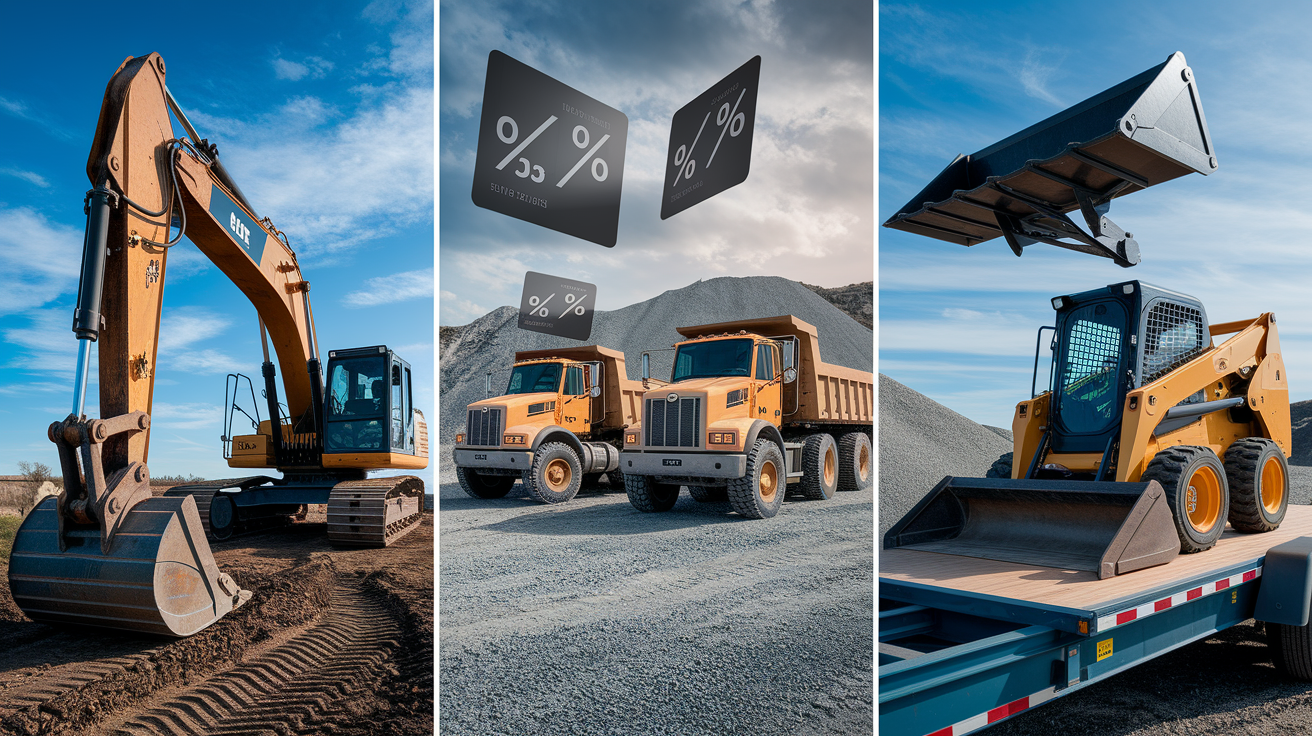
An excavation company with 615 credit purchased a used excavator for $95,000, traded in an older machine worth $25,000 (26% down), and financed $70,000 at 13% over four years. The monthly payment came to $1,875. Annual revenue was $650,000, and the excavator replaced a rental costing $2,800 per month, so the net cash flow improvement was $925 per month after the loan payment.
A construction business with 608 credit bought two used dump trucks totaling $140,000, put down $35,000 (25%), and financed $105,000 at 14% over four years with a monthly payment of $2,865. Annual revenue was $480,000, and the trucks allowed the company to take on hauling contracts it previously subcontracted out, adding about $8,000 per month in gross revenue.
A startup excavation contractor with 602 credit and just over one year in business financed a skid steer and attachments for $55,000 total. The lender required 30% down ($16,500), financed $38,500 at 15% over three years, and set the monthly payment at $1,334. Annual revenue was $320,000, and the owner had ten years of operator experience, which helped offset the short business history.
| Credit Score | Equipment | Down Payment | Rate | Term |
|---|---|---|---|---|
| 615 | $95,000 used excavator | $25,000 (26% trade-in) | 13% | 4 years |
| 608 | $140,000 dump truck fleet | $35,000 (25% cash) | 14% | 4 years |
| 602 | $55,000 skid steer + attachments | $16,500 (30% cash) | 15% | 3 years |
Used equipment age and condition directly affect approval and terms. Lenders finance equipment under five years old at standard rates, but once a machine crosses five years, expect higher rates, larger down payments, or shorter terms. High-hour equipment (excavators over 5,000 hours, trucks over 150,000 miles) gets similar treatment. Lenders know maintenance costs rise and resale value drops, so they price in the added risk or decline the deal outright. If the equipment’s essential and you can’t afford newer machinery, prepare to put down 25–30% and accept a three-year term instead of five.
Best Practices When Applying for Agricultural and Construction Equipment Loans

The most common mistake is applying only to traditional banks when your credit sits below 680. Banks auto-decline most files under that threshold, and multiple declines hurt your confidence and waste time. Start with alternative or specialty lenders who openly work with 600–650 credit, and save bank applications for when your score improves or you have a long banking relationship that justifies manual review.
Proactively explain any credit issues in writing when you submit your application. If late payments came from a medical emergency, client bankruptcy, or divorce, attach a one-page letter with supporting documents. Lenders see these situations regularly, and an honest explanation often moves your file from an automated decline into manual underwriting where someone actually reads the context. Silence looks worse than a problem with a reasonable cause.
Six best practices for machinery loan applications:
- Apply to lenders that specialize in your industry and openly state they work with your credit tier. Don’t waste time on banks with 680+ minimums if you’re at 620
- Prepare complete documentation upfront (tax returns, bank statements, financial statements, AR aging) so underwriting can start immediately without back and forth requests
- Include a simple one-page explanation of how the equipment generates revenue or reduces costs, with numbers that tie to your financials
- Disclose credit issues early with a brief written explanation and any supporting documents. Waiting for the lender to find problems creates doubt
- Offer a larger down payment or additional collateral if your approval’s marginal. Lenders often say yes when you reduce their exposure
- Avoid lenders charging fees above 5% of the loan, requiring daily or weekly payments, hiding terms in fine print, or advertising rates above 20% unless you’ve exhausted all other options
Final Words
in the action: banks usually want 680+, credit unions 640–660+, alternative lenders 600–650, and specialty lenders 520–590.
This post walked through how those scores change rates, down payments, required docs, and lender speed — plus real examples and fixes you can start today. Pick the path that fits your cash flow and timeline.
If you’re wondering about required credit score for agricultural and construction machinery loans, use these ranges and the improvement steps to plan your next move — you’ll be closer to getting the equipment you need.
FAQ
Q: Can I get an SBA loan with a 500 credit score?
A: An SBA loan with a 500 credit score is unlikely; SBA lenders typically want much higher credit, or strong revenue, collateral, and a co-signer to overcome that low score.
Q: What credit score is needed for a USDA construction loan?
A: A USDA construction loan generally needs around a 620 credit score or higher, though lenders may accept lower scores if you show steady income, low debt, and strong compensating factors.
Q: Can I get a construction loan with a 600 credit score?
A: A construction loan with a 600 credit score is possible but harder; banks prefer 680+, credit unions and alternative lenders may lend at 600 with bigger down payments and higher rates.
Q: How hard is it to get tractor financing?
A: Getting tractor financing depends on credit, revenue, and equipment age; easy with 680+, workable at 600–650 through alternative lenders, and harder below 600 unless you add down payment or a co-signer.