


Tired of waiting 60 days to get paid on a job?
Invoice factoring lets a contractor sell unpaid invoices to a financing company for cash in 24 to 48 hours, so payroll, suppliers, and equipment rentals don’t stall the next job.
In this post we walk through the whole process, show what you submit, how much you get up front, who the factor checks, typical fees, and construction-specific limits like retainage and lien rules, so you can decide if factoring fits your cash needs and how to prepare the docs.
How the Construction Invoice Factoring Process Works Step-by-Step
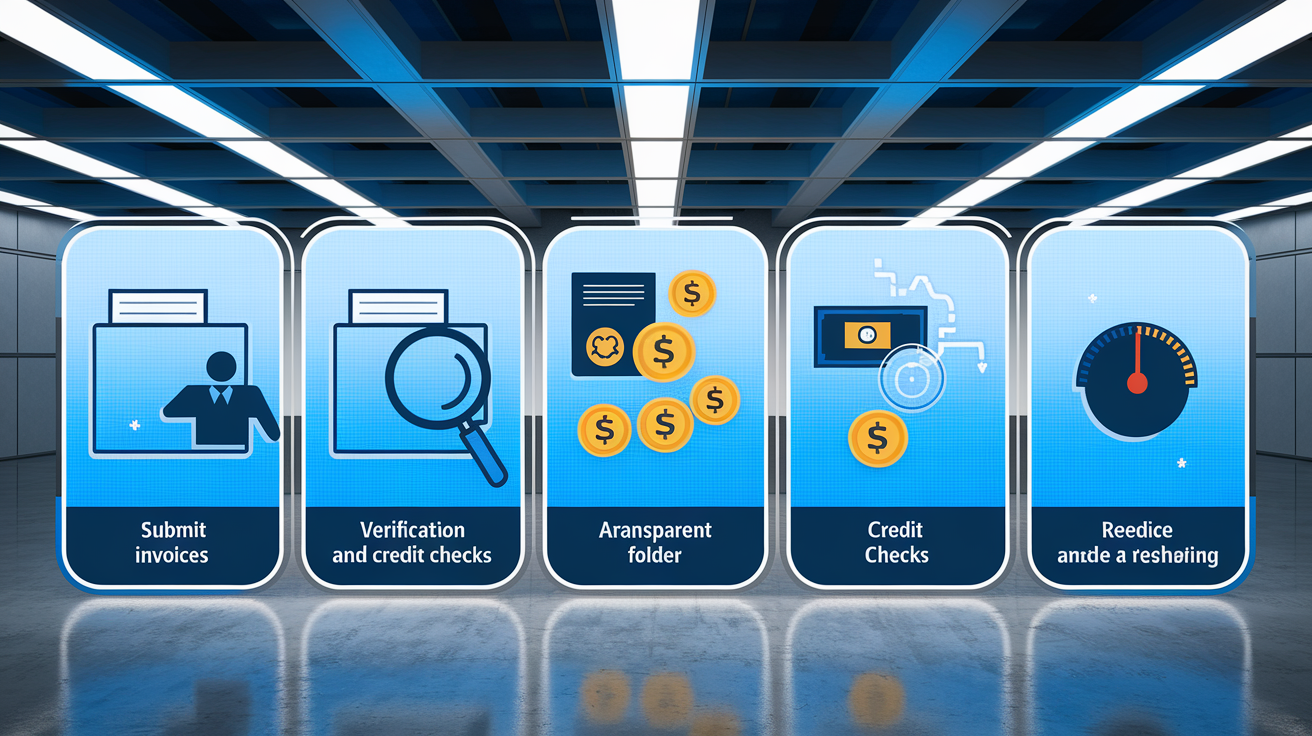
Construction invoice factoring is when you sell unpaid invoices to a financing company and get immediate cash. You don’t wait 30, 60, or 90 days for a general contractor or property owner to pay. You get most of the invoice value in a day or two. The factor buys the invoice, collects directly from your customer, then sends you what’s left once payment clears, minus their fee.
Construction payment cycles create serious cash pressure. Retainage clauses hold back 5 to 10% of every progress invoice until the project wraps. Payment terms stretch 50 to 75 days on average. Progress billing on long jobs means your revenue recognition lags weeks or months behind actual labor and materials costs. During that gap, payroll hits every Friday. Suppliers want payment in 15 to 30 days. Equipment rentals run on the clock. Factoring turns future receivables into working capital today, so you can bridge that timing gap without waiting for the invoice to age out.
The factoring workflow follows five steps:
-
Submit invoices. You provide copies of unpaid invoices, an accounts receivable aging report, proof that billed work or materials are complete (signed delivery tickets, lien waivers, progress certifications), and basic company formation documents.
-
Verification and credit checks. The factor confirms each invoice is free of disputes, mechanics liens, and prior assignments. They verify the billed work is done and check the creditworthiness of whoever’s paying the invoice (the GC or property owner), not your own credit score.
-
Advance funding. Once approved, the factor advances 70 to 90% of the invoice face value, typically within 24 to 48 hours of verification.
-
Collection. The factor notifies the customer (or processes payment through an agreed lockbox) and manages collection on the invoice’s original net terms.
-
Reserve release and fee deduction. When the customer pays, the factor releases the remaining 10 to 30% reserve to you, minus the factoring fee.
Funding speed is one of factoring’s main advantages. After invoice approval, funds usually hit your account within 24 to 48 hours, compared to weeks of waiting under standard payment terms. The factor often wires the advance the same business day the agreement is signed. That gives you cash to cover immediate obligations like payroll or a materials delivery due that afternoon.
Reserve and fee mechanics work like this. On a $100,000 invoice with an 80% advance rate, you receive $80,000 up front. The factor holds the remaining $20,000 as reserve. If the factoring fee is 2% of the invoice ($2,000), you get $18,000 when the customer pays in full. Total net proceeds of $98,000. The $2,000 fee is what it costs to turn a 60 day receivable into same week cash.
Key Cash Flow Benefits of Invoice Factoring for Construction Contractors

The typical construction payment cycle runs 50 to 75 days from invoice submission to cleared funds. Progress payments on active jobs sit in accounts receivable while payroll, subcontractor invoices, materials suppliers, and equipment rental companies all demand payment on much tighter schedules. That timing gap forces you to either carry deep cash reserves, borrow against assets, or delay growth. Factoring collapses the receivables cycle by 20 to 40 days. It turns invoices into operating cash the week you submit them instead of two months later.
You can use factoring proceeds for six common operational needs:
- Payroll. Meet weekly or biweekly payroll obligations without waiting for the GC’s next draw cycle.
- Materials purchases. Pay suppliers in time to capture early payment discounts or avoid COD holds.
- Subcontractor invoices. Keep subs paid promptly to preserve relationships and maintain crew availability.
- Equipment rental. Cover tool and machinery rentals that bill monthly or per job.
- New job mobilization. Fund startup costs (deposits, permits, initial labor) on a new contract before the first progress invoice is even submitted.
- Supplier discounts. Take 2/10 net 30 early pay discounts, turning factoring fees into net savings when the discount exceeds the factoring cost.
Faster cash supports scaling and seasonal management. A roofing contractor who factors June through August invoices can take on twice as many jobs during peak season without waiting for slow August collections to fund September payroll. A mechanical subcontractor bidding a $500,000 HVAC package can mobilize immediately after contract signature instead of deferring startup until the first progress payment clears 45 days later. Factoring turns revenue you’ve already earned into fuel for the next job.
Outsourcing collections reduces administrative drag. The factor manages invoice follow up, payment reminders, and reconciliation. Your office staff no longer spends hours each week chasing GCs for payment status or disputing short pays. The factor’s collections team handles that workflow. Their success depends on getting paid, so they stay on top of aging receivables professionally and persistently.
Eligibility Requirements and What Construction Invoices Qualify for Factoring

Eligible invoices must be clean, undisputed, and tied to completed work or delivered materials. Factors require that invoices are unencumbered. Not already pledged as collateral to a bank. Not subject to an active mechanics lien. Not contested by the customer. The billed work must be verifiable as complete, typically through signed progress certifications, delivery receipts, or conditional lien waivers exchanged at each payment milestone. Invoices disputing scope, quality, or pricing are ineligible until the dispute resolves.
Factors require six core documents during the application and underwriting process:
- Copies of unpaid invoices. Clean, itemized invoices showing amounts due, project identifiers, and invoice dates.
- AR aging report. A current list of all outstanding receivables by customer, showing invoice age and total balance due.
- Proof of completed work. Signed delivery tickets, progress certifications, inspection approvals, or partial lien waivers confirming the billed work is done.
- Lien status verification. Evidence you’ve filed required preliminary notices (if applicable) and confirmation no mechanics liens encumber the invoiced amounts.
- Corporate formation documents. Articles of incorporation, operating agreements, or partnership papers establishing the legal entity.
- Financial statements or tax returns (if requested). Recent profit and loss statements or filed tax returns. Not always required but common for first time applications.
Factors evaluate the invoice payor more than you. The general contractor or property owner. The factor’s risk is whether the GC or owner will pay the invoice on time and in full. They run credit checks on the payor, review payment history, and assess the project’s stability. A subcontractor with thin credit but invoicing a Fortune 500 general contractor on a public works job will often qualify easily. A contractor with strong financials invoicing a small, slow paying developer may face higher fees or reduced advance rates.
Progress billing invoices are treated like any other invoice once the work billed is verified complete. Factors advance against the current progress draw, not the full contract value. If a mechanical sub bills $50,000 for HVAC rough in on a $200,000 contract, the factor advances 70 to 90% of the $50,000 invoice, not the remaining contract balance. Future progress invoices are handled separately as each milestone is completed and billed.
Construction Specific Issues That Affect the Factoring Workflow

Retainage is the most common construction specific limitation in factoring. Most construction contracts withhold 5 to 10% of each progress invoice until final project completion and owner acceptance. Factors typically exclude retainage from the advance, because retainage isn’t due until the entire project closes out, sometimes months after the invoice is submitted. If a $100,000 progress invoice includes $10,000 retainage, the factor treats the billable amount as $90,000 and advances 70 to 90% of that net figure. Some factors will advance against retainage at a reduced rate (say, 50%) once it’s officially released by the owner, but most wait until retainage is paid in full before remitting those funds to you.
Mechanics liens and lien waivers directly affect factoring eligibility. Factors require invoices free of existing mechanics liens, because a filed lien clouds title and creates competing claims on the payment. Before advancing, factors often request conditional lien waivers showing you’ll release lien rights upon receipt of payment, or proof that required preliminary notices were filed to preserve lien rights without yet perfecting them. In some states, factors may require you to provide an unconditional lien waiver once the factored payment clears, confirming no further claim exists on that invoice. Contractors who haven’t filed preliminary notices or who face lien disputes may be ineligible until those issues resolve.
Subcontractor payment obligations and joint check agreements add a second layer of verification. Many general contracts require you to submit lien waivers from all subcontractors and suppliers before the GC releases payment. If you’re factoring that progress invoice, the factor needs the same documentation. Proof that subs and suppliers were paid or have waived lien rights for the covered work period. Joint check agreements (where the GC pays you and a listed subcontractor together on one check) can complicate factoring, because the factor may need the subcontractor’s endorsement to collect. Disclose joint check terms up front so the factor can structure the advance and collection process correctly.
Progress billing and disputed change orders affect invoice verification. Factors fund against completed, accepted work. If a change order is pending approval or the scope billed is under dispute (the GC claims the work is incomplete or defective), the factor won’t advance on that portion until the dispute clears. Clean progress invoices with signed certifications and matching pay app schedules move fastest. Conditional progress draws, where payment depends on third party inspections or owner approvals not yet received, may be eligible at reduced advance rates or held until conditions are satisfied.
| Issue | How It Affects Factoring |
|---|---|
| Retainage | Typically excluded from advance; some factors advance at reduced rate after owner releases retainage. |
| Mechanics Liens | Invoices must be lien free; factors require lien waivers or preliminary notice proof to confirm clean title. |
| Subcontractor Payments | Factor may require sub lien waivers or proof of payment; joint check agreements complicate collection and advance terms. |
| Change Orders and Disputes | Disputed amounts or pending change orders are ineligible until accepted and certified; reduces effective invoice amount. |
Advance Rates, Fees, Reserve Accounts, and Total Cost Breakdown
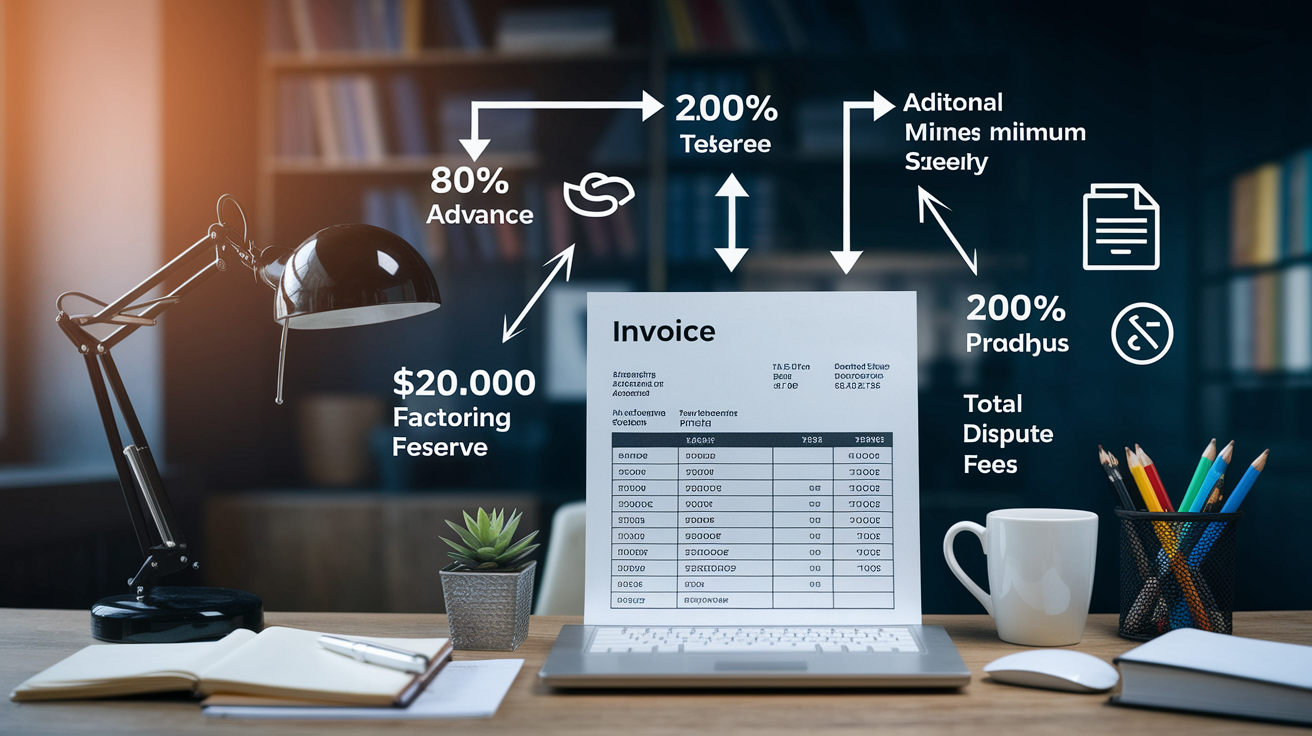
Advance rates typically run 70 to 90% of the invoice face value. The exact percentage depends on the invoice payor’s credit strength, the invoice size, how long the payment terms are, and the perceived collection risk. A $200,000 invoice to a creditworthy public agency general contractor on a 30 day net term might qualify for a 90% advance. A $25,000 invoice to a small private developer on 60 day terms with a history of slow pays might receive a 70% advance. The difference between the advance and the full invoice is the reserve, held by the factor until the customer pays.
Factors charge multiple fee types. Understanding each one matters when calculating true cost:
- Factoring fee. The primary cost, usually expressed as a percentage of the invoice. Typical range is 1 to 5% depending on invoice size, risk, and term length. A 2% fee on a $100,000 invoice is $2,000.
- Origination or setup fee. A one time charge to establish the factoring relationship, common on contract factoring arrangements. May be waived on spot deals.
- Monthly minimums. Some contract factoring agreements require a minimum monthly invoice volume or assess a monthly service fee if volume falls short.
- Wire or transaction fees. Per advance fees to cover wire transfers or ACH costs, typically $10 to $50 per funded invoice.
- Dispute or chargeback fees. Charges assessed if an invoice is disputed after advance, or if you must buy back an unpaid invoice under recourse terms.
Flat fee pricing charges a fixed dollar amount per invoice regardless of how long the invoice remains outstanding. Discount rate pricing calculates the fee based on the time between advance and customer payment, structured like interest accruing weekly or monthly. Discount rate models penalize longer collection cycles, so invoices paid early cost less than invoices that age. If you’ve got reliable 30 day customers, you’ll benefit more from discount rate structures. Those facing slow 60 to 90 day pay cycles may prefer flat fee predictability.
Here’s a numeric example using the scraped reference case. A contractor submits a $100,000 progress invoice. The factor offers an 80% advance and charges a 2% factoring fee. You receive $80,000 within 48 hours. The factor holds a $20,000 reserve. When the general contractor pays the invoice in full 45 days later, the factor deducts the $2,000 fee and remits the remaining $18,000 to you. Total net proceeds are $98,000. You paid $2,000 to access $80,000 in cash six weeks early.
Recourse vs Non Recourse Factoring Options for Contractors

Recourse factoring means you remain ultimately responsible if the invoice goes unpaid. If the general contractor or owner fails to pay within the agreed collection period (commonly 90 days from the invoice date), the factor can demand you buy back the invoice at full face value or repay the advance plus fees. Recourse agreements shift non payment risk back to you. The trade off is lower factoring fees, because the factor’s credit risk is reduced. They can recover funds from you if the customer defaults.
Non recourse factoring transfers credit risk to the factor. If the invoice payor becomes insolvent or refuses to pay for reasons unrelated to your performance, the factor absorbs the loss and can’t demand repayment from you. Non recourse protection applies only to credit qualified customers and only covers true credit defaults, not disputes over work quality, scope changes, or contract performance. Because the factor assumes more risk, non recourse fees run higher than recourse rates. Factors apply stricter underwriting to the invoice payor’s creditworthiness before advancing.
Four key differences shape the choice between recourse and non recourse terms:
- Cost. Recourse factoring costs less. Non recourse costs more due to credit risk assumption.
- Eligibility. Recourse is available for a broader range of customers. Non recourse requires pre approved, credit qualified payors.
- Risk exposure. Recourse leaves you exposed to customer defaults. Non recourse protects you (within policy limits).
- Collections approach. Recourse factors may pursue you if collection efforts fail. Non recourse factors handle collections and write off uncollectible balances internally.
Factoring for Different Types of Construction Contractors and Trades

Subcontractors are the most common users of construction invoice factoring. Electrical, plumbing, HVAC, drywall, and site work subs often work on thin margins with long payment chains. The owner pays the GC, the GC pays the sub 30 to 45 days later. Factoring compresses that cycle, letting subs cover payroll and materials without waiting for the GC’s payment process to clear. Factors underwrite the GC’s credit and payment reliability, so a small subcontractor with limited operating history can qualify as long as the invoiced general contractor is creditworthy and the work is verified complete.
General contractors use factoring differently. GCs managing multiple projects may factor select invoices to fund new job mobilization or bridge gaps between owner draws. Because GCs typically hold retainage from subs and release it only after the owner releases final payment, factoring is often limited to billable progress amounts excluding retainage. GCs working on large commercial projects with reliable payment chains benefit from lower factoring fees and faster approvals when invoicing institutional owners or investment grade developers.
Five specialty trades and how factoring fits each:
- HVAC contractors. High material and labor costs. Progress billing on commercial installs. Retainage and change orders common. Factors focus on GC credit and milestone certifications.
- Electrical subcontractors. Frequent progress draws. Material purchases from suppliers often due before GC payment. Factoring covers wire, panel, and fixture costs while waiting for draw approval.
- Roofing contractors. Seasonal revenue peaks. Fast project cycles. Invoices often paid within 30 to 45 days. Lower retainage on residential work makes invoices cleaner for factoring.
- Plumbing contractors. Multi phase billing (rough in, top out, fixture install). Each phase generates a separate invoice. Factors treat each draw independently once certified.
- Site work and grading subs. Front loaded costs (equipment mobilization, base material). Early invoices critical to cash flow. Factors require survey or engineering sign off confirming work completion.
Public and government projects introduce additional verification steps. Payment chains are often longer but more predictable. Municipalities and agencies rarely default, but bureaucratic approval cycles stretch 60 to 90 days. Factors require proof you’re an approved vendor, confirmation the project is funded, and copies of progress certifications or inspector approvals. Retainage rules on public jobs are strict and non negotiable, so factors exclude retainage entirely and advance only on the net billable amount. Private commercial projects vary widely by general contractor. National GCs with strong credit and established payment systems qualify for higher advance rates and lower fees. Small regional developers or owner builders require more due diligence, and factors may reduce advance rates or require recourse terms to offset collection uncertainty.
Comparing Invoice Factoring to Bank Loans, Credit Lines, and Other Financing

Bank lines of credit require extensive documentation, established profitability, and often demand collateral beyond the receivables being financed. A contractor applying for a $250,000 credit line will submit two years of tax returns, audited financials, personal guarantees, and may pledge equipment, real estate, or inventory as security. Underwriting takes weeks. The bank evaluates your overall financial health, debt to equity ratio, and business longevity. Approval depends on your credit, not the invoice payor’s. Once approved, draws against the line add interest monthly, and unused capacity may carry commitment fees.
Factoring approves based on the invoice payor’s creditworthiness, not your balance sheet. A startup electrical contractor in year one with minimal credit history can factor invoices to a Fortune 500 general contractor and receive funding within 48 hours. No collateral beyond the invoice is required. The factor’s underwriting focuses on whether the GC will pay, not whether you’re profitable or have equity. Documentation is simpler. Invoice copies, AR aging, and proof of work completion. Funding happens fast because the decision hinges on one data point. Will this invoice get paid?
Cost structures differ fundamentally. A bank line of credit charges interest (APR) that accrues over time. The longer the draw is outstanding, the more interest accumulates. Factoring charges a fee based on the invoice, not time. A 2% factoring fee on a $50,000 invoice costs $1,000 whether the GC pays in 30 days or 60 days (under flat fee pricing). Some factors use discount rate models where cost does scale with time, but the fee is still tied to the invoice amount and collection period, not your overall debt load.
Funding speed separates factoring from traditional credit. A contractor who needs $75,000 by Friday to cover payroll and a supplier invoice can submit invoices Monday, receive approval Tuesday, and have funds in the bank Wednesday. A bank loan application submitted Monday might not reach the underwriting committee for two weeks. By the time the loan closes, the payroll crisis has already forced layoffs or missed payments.
Alternatives include purchase order financing, invoice discounting, and mobilization funding for contractors. Purchase order financing advances cash against a confirmed PO or awarded contract before work begins, useful for funding startup costs on a new job. Invoice discounting works like factoring but keeps collections in house. You still manage customer payments and remit funds to the lender. Mobilization financing provides upfront capital to cover permits, bonding, deposits, and initial labor on large projects, structured as a short term loan or advance against the contract value. Some payroll specific loans offer streamlined terms: application under 2 minutes, approval within 2 days, same day funding, up to $500,000, with costs around 1.5% per week. Each option trades different variables (speed, cost, control, and risk) against your immediate cash need and repayment capacity.
| Feature | Factoring | Bank Line of Credit | Short Term Loan |
|---|---|---|---|
| Approval basis | Invoice payor credit | Contractor credit and financials | Revenue and repayment capacity |
| Funding speed | 24 to 48 hours after verification | 2 to 6 weeks underwriting and closing | 1 to 3 days (varies by lender) |
| Cost structure | Factoring fee per invoice (1 to 5%) | Interest (APR) on outstanding balance | Fixed fee or weekly rate (example: 1.5% per week) |
How to Prepare and Apply for Invoice Factoring as a Contractor

Approval timelines vary by factor and invoice complexity, but most decisions happen within a few business days. After you submit documentation, the factor verifies invoice details, checks the payor’s credit, and confirms lien status. Simple invoices to established general contractors with clean payment histories can clear underwriting in 24 hours. Invoices involving disputed change orders, complex retainage, or first time customers may take three to five days while the factor requests additional documentation or negotiates verification with the GC. Once approved, funding typically occurs within 24 to 48 hours, often the same business day the factoring agreement is signed.
Seven steps take you from initial inquiry to funded invoice:
-
Gather current invoices and AR aging. Identify unpaid invoices 30 to 120 days old, pull an aging report showing all outstanding receivables by customer, and confirm which invoices are unencumbered and dispute free.
-
Collect proof of work completion. Assemble signed delivery tickets, progress certifications, inspector approvals, or conditional lien waivers showing the billed work is done and accepted.
-
Verify lien status and preliminary notices. Confirm no mechanics liens are filed against the invoices, and gather copies of any required preliminary notices or lien waiver exchanges.
-
Prepare corporate and financial documents. Pull together articles of incorporation, operating agreements, recent profit and loss statements, and the last filed tax return (some factors request these, others skip financials entirely).
-
Submit application and documentation. Complete the factor’s intake form (often online), upload invoice copies, AR aging, work completion proof, and entity documents.
-
Respond to underwriting requests. The factor may ask for customer references, GC contact details, project details, or clarification on retainage and payment terms. Reply promptly to avoid delays.
-
Review and sign the factoring agreement. Confirm advance rate, factoring fee, recourse terms, reserve release timing, retainage policy, and any monthly minimums or transaction fees before signing. Once signed, the factor wires the advance.
Comparing factoring companies requires clarity on four deal points: advance rate (how much cash up front), factoring fee (total cost per invoice), recourse vs non recourse terms (who bears default risk), and construction specific policies (how retainage, liens, and progress billing are handled). A 90% advance at 3% cost may deliver less net cash than an 80% advance at 1.5% cost, depending on invoice size. Non recourse protection offers peace of mind but costs more. Recourse terms reduce fees but leave you exposed if the GC fails to pay. Retainage policies matter most on long projects. Factors who advance against released retainage at reasonable rates provide better total liquidity than those who exclude retainage entirely.
You should also evaluate customer notification and collections approach. Some factors operate on a notification basis, informing the GC or owner that the invoice has been assigned and directing payment to a lockbox. Others use non notification structures where you continue normal customer communication and forward payments to the factor. Notification factoring is more common and often required, but if you’re concerned about customer perception, confirm the factor’s communication style and professionalism before signing. For broader cash flow planning and working capital strategies, you can explore business working capital solutions that complement or substitute for factoring depending on project mix and payment cycles.
Final Words
Right in the action: you send an invoice, the factor verifies it and the payor, then you get a 70-90% advance. They collect payment and release the reserve minus fees.
That process closes a 50-75-day cash gap so you can cover payroll, buy materials, and mobilize jobs. Funding often lands in 24-48 hours.
If you ask how does invoice factoring work for construction contractors, it’s turning completed, lien-free invoices into fast cash while you compare advance rates and recourse terms. Done right, it keeps crews paid and projects moving.
FAQ
Q: How does invoice factoring work for construction contractors?
A: Invoice factoring for construction contractors converts unpaid invoices into cash: you submit invoices, the factor verifies them, advances 70–90% within 24–48 hours, then collects and releases the reserve minus fees when the customer pays.
Q: Why do construction contractors use invoice factoring?
A: Contractors use invoice factoring because it closes the cash gap from slow pays and retainage, so you can cover payroll, materials, subs, and mobilize on new jobs without waiting 30–75 days for payment.
Q: What invoices qualify for construction factoring?
A: Invoices that qualify are tied to completed work or delivered materials, free of disputes and mechanics liens, and payable by creditworthy GCs or owners; progress invoices must show verified milestones or completion.
Q: What documents do I need to apply for factoring?
A: You need invoice copies, an AR aging report, proof of completed work or delivery, lien waivers, your company formation documents, and sometimes recent financials or tax returns for due diligence.
Q: How fast is funding with construction invoice factoring?
A: Funding with construction invoice factoring is typically 24–48 hours after the factor verifies the invoice and payor; initial advance happens fast, final reserve follows once the customer pays.
Q: How much will I get upfront and what do factoring fees look like?
A: You’ll usually get a 70–90% advance and a 10–30% reserve. Fees vary by payor credit and invoice size. Example: $100,000 invoice, 80% advance = $80,000; $2,000 fee leaves $18,000 reserve payout.
Q: What’s the difference between recourse and non-recourse factoring?
A: Recourse factoring means you must buy back unpaid invoices; non-recourse shifts payor credit risk to the factor but is limited to invoices from credit-approved customers and usually costs more.
Q: How do retainage, change orders, and liens affect the factoring process?
A: Retainage is often excluded or advanced at lower rates, disputed change orders delay verification, and active mechanics liens block factoring until waived or cleared by the contractor or GC.
Q: How does invoice factoring compare to a bank line or short-term loan?
A: Invoice factoring is based on your customer’s credit, needs less collateral, and funds faster (24–48 hours). Bank lines take longer, need more docs and collateral, but may cost less long term for stable cash flow.
Q: What steps should I take to apply and choose a factoring company?
A: Start by gathering invoices, AR aging, proof of work, lien waivers, and entity docs. Compare advance rates, fees, recourse terms, retainage policy, and typical funding speed before signing.