


What if you could turn a 60-day invoice into cash in 48 hours?
Invoice factoring for contractors means selling an unpaid invoice to a third party at a discount so you get cash now instead of waiting.
That fast cash covers payroll, materials, or the next bid and keeps cash coming in and going out while jobs close slowly.
We’ll show how factoring works for construction, real cost examples, what factors look for, and when it actually makes sense for your business.
Understanding How Contractor Invoice Factoring Works

Invoice factoring for contractors means selling an outstanding invoice to a third party at a discount in exchange for immediate cash. Contractors use factoring to close the gap between finishing work and getting paid. In construction, jobs often front load labor and materials costs while client payments arrive weeks or months later. Factoring converts that receivable into working capital fast, usually within a few days.
Here’s how funds flow: the contractor assigns the invoice to the factoring company, which advances a large portion of the invoice value up front, typically 70 to 90%. The factor then collects payment directly from the customer. Once the customer pays in full, the factor releases the remaining balance to the contractor, minus the factoring fee and any interest. That final release might be 10 to 30% of the original invoice, depending on the advance rate and total fee.
Customer creditworthiness drives the whole transaction. Factors evaluate the paying customer, not the contractor’s credit. If the general contractor or property owner has a solid payment history, the factor is more likely to approve the invoice and offer a higher advance rate. If the customer is new, slow to pay, or tied to a risky project, the factor may decline the invoice, lower the advance, or charge higher fees.
Construction focused factors also review several unique details before advancing funds:
Progress billing compatibility. Some factors accept partial completion invoices tied to milestones, while others only fund invoices for finished work.
Lien waivers. Factors often require proof that lien rights are clear or that waivers will be exchanged on payment, avoiding future legal claims.
Retainage. Most factors exclude retainage from the advance and may wait until final project completion to handle that portion, if at all.
Invoice verification. Factors confirm the work was completed, accepted, and invoiced correctly before releasing funds.
Holdback reserves. The 10 to 30% held in reserve protects the factor if disputes, chargebacks, or short payments occur.
Dispute handling. Any open claim, change order disagreement, or punch list holdback can delay funding or disqualify the invoice entirely.
Eligibility Requirements for Contractor Invoice Factoring

Factors want clean, collectible invoices. That means the work must be completed (or an accepted progress payment), the invoice must be properly documented, and the paying customer must be creditworthy. Invoices tied to unfinished work, disputed change orders, or projects with active mechanics liens are usually declined or delayed until those issues are resolved.
Customer credit matters more than contractor credit. The factor is buying the right to collect from the general contractor or property owner, so it runs credit checks and payment history reviews on that entity. Contractors with weak credit or short operating histories can still qualify if their customers have strong payment records. Documentation requirements typically include a signed contract or purchase order, the invoice itself, proof of delivery or work completion, and customer contact details.
| Requirement | Why It Matters | Example |
|---|---|---|
| Lien-free invoice | Factors avoid invoices with legal claims that could reduce or block payment | Preliminary notice filed, conditional lien waiver ready |
| Customer credit check | Factor must believe the customer will pay on time and in full | General contractor with 90+ Paydex score, no recent defaults |
| Proof of completed work | Validates that the invoice represents real, delivered value | Signed delivery ticket, progress payment certificate, inspection signoff |
| Contract or purchase order | Confirms terms, price, and scope; reduces dispute risk | Executed subcontract showing labor rates and project milestones |
Costs, Rates & Advance Percentages in Contractor Factoring

Advance rates usually run 70 to 90%, though some providers go as high as 100% for very low risk invoices or large volume accounts. The remaining 10 to 30% sits in a reserve account until the customer pays. Once payment clears, the factor releases the reserve minus its fee.
Factoring fees typically range from 0.5% to 3% per 30 days. Longer customer payment terms drive up total cost. An invoice paid in 60 days might accrue two monthly fees; a 90 day invoice could rack up three. When expressed as an APR, factoring often runs 15 to 33% or higher, depending on the provider, customer risk, and payment speed.
Here’s how the math flows on a real invoice:
$120,000 invoice submitted. Contractor completes electrical rough in and bills the general contractor.
80% advance ($96,000). Factor verifies the invoice and wires $96,000 within 48 hours.
20% reserve ($24,000). Held until the general contractor pays.
Fee example at 1.5% per 30 days. If the customer pays in 30 days, the fee is $1,800 (1.5% of $120,000).
Final remittance. Factor receives $120,000 from the customer, deducts $1,800, and sends the contractor $22,200 ($24,000 reserve minus $1,800 fee). Total net to contractor: $118,200. Total cost: $1,800.
If the same invoice takes 60 days to pay and the factor charges 1.5% per 30 days, the fee doubles to $3,600, netting the contractor $116,400.
Construction Specific Challenges in Factoring Invoices

Construction invoices carry complications that other industries don’t face. Retainage (a portion of each payment withheld until project completion) means the full invoice amount isn’t available for immediate factoring. Many factors exclude retainage from the advance and holdback calculations, treating it as a separate payment that may or may not be factored later.
Mechanics liens add another layer. Most factors require invoices to be free of active liens, pre liens, or bond claims. If a subcontractor files a lien to secure payment, the invoice becomes harder to factor because the lien clouds the customer’s obligation. Some construction focused factors can work around lien processes if the contractor follows preliminary notice rules and exchanges conditional lien waivers on payment, but those workflows take coordination.
Progress billing creates timing and verification challenges. Unlike finished goods invoices, progress payments tie to milestones, percentages of completion, or approved draw schedules. Factors must confirm that the work was inspected, the payment application was approved, and the invoice matches the contract schedule. That verification can delay funding by days, especially on large projects with multiple approval layers.
Here are four construction specific roadblocks factors encounter:
Retainage holdbacks. The 5 to 10% withheld per draw doesn’t hit the contractor’s account until final completion, sometimes months after the invoice is issued.
Lien and bond complications. Active claims, payment bond disputes, or missing preliminary notices can disqualify invoices entirely.
Progress billing acceptance. Factors vary widely on whether they’ll fund partial completion invoices; many require final, approved draw amounts before advancing.
Customer verification delays. General contractors often take extra time to confirm subcontractor work, especially when coordinating multiple trades and inspections.
Types of Contractor Invoice Factoring Options

Recourse Factoring
Recourse factoring means the contractor remains responsible if the customer doesn’t pay. If the general contractor disputes the invoice, delays payment beyond the agreed window, or goes out of business, the factor can demand repayment from the contractor. Recourse arrangements typically cost less because the factor transfers collection risk back to the seller. Contractors with reliable, repeat customers often choose recourse factoring to save on fees.
Non-Recourse Factoring
Non recourse factoring shifts customer nonpayment risk to the factor. If the customer refuses or fails to pay due to insolvency, the factor absorbs the loss instead of clawing back funds from the contractor. That protection costs more. Fees can run 0.5 to 1.5 percentage points higher than recourse deals. Non recourse is most useful when working with new customers, distant owners, or projects where payment reliability is uncertain.
Spot Factoring
Spot factoring lets contractors sell individual invoices one at a time. It’s an emergency tool. Cover payroll this week, buy materials for the next job, or bridge a short cash gap. Spot deals carry higher fees because the factor has less volume and no ongoing relationship to spread costs across. Contractors might pay 2 to 4% per 30 days on a spot invoice versus 1 to 2% on a contract arrangement.
Contract / Whole Turnover Factoring
Contract factoring ties the contractor to an ongoing relationship, often covering all invoices or all invoices above a certain dollar threshold. As volume grows, per invoice rates typically decline. Whole turnover arrangements work well for contractors with steady billing cycles and predictable customers. The factor underwrites the contractor’s customer base once, then funds invoices quickly as they’re submitted. Monthly minimums or volume commitments are common.
Progress Billing Factoring
Progress billing factoring handles the milestone based payments typical in construction. The contractor submits each approved draw as a separate factoring transaction. Specialized construction factors verify the draw schedule, inspect lien waivers, and confirm that retainage is handled separately. Not all factors offer this; general commercial factors often decline progress invoices because verification is slower and riskier than funding a completed sale.
| Type | Risk Level | Typical Cost Range |
|---|---|---|
| Recourse | Contractor assumes customer nonpayment risk | 0.5% to 2% per 30 days |
| Non-Recourse | Factor assumes customer nonpayment risk | 1.5% to 3% per 30 days |
| Spot | One-off; higher per-invoice cost | 2% to 4% per 30 days |
| Contract / Whole-Turnover | Ongoing; lower per-invoice cost with volume | 0.5% to 2% per 30 days |
Comparing Contractor Factoring vs Bank Loans & Other Funding Options

Bank loans require collateral, detailed financials, and strong credit. Underwriting can take weeks, and approvals hinge on the contractor’s balance sheet, not the quality of a single invoice. Factoring focuses on customer credit and can fund in 24 to 72 hours. Contractors with thin credit histories, seasonal revenue, or rapid growth often find factoring faster and more accessible than a traditional term loan.
Lines of credit offer revolving access to capital and generally cost less than factoring when measured by APR. But credit lines require established banking relationships, regular financial reporting, and personal guarantees. Draw limits are based on the contractor’s overall creditworthiness, not individual receivables. Factoring, by contrast, scales with invoice volume and doesn’t encumber other assets.
Equipment financing and working capital loans each serve specific needs. Equipment loans spread the cost of a new excavator or truck over years at fixed rates, but they don’t solve short term cash crunches. Working capital loans provide lump sum cash for overhead or materials but add debt to the balance sheet and require monthly principal and interest payments. Factoring converts receivables into cash without taking on debt in the traditional sense, though it does reduce the contractor’s net margin on each job.
Here’s how the options stack up:
Bank loan. Lower cost, longer approval, requires strong credit and collateral; not practical for urgent payroll or immediate materials buys.
Line of credit. Revolving access, moderate cost, easier repeat draws, but needs solid financials and often a personal guarantee.
Invoice factoring. Fast funding (24 to 72 hours), customer credit matters more than contractor credit, higher cost, reduces job margin.
Equipment financing. Purpose built for assets, long repayment terms, doesn’t help with day to day cash flow or invoice timing gaps.
Best Contractor Factoring Companies & What to Look For

Some factoring companies advance up to 100% of invoice value, especially for high quality customers or large contracts. Others cap advances at 80 to 90% and hold the remainder in reserve. Monthly fees vary widely, 0.5% to 3% per 30 days, and effective APRs can range from 15% to 33% or more depending on how long customers take to pay. Startups and low revenue contractors should look for providers with no minimum revenue requirements; established firms with steady billing may benefit from contract factoring that lowers rates over time.
Direct lenders make in house underwriting decisions and can fund faster, sometimes within 24 hours of invoice submission. They also handle unusual situations (bonded jobs, progress billing, distressed projects) more flexibly because there’s no intermediary. Brokers, on the other hand, connect contractors to a network of funders (sometimes 75 or more), which can produce better rate matches and more options for early stage businesses. The tradeoff is an extra layer of communication and potentially slower decisioning.
When comparing providers, focus on these six factors:
Fees and APR transparency. Get the monthly percentage in writing and calculate the annualized cost; watch for application fees, wire fees, and early termination charges.
Advance rates. Higher advances mean less cash tied up in the reserve account; look for 80 to 100% depending on invoice size and customer quality.
Funding speed. Some companies fund within 24 hours; others take 3 to 5 days after approval; speed matters when payroll or supplier payments are due.
Documentation requirements. Startups may only have 3 months of bank statements; established contractors can provide tax returns and financial statements; match the provider to your paperwork reality.
Industry specialization. Factors that understand progress billing, retainage, and lien waivers will move faster and handle construction nuances better than generalist factors.
Contract length and minimums. Month to month agreements offer flexibility; one year contracts may lock in better rates but reduce your ability to switch if terms don’t fit.
Step by Step Process for Submitting Construction Invoices to a Factor
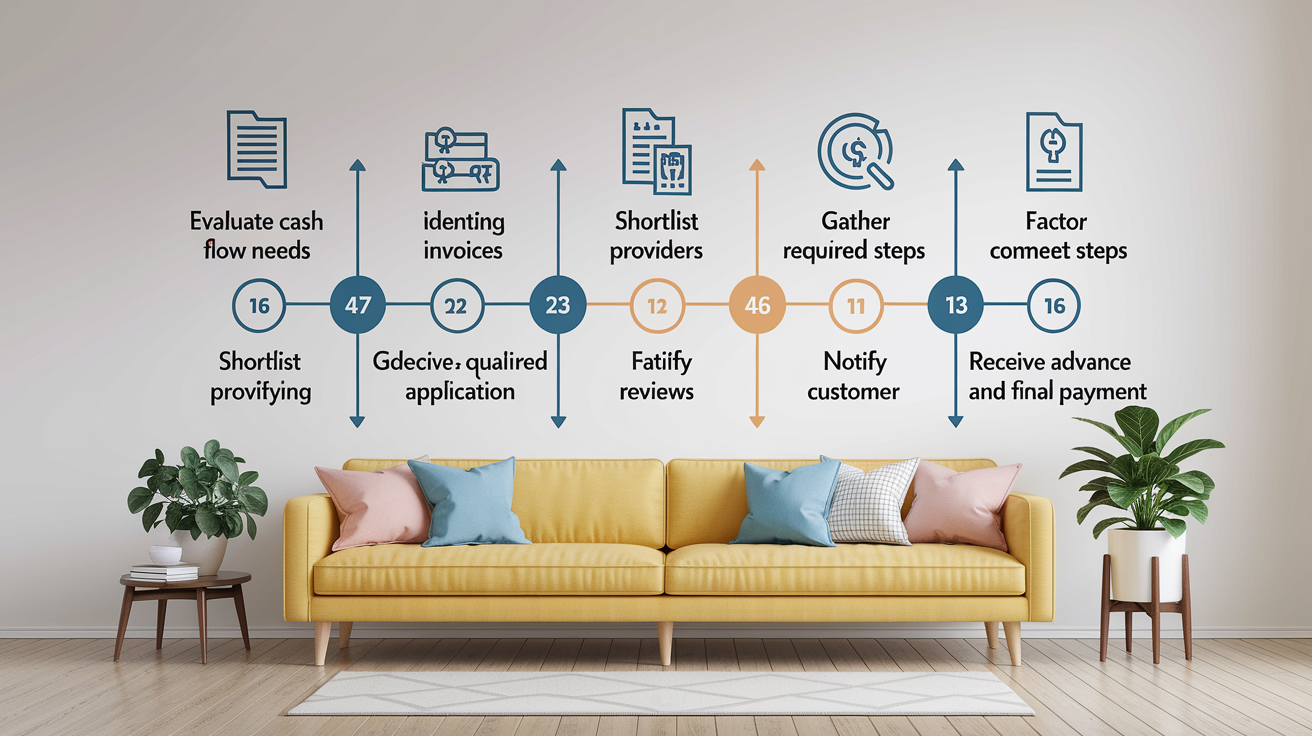
Factoring starts with a clear picture of your cash flow and which invoices will close the gap. Once you know the timeline and dollar need, the workflow is straightforward.
Evaluate cash flow needs. Figure out how much you need and when (payroll Friday, supplier payment Tuesday, equipment deposit next week).
Identify qualifying invoices. Pull invoices for completed work or approved progress payments; confirm customers are creditworthy and invoices are lien free.
Shortlist factoring providers. Compare fees, advance rates, funding speed, and construction experience; read reviews and check contract terms.
Submit initial application. Provide business details, recent bank statements (usually 3 months), and a sample invoice or two.
Gather required documents. Collect signed contracts, delivery tickets, lien waivers, customer contact info, and the full invoice detail.
Factor reviews and underwrites. The company checks your customer’s credit, verifies the work, and confirms there are no disputes or liens.
Notify your customer. Let the general contractor or property owner know the invoice has been assigned and that the factor will handle collection; this reduces confusion and friction.
Receive advance and final payment. The factor wires the advance (typically 70 to 90%) within 24 to 72 hours; once your customer pays, the factor releases the reserve minus fees.
Accounting, Tax & Software Considerations in Contractor Factoring

Factoring may not appear as a loan liability on your balance sheet, depending on how your accountant classifies the transaction. Because you’re selling the receivable rather than borrowing against it, some accounting frameworks treat factoring as an off balance sheet transaction. That can keep debt ratios lower when bidding bonded work or applying for other credit. Check with your CPA to confirm the treatment fits your reporting standards.
Many factoring providers integrate directly with QuickBooks, Sage, or other construction accounting platforms. Invoice data uploads automatically, and the factor’s advances and fee deductions sync back to your AR aging reports. That integration speeds underwriting (no manual re keying of customer names, amounts, or payment terms) and keeps your books accurate without extra reconciliation work.
Four accounting and system considerations to review before you start factoring:
Tax reporting. Factoring fees are business expenses; the advance and reserve are cash flow events, not taxable income; consult your accountant on proper categorization.
AR aging impact. Factored invoices move off your receivables ledger once sold; make sure your accounting software reflects the assignment and doesn’t double count the cash.
Software integrations. Ask the factor which platforms they support (QuickBooks Online, Desktop, OpenInvoice, Procore); direct sync reduces errors and speeds approvals.
Audit trails. Keep copies of all factoring agreements, advance confirmations, and final settlement statements; auditors and bonding companies will want to see how cash flow was managed and what fees were paid.
Final Words
in the action: we walked through how contractor invoice factoring moves cash — invoice assignment, advance payment, and final remittance — plus eligibility, advance rates, fees, construction holdbacks, and the main factoring types.
Pick the fit that matches your cash rhythm, document invoices, and know the true cost and who’s on the hook if a customer delays.
If you need faster working capital for payroll or materials, invoice factoring for contractors can bridge slow pay cycles without adding traditional loan debt. That’s workable and realistic.
FAQ
Q: What is invoice factoring for contractors and how does it work?
A: Invoice factoring for contractors is selling your unpaid invoices to a factoring company for immediate cash, usually 70–90% up front; the factor collects the customer and sends the remainder minus fees when paid.
Q: What advance rates can contractors expect from factoring?
A: Advance rates for contractors typically range from 70% to 90% of the invoice value, sometimes up to 90–100% for low-risk accounts or larger invoices, depending on customer credit and provider.
Q: How do factoring fees and total cost work?
A: Factoring fees are usually 0.5%–3% per 30 days; total cost rises with longer payment times. Providers may quote APRs around 15%–33% depending on invoice age and risk.
Q: What is a reserve account or holdback in factoring?
A: A reserve account (holdback) is the portion the factor keeps from your invoice until the customer pays, used to cover fees and disputes; you get the remaining balance after collection.
Q: What invoices are eligible and what documents do factors require?
A: Eligible invoices must be free of liens or disputes and show completed work or accepted progress billing. Factors typically want contracts, invoices, client contact info, and proof of delivery or completion.
Q: Do factors check my credit or my customer’s credit?
A: Factors check your customer’s credit, not primarily yours. Approval depends on the buyer’s ability to pay and any outstanding disputes on the invoice.
Q: How fast will I get funds after submitting an invoice?
A: Funding after approval commonly arrives within 24–72 hours, accelerating payment by 20–40 days compared with typical construction cycles, depending on the factor’s process and verification speed.
Q: How does retainage or progress billing affect factoring?
A: Retainage and progress billing complicate factoring because funds are partial or held back; some factors specialize in progress-payment invoices, but retainage often reduces advance rates or needs special terms.
Q: What are lien waivers and why do they matter to factors?
A: Lien waivers prove you won’t file a mechanics lien for that invoice; factors require them to reduce legal risk and ensure the invoice is clear for assignment and collection.
Q: What is the difference between recourse and non‑recourse factoring?
A: Recourse factoring means you repay the factor if the customer doesn’t pay, usually lower cost. Non‑recourse shifts nonpayment risk to the factor but costs more and has stricter eligibility.
Q: When should a contractor use spot factoring versus contract factoring?
A: Spot factoring is for one-off invoices needing fast cash but carries higher fees. Contract (whole-turnover) factoring suits ongoing invoice flows and often lowers rates for steady volume.
Q: How does invoice factoring compare with bank loans or lines of credit?
A: Invoice factoring is based on your customer’s credit and gives faster cash with less paperwork. Bank loans need collateral and stronger credit but generally have lower long-term cost.
Q: What are the typical steps to submit construction invoices to a factor?
A: To submit invoices, evaluate cash needs, choose invoices, gather contracts and proofs, upload docs, notify the customer, wait approval, and receive funding—often in 24–72 hours after approval.
Q: How does factoring affect accounting, taxes, and bookkeeping software?
A: Factoring may not be recorded as traditional debt depending on accounting method. Many factors integrate with QuickBooks or AR systems to sync invoices, easing bookkeeping and AR aging management.