


Think you can get a short-term business loan without paperwork? Think again.
Lenders need numbers, not promises.
Bring the right documents and the approval can move fast. Miss one and you stall.
This checklist walks you through the core items, including tax returns, bank statements, profit and loss, balance sheet, credit reports, and legal formation papers, and explains why each matters for speed, cost, and approval odds.
Read it to gather everything before you apply, cut back and forth, and get funds when you need them.
Core Documentation Required for Fast Short-Term Business Loan Approval

Lenders want proof your business can repay. Not your word, not a handshake. Real numbers.
Documentation converts claims into verifiable facts: tax filings, bank activity, current financials, legal paperwork showing you’re running a legitimate operation with revenue and a path to paying back what you borrow. Short-term loans move faster than traditional bank financing, but approval still hinges on hard evidence.
The 5 C’s of credit (Character, Capacity, Capital, Collateral, Conditions) frame every lender’s evaluation. Character is your credit history. Capacity is cash flow and your ability to handle monthly or daily repayments. Capital is the money you’ve put into the business. Collateral is what you can pledge. Conditions cover loan purpose and economic backdrop. Every document feeds into one or more of those C’s. Miss even one core item and your application stalls or dies.
Eight core documents lenders request:
- Business tax returns (last 2 to 3 years)
- Personal tax returns for each owner (last 2 to 3 years)
- Business bank statements (3 to 12 months, depending on lender)
- Profit and loss statement (year to date and prior years)
- Balance sheet (current and prior periods)
- Business and personal credit reports
- Business licenses and articles of incorporation or organization
- Completed loan application with signatures and dates
Financial Documentation Needed for Short-Term Business Loan Approval

Financial statements tell lenders whether you’re making money, burning cash, or barely breaking even. Banks and alternative lenders both want numbers laid out in standard formats (profit and loss, balance sheet, cash flow forecast) so they can compare your revenue, margins, and working capital to the loan size and repayment schedule you’re signing up for.
A profit and loss statement lists revenue, cost of goods sold, operating expenses, and net income over a specific period (monthly or annually). Lenders scan P&Ls for trends. Are sales growing? Margins stable? Is the business profitable or running on fumes? Bring the last 1 to 3 years of annual P&Ls and your most recent year to date statement. The balance sheet shows what you own (cash, receivables, inventory, equipment) and what you owe (payables, credit lines, other loans), with the difference being your equity. Lenders use it to measure liquidity and leverage. The cash flow forecast is your 12 month projection of money in and out, month by month. It proves you’ve thought through how repayment fits alongside payroll, rent, inventory buys, and seasonal dips. Without a realistic cash flow forecast, lenders assume you haven’t mapped the loan against your actual operating rhythm.
Accounts receivable aging reports break down who owes you money and how long invoices have been sitting out there (30, 60, 90 days or more). Lenders care because old receivables may never get collected, which shrinks your real cash position. If you’re financing against receivables or showing AR as a major asset, expect lenders to ask for aging detail.
| Document | Required Timeframe | Why It’s Needed |
|---|---|---|
| Profit & Loss Statement | Last 1–3 years + current year-to-date | Confirms revenue trends, margins, profitability, and operating-expense patterns |
| Balance Sheet | Most recent (within 30 days) + prior year(s) | Shows assets, liabilities, equity, liquidity, and leverage ratios |
| Cash Flow Forecast | 12-month monthly projection | Proves loan repayment fits within projected cash inflows and outflows |
| Cash Flow Statement | Last 1–2 years (if available) | Traces actual sources and uses of cash; validates operating, investing, financing activities |
| Accounts Receivable Aging Report | Current (within 30 days) | Verifies quality and collectability of receivables listed as assets |
Bank Statements and Cash Flow Documentation for Short-Term Loan Approval

Bank statements are the backbone of cash flow verification for short-term lenders, especially online and alternative funders. Traditional banks may ask for 12 to 24 months of statements to study deposit patterns, but most alternative lenders start with the last 3 to 4 months and focus on consistency, average daily balance, overdrafts, and whether your deposits match the revenue you claimed on tax returns and P&Ls.
Merchant processing statements matter if you take credit or debit cards. Some lenders (particularly merchant cash advance providers) will ask for 3 to 24 months of card processing history because they use daily sales volume to size the advance and structure daily repayment via a percentage of each batch. If your business runs on cash or checks, bank deposits become even more critical since there’s no card trail to validate revenue.
Lenders evaluate five key elements inside your bank statements:
- Average monthly deposits and whether they align with reported revenue on tax returns and financials
- Frequency and size of overdrafts or NSF fees, which signal cash flow problems
- Regularity of deposits. Steady weekly or monthly patterns suggest stable operations, erratic spikes raise questions
- Large one-time deposits that don’t match normal business activity, requiring explanation (loan proceeds, asset sales, owner injections)
- Outflow patterns for payroll, rent, vendor payments, and existing loan payments to confirm operating expense accuracy
Tax Returns and Credit Documentation Needed for Short-Term Loan Approval
Tax returns verify the revenue and income you reported to the IRS over multiple years, giving lenders a third party validated view of your business performance. Most lenders require the last 2 to 3 years of signed business tax returns (complete with all schedules, K-1s if you’re a partnership or S-corp, and any supporting forms). Transactions over $100,000 almost always trigger a tax return requirement, even with alternative lenders who otherwise keep documentation light. Personal tax returns for each owner with substantial interest (usually 20% or more) are also standard, since lenders use personal income to gauge the owner’s capacity to support the business if cash gets tight.
Credit reports (both business and personal) show lenders your payment history, existing debt load, and credit utilization. Business credit bureaus like Dun & Bradstreet, Experian Business, and Equifax Business track trade lines, vendor accounts, and business loans. Personal credit reports from the three consumer bureaus reveal your individual responsibility with credit cards, mortgages, auto loans, and other personal obligations. Lenders pull both, and they want recent reports (ideally within the last 30 days) so the data reflects your current situation. A personal credit score of 690 or higher improves your odds. Scores below that threshold can trigger declines or higher pricing. Lenders also calculate your debt to income ratio (total monthly debt payments divided by gross monthly income), and a DTI above 43% commonly raises red flags.
Before you apply, pull your own credit reports and check for errors. Incorrect balances, accounts that aren’t yours, late payments that were actually paid on time. Dispute and correct those issues before a lender sees them. If your credit is borderline, focus on paying down revolving balances and keeping all accounts current for at least 90 days before you submit an application. Clean, recent credit documentation speeds approval and strengthens your negotiating position on rate and terms.
Legal and Business Formation Documentation for Short-Term Loan Approval

Lenders need proof your business legally exists, that you’re authorized to borrow on its behalf, and that ownership and registration are clear. These documents confirm you’re not a shell company, that licenses are current, and that the person signing the loan agreement actually has the authority to bind the business.
Articles of incorporation (for corporations) or articles of organization (for LLCs) establish your legal entity with the state. Lenders request a certified copy or a copy stamped by the Secretary of State to verify formation date, entity type, and registered agent. A certificate of good standing (issued by the state where you’re registered) confirms your business is current on filings, fees, and compliance. Operating agreements (for LLCs) and partnership agreements detail ownership percentages, profit distribution, and management structure. Lenders use these to identify who owns what and who can commit the company to debt. Your Employer Identification Number (EIN) confirmation letter from the IRS ties the business to its federal tax ID and validates that the entity on the loan application matches the entity filing taxes. Business licenses and permits (city, county, state, or industry-specific) prove you’re allowed to operate in your location and sector.
Key legal documents and why they matter:
- Articles of incorporation or organization – Confirms legal formation, entity type, and state registration
- Certificate of good standing – Verifies current compliance and active status with the state
- Operating or partnership agreement – Shows ownership structure, percentages, and decision making authority
- EIN confirmation letter – Links the business to its federal tax ID and IRS records
- Business licenses and permits – Proves regulatory compliance and lawful operation
- DBA (Doing Business As) filings – Documents any trade names or assumed names under which you operate
Collateral and Asset Documentation for Secured Short-Term Loan Approval

Secured short-term loans require collateral. Real estate, equipment, vehicles, inventory, or receivables that the lender can claim and sell if you default. Collateral documentation proves you own the asset, establishes its current value, and confirms there are no prior liens (or discloses existing liens and their priority). Lenders size the loan based on a percentage of the collateral’s appraised or market value, often called the loan to value (LTV) ratio.
Real estate collateral demands a deed showing clear title, a recent appraisal (usually within the last 90 to 180 days), and a title search or lien search confirming no undisclosed mortgages or judgments. Equipment and vehicles require titles, serial numbers, invoices or purchase receipts, and an independent valuation or appraisal if the asset is high value. Inventory collateral involves a detailed list with SKUs, quantities, and current wholesale or liquidation value. Lenders discount inventory heavily because it can spoil, become obsolete, or be hard to sell. Accounts receivable pledged as collateral must be supported by aging reports, invoices, and customer credit quality. Lenders usually advance only a percentage of receivables under 90 days old. UCC-1 filings (public notices of a secured interest) will be recorded by the lender to establish their claim on the collateral, and they’ll search existing UCC filings to see if another creditor already has a lien.
Collateral categories and documentation lenders request:
- Commercial real estate – Deed, title insurance, recent appraisal (within 90 to 180 days), survey, environmental review for certain property types
- Equipment and machinery – Titles, serial numbers, invoices, purchase agreements, third party valuation or depreciation schedule
- Business vehicles – Vehicle titles, current registration, VIN, insurance proof, and market value estimate (Kelley Blue Book or NADA for commercial vehicles)
- Inventory – Detailed list with quantities, wholesale cost, turnover rates, and liquidation value estimate
- Accounts receivable – Aging report (current), invoices for largest receivables, customer credit history if available, and proof of no prior factoring or assignment
Supporting Operational Documents That Strengthen a Short-Term Loan Application

Beyond core financials and legal filings, lenders look for operational proof that your business runs consistently and has real contracts, customers, and infrastructure. These supporting documents aren’t always required up front, but including them early can speed approval, reduce follow-up requests, and improve your credibility (especially if you’re a newer business or applying for a larger amount).
Customer contracts, signed purchase orders, and invoices validate that revenue is real and ongoing. If you’re borrowing to fulfill a specific contract or to scale up for a new customer, attach the signed agreement and show the revenue timeline. Vendor contracts and supplier agreements prove you have reliable sources for inventory or materials, and they help lenders understand your cost structure and payment terms. Accounts payable aging reports (similar to AR aging but for what you owe) show whether you’re paying vendors on time or stretching payables, which can signal cash flow stress or smart working capital management depending on context.
Payroll reports and payroll tax filings (Form 941 quarterly returns, state withholding reports) confirm headcount, wage levels, and tax compliance. Lenders want to know you’re current on payroll taxes because unpaid employment taxes create priority liens that jump ahead of lender claims. Your commercial lease agreement for your office, retail space, warehouse, or production facility shows fixed occupancy costs and lease term, helping lenders project your monthly burn rate. Insurance certificates (general liability, property, workers’ compensation) prove you’re protected against common risks and often satisfy lender requirements if collateral or certain loan covenants are involved.
Operational documents that improve approval odds:
- Signed customer contracts or recurring revenue agreements
- Purchase orders for upcoming deliveries or projects
- Vendor contracts and trade credit terms
- Accounts payable aging report (current)
- Payroll registers and quarterly payroll tax returns (Form 941)
- Commercial lease or property use agreement
- Insurance certificates (general liability, property, workers’ comp)
Differences in Documentation Requirements by Lender Type for Short-Term Loan Approval
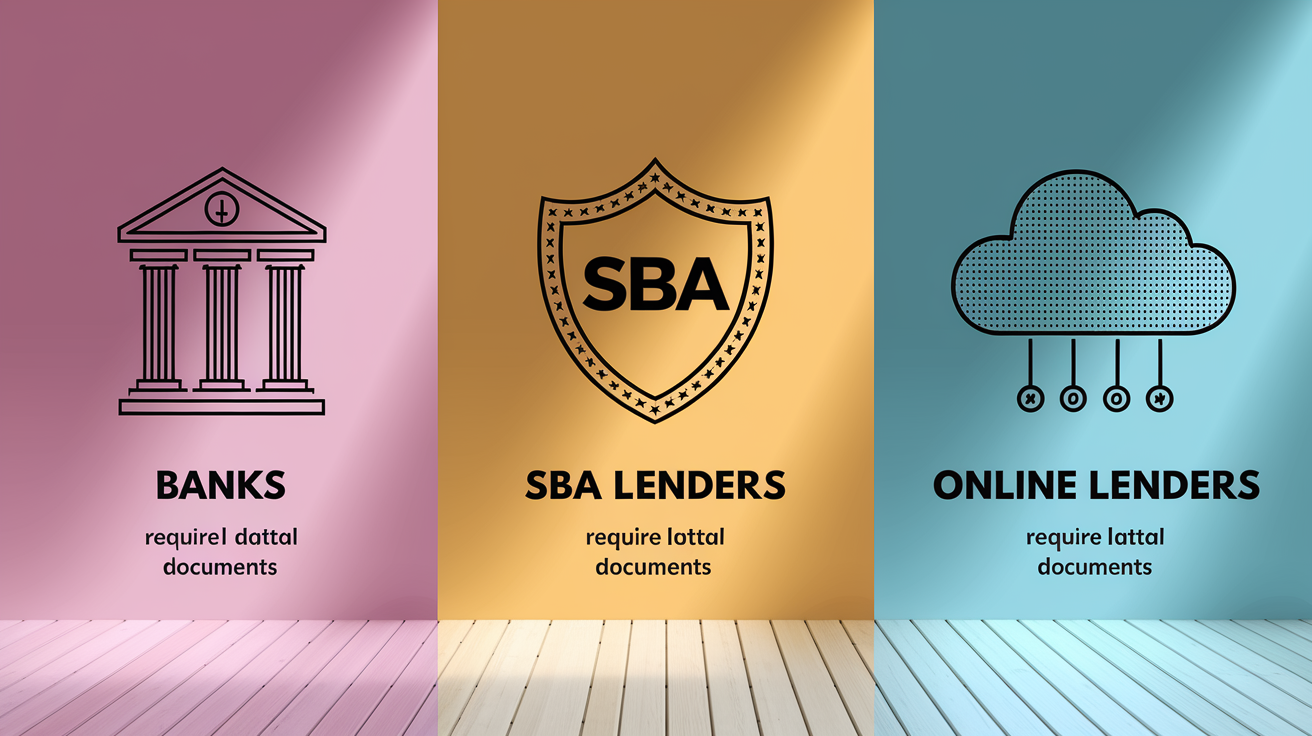
The lender type you choose directly shapes the size of your documentation pile. Traditional banks want the most paperwork, online lenders ask for the least, and SBA-backed programs sit somewhere in between with their own specialized forms and underwriting overlays.
Banks and Credit Unions
Community banks and regional commercial banks require full documentation packages: 2 to 3 years of signed business and personal tax returns with all schedules, year to date and historical financial statements (P&L, balance sheet, cash flow statement), a detailed schedule of existing debt showing every loan, credit line, and lease obligation, personal financial statements for each principal owner, 6 to 12 months of business bank statements, collateral appraisals and title evidence, proof of insurance, and often a formal written business plan with projections. Approval timelines run weeks, not days, because underwriters review every line item and compare ratios to internal benchmarks. In exchange, banks offer the lowest interest rates, longer terms, and more flexible repayment structures. They also value relationship banking. If you’ve held accounts or prior loans with them, you may get more lenient underwriting and faster decisions.
SBA Lenders
SBA 7(a) and other government-guaranteed loan programs layer additional documentation on top of bank requirements. Expect to provide personal history statements and resumes for all owners and key managers, environmental questionnaires if real estate is involved, detailed use of proceeds schedules, affiliates disclosures (listing other businesses you own or control), and SBA-specific forms like the borrower information form and personal financial statement template. Collateral requirements are strict. Most SBA loans require all available business assets to be pledged, and personal real estate may be added if business collateral doesn’t cover the loan amount. Processing takes longer because the SBA reviews and guarantees a portion of the loan, but the tradeoff is lower down payments, longer amortization (up to 10 years for working capital, 25 years for real estate), and competitive rates.
Online and Alternative Lenders
Alternative lenders (term loan platforms, revenue-based funders, and merchant cash advance providers) streamline documentation to speed funding. Many start with just a completed online application and 3 to 4 months of business bank statements. Some request recent financials (a current P&L and balance sheet) and business tax returns only for deals above $100,000 or $150,000. Personal and business credit reports are pulled electronically. Collateral is often optional for smaller advances, though larger facilities may require a blanket lien on business assets or a personal guarantee. Decisions happen in hours or days, and funding can arrive within 24 hours to one business week for approved applicants. The tradeoff is higher cost. Factor rates instead of traditional APR, shorter repayment windows (3 to 18 months), and daily or weekly ACH debits. If speed and lighter documentation matter more than cost, alternative lenders fit. If you want the lowest rate and longest term, traditional banks are the better path (assuming you can wait and provide the full documentation stack).
How Lenders Evaluate Financial Metrics from Submitted Documentation

Lenders don’t just collect documents and check boxes. They extract specific financial ratios and cash flow metrics to measure repayment capacity and risk. The most common calculations are debt service coverage ratio (DSCR), debt to income ratio (DTI), profitability trends, and monthly cash flow coverage. These numbers decide whether you get approved, what rate you’re quoted, and how much you can borrow.
DSCR compares your net operating income (revenue minus operating expenses, before debt payments) to your total debt service (all loan and lease payments due in the same period). A DSCR of 1.25 means you generate $1.25 of cash for every $1.00 of debt payment. Enough cushion to handle a revenue dip without missing payments. Most banks want DSCR above 1.20 or 1.25. Alternative lenders may accept 1.10 or lower if other factors are strong. DTI divides your total monthly debt obligations (business and personal) by your gross monthly income. A DTI above 43% signals high leverage and limited room to absorb new debt. Lenders also review your break-even point (the revenue level where you cover all fixed and variable costs) and your cash flow sensitivity, which shows how a 10% or 20% revenue drop would affect your ability to make payments.
Your schedule of debt (listing every existing loan, credit line, lease, and vendor financing commitment with creditor name, monthly payment, interest rate, balance, and maturity) feeds directly into DSCR and DTI calculations. Lenders overlay that schedule against your P&L and cash flow forecast to see if adding another monthly payment is realistic or reckless.
| Metric | What It Measures | Ideal Range |
|---|---|---|
| Debt Service Coverage Ratio (DSCR) | Net operating income ÷ total debt payments | 1.20–1.50 or higher |
| Debt-to-Income Ratio (DTI) | Total monthly debt ÷ gross monthly income | Below 43% |
| Net Profit Margin | Net income ÷ total revenue | 10% or higher preferred; varies by industry |
| Monthly Cash Flow Coverage | Available cash after expenses ÷ new monthly loan payment | 1.5× or higher (cash covers payment with margin) |
Preparing, Organizing, and Submitting Documentation for Fast Short-Term Loan Approval

Disorganized or incomplete documentation is the single biggest reason loan applications stall or get rejected outright. Lenders won’t chase missing schedules, hunt for signatures, or reconcile unexplained deposits. They’ll just move to the next applicant whose paperwork is clean and ready. Spending a few hours up front to organize, label, and verify every document pays off in faster decisions, fewer follow-up requests, and higher approval odds.
Start by creating a digital folder structure: Financials, Tax Returns, Bank Statements, Legal/Ownership, Collateral, Contracts, Projections. Scan all documents as searchable PDFs (use OCR if your scanner supports it) and name each file clearly. “2023-2025BusinessTaxReturns.pdf,” “2026-01-31BalanceSheet.pdf,” “OwnerSmithPersonalFinancialStatementSigned_2026-03-15.pdf.” Include dates and entity names in the filenames so lenders can identify and sort quickly. Pull your personal and business credit reports within 30 days of applying, review them for errors, and dispute anything incorrect before the lender pulls their own copy. Reconcile your bank statements to your accounting records and prepare one sentence explanations for any large or unusual deposits. Like “March 10 deposit of $50,000 was proceeds from equipment sale, invoice attached” or “February 15 deposit of $25,000 was owner equity injection, personal bank transfer confirmation attached.”
Prepare a one page cover sheet listing every document you’re submitting, organized by category, with page counts and date ranges. This index acts as a table of contents and proves you didn’t skip anything. Make sure every required form is signed and dated. Unsigned loan applications, personal financial statements, or authorization forms are the fastest way to delay your approval by days or weeks. If the lender provides templates for personal financial statements or use of proceeds forms, use their exact format instead of your own version. Keep original signed copies of personal financial statements, partnership agreements, and loan applications in a safe place. Some lenders require notarized originals or will ask for hard copies after initial digital submission.
Ten practical steps to organize and submit documentation without delays:
- Create labeled digital folders (Financials, Tax, Bank, Legal, Collateral, Contracts, Projections) and use consistent file naming with dates and entity names
- Scan all documents as searchable PDFs (OCR-enabled) for easy review and keyword search by underwriters
- Pull and review your personal and business credit reports within 30 days, dispute errors, and include clean copies in your submission
- Reconcile bank statements to accounting records and prepare written explanations for any large, one-time, or unusual deposits
- Complete a one page document index listing every file, page count, and date range so lenders can verify completeness at a glance
- Ensure all applications, personal financial statements, and authorization forms are signed and dated. Unsigned forms stop underwriting immediately
- Use lender provided templates for personal financial statements, use of proceeds schedules, and debt schedules instead of creating your own formats
- Double-check that tax returns include all schedules, K-1s, and supporting forms (incomplete returns trigger automatic follow-up requests)
- Provide collateral appraisals dated within the last 90 to 180 days. Older appraisals may require updates or new valuations
- Submit via secure lender portal or encrypted file transfer. If emailing, password protect sensitive files and send the password separately
Final Words
Get your files in order: core docs, financial statements, bank records, tax and credit paperwork, legal formation papers, collateral evidence, and supporting contracts. That’s the checklist lenders use when they size up capacity and risk.
Match the paperwork to the lender — banks usually want more detail, alternative lenders accept less — and let the 5 C’s (character, capacity, capital, collateral, conditions) guide what you pull together.
Pulling the right items up front speeds approval and cuts surprises. Start by assembling the documentation needed for short term business loan approval.
FAQ
Q: What documentation is needed for a small business loan?
A: Documentation needed for a small business loan includes business and personal tax returns, bank statements, profit & loss and balance sheet, cash-flow forecast, business license/EIN, credit reports, and ownership/formation documents.
Q: What disqualifies you from a small business loan?
A: Factors that can disqualify you from a small business loan include low revenue, recent bankruptcies, unresolved tax liens, poor credit history, insufficient collateral, inaccurate documents, or time in business under lender minimums.
Q: How hard is it to get a $1,000,000 business loan?
A: Getting a $1,000,000 business loan is harder: lenders require strong, stable revenue, multiple years of financials, solid collateral, high credit, and a detailed cash-flow forecast; approval depends on industry and lender.
Q: What credit score do you need to get a $30,000 loan?
A: A credit score needed to get a $30,000 loan typically ranges 650–700+; scores above about 690 improve odds, but lenders also consider revenue, time in business, and available collateral.