


Missing one form can cost you weeks in SBA review.
Most owners don’t know every document lenders want for an SBA 7a loan, and lenders will stop on an incomplete file.
This post gives a complete checklist of the documents needed for an SBA 7a loan application, explains why each item matters, and shows how to organize them so your lender can move fast.
Read on to gather the right tax returns, financials, IDs, legal papers, and collateral docs before you hit submit.
Complete SBA 7(a) Loan Document Checklist

Every SBA 7(a) application needs a complete document set that proves you’re legally operating, financially healthy, and capable of paying the loan back. Lenders won’t touch an incomplete file. Missing even one form can push your timeline back weeks. Gather everything before you start.
- SBA Form 1919 (Borrower Information Form) – Required disclosure for all SBA 7(a) loans covering loan amount, existing debts, and any prior government financing.
- SBA Form 912 (Statement of Personal History) – Background certification for each owner with 20% or more equity.
- SBA Form 413 (Personal Financial Statement) – Complete balance sheet of personal assets, liabilities, and net worth for each principal.
- Business tax returns – Full, unredacted returns for the last three years (Form 1065, Form 1120, Form 1120-S, or Schedule C).
- Personal tax returns – Three years of returns for every owner holding 20% or greater ownership.
- Year-to-date profit and loss statement – Dated within 90 days of application, showing revenue and expenses from the start of the current fiscal year.
- Current balance sheet – Snapshot of assets, liabilities, and equity dated within 90 days of submission.
- Business bank statements – Last three months of operating account activity.
- Business debt schedule – Table listing each creditor, original amount, current balance, interest rate, monthly payment, and maturity date.
- Two-year financial projections – Monthly income and expense forecasts for the first 12 months, then annual for year two.
- Business plan – Executive summary, use of proceeds, market overview, management structure, and operations narrative tied to your projections.
- Resumes of principals – Background and relevant experience for each owner or key manager.
- Articles of Organization or Incorporation – Official formation documents filed with your Secretary of State.
- Operating Agreement, Bylaws, or Partnership Agreement – Governance and ownership structure records.
- Business licenses and permits – Current copies of all local, state, and federal operating licenses.
- Commercial lease or property deed – Proof of business location and occupancy rights.
- EIN Confirmation Letter (CP 575) – IRS-issued federal tax ID verification.
- Driver’s license or state ID (front and back) – Valid photo identification for each owner with 20% or more equity.
- Permanent Resident Card and USCIS documents – Required for non-citizen owners. Include Form I-9 when applicable.
- Collateral documentation – Titles, UCC filings, appraisals, or purchase agreements if you’re pledging assets.
- Environmental assessments – Site or operational reports if required by lender based on collateral or industry.
- Acquisition package (if buying a business) – Letter of intent, signed purchase agreement, seller’s three-year financials, AR/AP aging, and certified business valuation.
Categories of SBA 7(a) Loan Documents
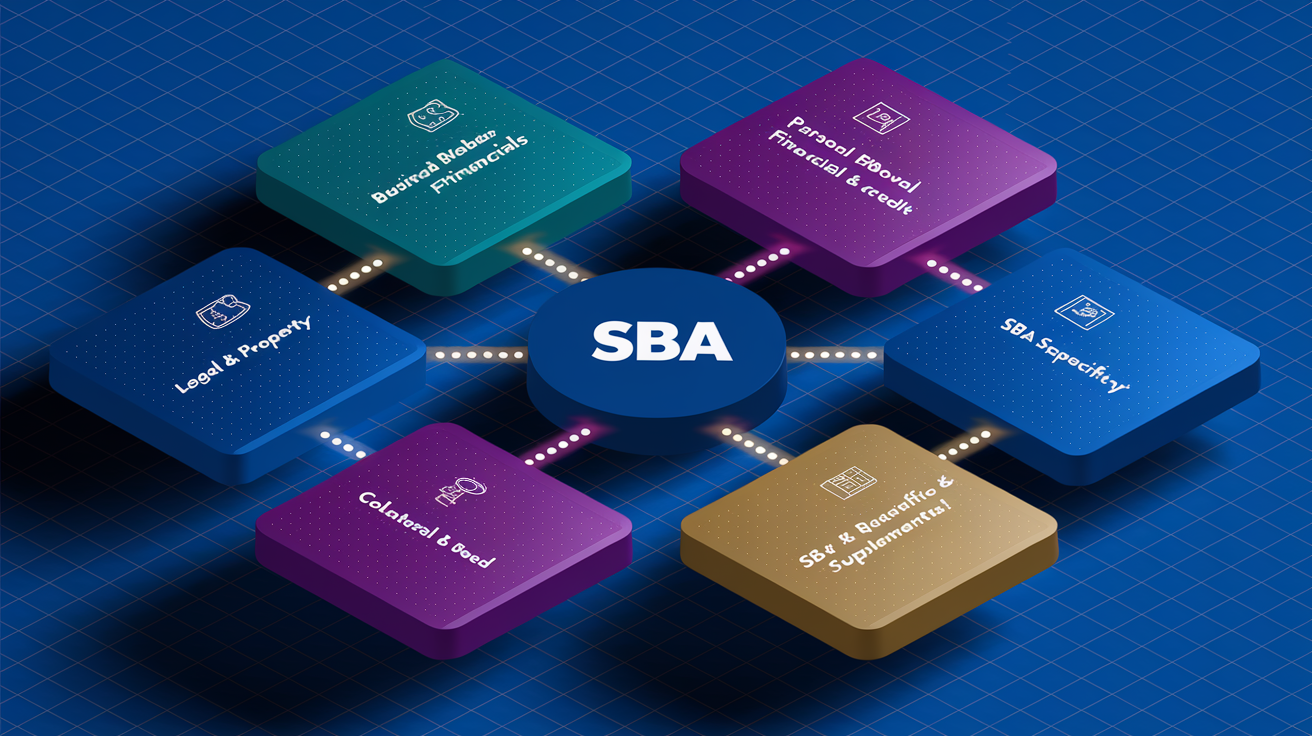
SBA 7(a) paperwork breaks into five major groups. Each one serves a different underwriting purpose. Organizing your submission by category helps lenders move faster and cuts down on duplicate requests.
The first group covers business financials. These prove revenue, cash flow, and historical performance. The second group holds personal financials and credit materials that assess guarantor strength and owner character. Third category? Legal and organizational records that confirm the business exists, is properly formed, and authorized to operate. Fourth group documents collateral, property, and leases that secure the loan or validate the business location. Fifth category holds SBA-specific forms and any specialized materials tied to acquisitions, environmental compliance, or franchise agreements.
- Business financials – Tax returns, profit and loss statements, balance sheets, projections, bank statements, and debt schedules that show how the business earns and spends money.
- Personal financials and credit – Personal tax returns, Form 413, driver’s licenses, credit reports, and immigration documents for each 20% plus owner.
- Legal and organizational – Articles of incorporation, operating agreements, DBA filings, EIN confirmation, and business licenses.
- Collateral and property – Lease agreements, property deeds, titles, UCC filings, appraisals, and insurance certificates.
- SBA-specific and supplemental – Forms 1919 and 912, business plans, resumes, environmental reports, and acquisition documents when buying an existing business.
Purpose of Key SBA 7(a) Loan Documents

Lenders and the SBA don’t ask for paperwork to slow you down. Every document serves a specific underwriting function. Understanding the “why” helps you prepare better files.
Business tax returns verify actual revenue over multiple years and confirm the IRS has your reported income on record. They show seasonal patterns, growth trends, whether the business generates consistent taxable profit. Personal tax returns do the same for guarantors, revealing salary, investment income, tax compliance that affect personal repayment capacity.
Profit and loss statements and balance sheets provide the current financial picture. A three-year-old tax return doesn’t tell a lender what happened in the last 90 days, so interim financials dated within 90 days prove recent performance. The debt schedule maps every existing monthly obligation, which feeds into the Debt Service Coverage Ratio calculation. Lenders use DSCR to confirm your net operating income can cover total monthly debt service plus the new SBA payment. A business plan and two-year projections explain how the loan proceeds will generate enough additional cash flow to service the debt without squeezing payroll or vendor payments.
- Tax returns – Prove historical revenue, compliance, and multi-year trends for both business and guarantors.
- Interim P&L and balance sheet – Verify current cash position, recent income, and any material changes since the last tax return.
- Debt schedule – Calculate total monthly debt service and support DSCR underwriting.
- SBA Form 1919 – Standardize borrower disclosure on loan amount, existing debts, and prior SBA financing.
- SBA Form 413 – Document personal net worth, liquid assets, and liabilities for guaranty evaluation.
- Business plan and projections – Demonstrate use of proceeds, market viability, and repayment ability under realistic revenue assumptions.
Preparing and Organizing SBA 7(a) Documents

A well-organized document package moves faster through underwriting. It also signals that you take the process seriously.
Start by creating a master digital folder with subfolders matching the five document categories. Name every file clearly with the document type and date range, like “BusinessTaxReturns2022-2024.pdf” or “YTDProfitLossJanMar2025.pdf.” Scan all paper records into high-resolution, searchable PDFs so lenders can keyword-search your returns and statements. Sign and date required forms before scanning. A missing signature on Form 1919 or Form 413 will stop review immediately.
Pull your business and personal tax returns for the last three years. If you filed an extension for 2024 after April 18, include the extension notice and proof of estimated tax payments. Update your profit and loss statement and balance sheet so the reporting date falls within 90 days of your planned submission date. Reconcile your P&L against the last three months of bank statements to make sure reported revenue matches actual deposits. Use the lender’s or application portal’s templates for the debt schedule, balance sheet, and personal financial statement to avoid formatting rework. Keep physical certified copies of formation documents, licenses, and lease agreements in a binder as a backup. Include your accountant’s and attorney’s contact information in a cover memo so the lender can reach them if questions arise.
- Pull three years of business and personal tax returns or the number of years your business has operated if younger than three years.
- Produce a current profit and loss statement and balance sheet dated within 90 days of submission.
- Download the last three months of business bank statements and reconcile them to your P&L.
- Complete the business debt schedule using the lender’s template, listing creditor, original amount, balance, rate, monthly payment, and maturity.
- Scan driver’s licenses and any permanent resident cards front and back at high resolution.
- Gather formation documents from your Secretary of State filing records and your EIN confirmation letter. If you’ve lost the CP 575, request a copy from the IRS at 1-800-829-4933.
- Use portal-provided templates for Form 413, balance sheets, and projections to match lender formatting.
- Organize files into clearly labeled folders and save everything as searchable PDFs with consistent naming conventions.
Common Issues and How to Avoid Application Delays
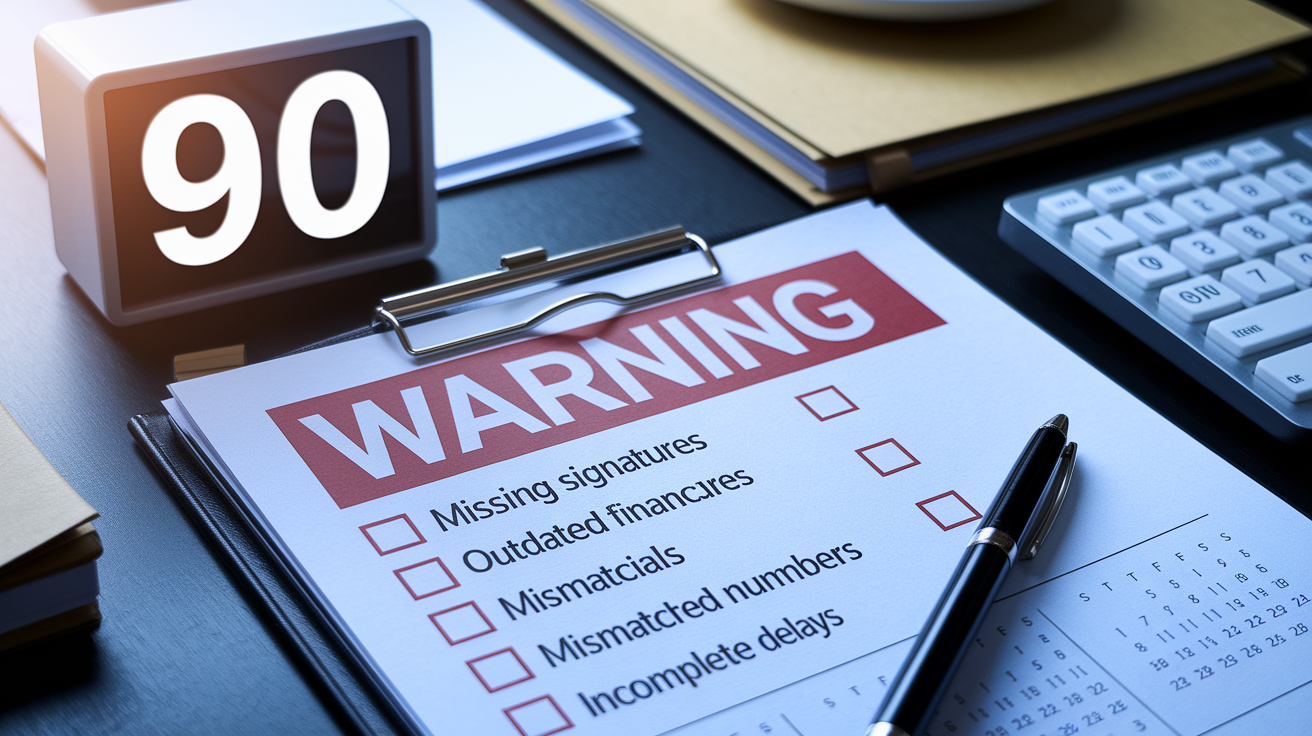
Most SBA 7(a) delays come from incomplete packets, outdated financials, or mismatched numbers across documents. Lenders won’t guess what you meant. The SBA won’t approve a file with inconsistencies.
Missing signatures on Form 1919, Form 413, or tax-return acknowledgment pages will pause your application immediately. Outdated profit and loss statements or balance sheets dated more than 90 days before submission trigger automatic requests for updated versions. Inconsistent revenue figures between your tax return, P&L, and bank deposits raise red flags and extend underwriting while the lender reconciles discrepancies. Incomplete business plans that skip use of proceeds or lack realistic monthly projections force lenders to ask for rewrites. Failing to include all three years of business tax returns, or submitting personal returns for only some owners, creates gaps that require follow-up rounds.
- Missing signatures – Sign and date every required form and tax acknowledgment page before scanning. Double-check signature lines on Forms 1919, 413, and any affidavits.
- Outdated financials – Confirm your P&L and balance sheet are dated within 90 days of submission. If you’re close to the 90-day mark, update them before applying.
- Mismatched revenue numbers – Reconcile reported revenue on your tax return, P&L, and bank statements. If deposits don’t match sales, include a brief memo explaining timing differences or non-operating deposits.
- Incomplete tax-return packages – Submit all schedules and attachments, not just the front page of Form 1120 or 1065. Lenders need depreciation schedules, K-1s, and balance-sheet pages.
- Weak or missing business plan – Include a one-page executive summary, clear use-of-proceeds statement, and monthly projections for the first 12 months. Tie your revenue assumptions directly to how the loan will generate sales or reduce costs.
Final Words
You’ve now got the complete SBA 7(a) document checklist up front, the exact items lenders expect and how to assemble them.
We broke those papers into clear categories, explained why each matters, and gave practical prep tips plus fixes for common delays.
Use this as your day-of-application roadmap. Gather forms, sign where needed, update financials, and cross-check the documents needed for sba 7a loan application. Do it right and you’ll speed review and improve your chances.
FAQ
Q: What documents are required for an SBA 7a loan?
A: The documents required for an SBA 7(a) loan are SBA Form 1919, a personal financial statement, three years of business and personal tax returns, profit-and-loss and balance sheet, recent bank statements, business licenses, ownership papers, and collateral documentation.
Q: What are the common reasons 7(a) loans are denied?
A: The common reasons 7(a) loans are denied are weak cash coming in and going out, low personal or business credit, incomplete or inconsistent paperwork, insufficient collateral, too little time in business, or ineligible business type.
Q: What are the 5 documents required for a loan?
A: The five documents lenders often require are a personal financial statement, three years of business tax returns, a current profit-and-loss statement, a balance sheet, and recent business bank statements.
Q: What is the 20% rule for SBA?
A: The 20% rule for SBA refers to the common expectation of a roughly 10–20% owner equity injection or down payment on many SBA-backed deals; exact requirements depend on lender, loan program, and borrower risk.