


Which gets you cash fast without strangling cash flow: invoice financing or a short-term working capital loan?
Both can fund fast, but they work very differently.
Invoice financing advances money against unpaid invoices, so your customer’s credit matters and payments clear the advance.
A short-term working capital loan gives a lump sum you repay on a fixed schedule, so your revenue and credit matter more.
Which works better depends on the fit: invoice financing often suits B2B sellers with dependable customers; short-term loans suit owners who need one lump sum and can make regular payments.
Quick Comparison of Invoice Financing and Short-Term Working Capital Loans

Invoice financing and short-term working capital loans both get you cash fast when bills can’t wait. The difference is what backs the money. Invoice financing advances you cash against what customers already owe, usually 70 to 90 percent of the invoice value within one to three days. The financing company collects from your customer, then releases what’s left minus a fee. Short-term working capital loans give you a lump sum based on whether your business can actually pay it back, with fixed payments spread over three to eighteen months. One ties to receivables and customer credit. The other ties to your revenue, how long you’ve been operating, and creditworthiness.
Here’s the breakdown:
Speed: Invoice financing can fund in 24 to 72 hours once invoices are verified. Short-term loans from online lenders take one to seven days. Traditional banks? Two to six weeks, sometimes longer.
Approval basis: Invoice financing hinges on your customers’ credit and payment history. Short-term loans depend on your business revenue, credit score, and time in business.
Cost structure: Invoice financing charges a discount or fee per invoice period, often 0.5 to 5 percent per cycle. Short-term loans carry APRs from roughly 7 to 50 percent, sometimes higher for merchant cash advances.
Repayment: Invoice financing has no fixed repayment schedule. Money comes back when customers pay. Short-term loans require regular installments, usually weekly or monthly.
Collateral: Invoice financing uses receivables as collateral and may involve the lender collecting directly from customers. Short-term loans can be unsecured or secured by business assets and often require a personal guarantee.
Balance sheet treatment: Invoice financing is typically recorded as an advance, not new debt. Short-term loans create a debt liability with scheduled principal and interest payments.
Invoice financing works best for B2B companies with steady invoicing, creditworthy customers, and payment terms of 30 to 120 days. It scales with sales and gets cash moving without a fixed repayment calendar. Short-term working capital loans suit businesses needing a lump sum for a specific expense like inventory restocking, payroll coverage, or equipment repair. You keep customer collections in house. If your credit is solid and you can handle regular payments, the predictability of a loan may cost less over time than rolling invoice fees.
Understanding Invoice Financing

Invoice financing turns unpaid invoices into immediate working capital by advancing a percentage of what customers owe before they actually pay. The financing provider reviews your outstanding invoices, verifies the customers and amounts, then advances typically 70 to 90 percent of the invoice face value within a day or two. When your customer settles the invoice, the provider releases the remaining balance to you, minus the agreed fee. The entire cycle ties to your receivables, not a fixed loan term.
Here’s how it works. You issue an invoice with net 30, net 60, or net 90 terms. Instead of waiting, you submit the invoice to the financing company. They advance 80 percent that day. Thirty days later, your customer pays the full invoice amount to the financing company. The provider then sends you the remaining 20 percent, minus a fee that might be 2 percent of the invoice value. Your net realized cash is the original advance plus the reserve, less the fee. For a $100,000 invoice, you’d receive $80,000 up front, then roughly $18,000 when the customer pays, assuming a $2,000 fee for that 30 day cycle.
Approval speed is one of the biggest draws. Because the focus is on your customers’ creditworthiness rather than your own balance sheet, providers can underwrite and fund quickly. If your customer is a creditworthy corporation or government entity, invoice financing can deliver cash in 24 to 72 hours. There’s no amortization schedule and no monthly loan payment. The trade off is the fee per invoice cycle and, in many cases, the provider takes over collection, which means your customer knows a third party is involved.
Understanding Short-Term Working Capital Loans

A short-term working capital loan provides a lump sum or revolving credit line that you repay over a compressed timeline, usually three to eighteen months. The loan exists to cover immediate operational needs. Payroll during a slow month, inventory purchases ahead of a busy season, or bridge financing until receivables come in. Unlike invoice financing, the loan isn’t tied to specific invoices. It’s a general cash injection based on your business’s ability to service debt.
The structure is straightforward. You apply, the lender reviews your revenue history, business credit, personal credit, and time in operation, then approves a loan amount. You receive the full sum in one disbursement. Repayment happens on a fixed schedule: daily, weekly, or monthly installments that include principal and interest. Some online lenders use factor rates instead of traditional APRs, which means your total repayment is calculated as a flat multiple of the borrowed amount. For example, borrowing $50,000 with a 1.2 factor rate means you repay $60,000 total, regardless of how fast you pay it back.
Short-term loans can range from a few thousand dollars to several hundred thousand, depending on lender type and your qualifications. Online alternative lenders often fund in one to seven business days with looser credit requirements but higher rates. Traditional banks take longer and demand stronger financials but may offer lower APRs. Merchant cash advances, a related product, advance cash based on future credit card sales and deduct repayment as a fixed percentage of daily card receipts. All these products share one feature: scheduled outflows that reduce your available cash each period until the loan is paid off.
Eligibility and Qualification Comparison
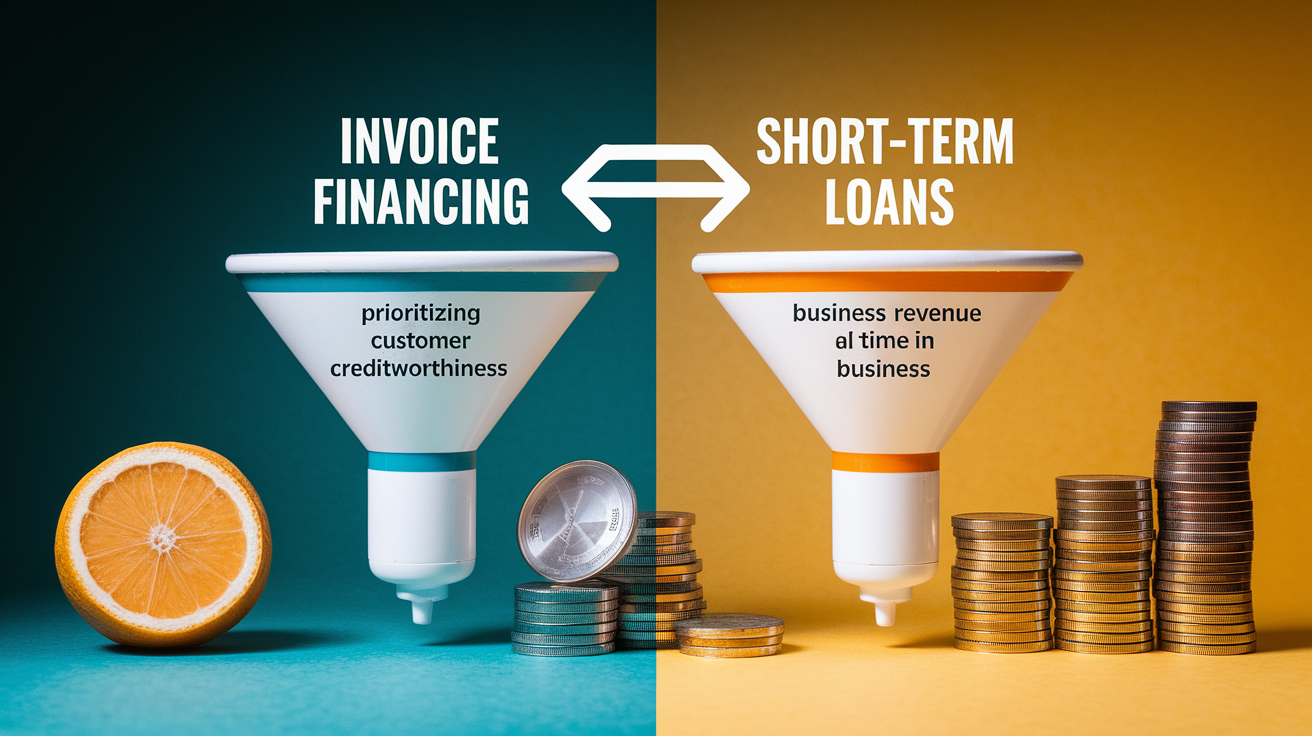
Invoice financing and short-term working capital loans evaluate risk in fundamentally different ways, which shapes who qualifies and how fast approval happens. Invoice financing providers care most about the creditworthiness of your customers. If you invoice large, established corporations or government agencies with clean payment records, you’re likely to qualify even if your own business credit is weak or your company is relatively new. The logic is simple: the provider is betting on your customer’s ability and willingness to pay the invoice, not your ability to generate profit or manage debt.
Short-term working capital loans flip that focus. Lenders underwrite your business’s revenue, credit profile, and operational history. Online lenders commonly require at least $50,000 to $250,000 in annual revenue, six to twenty four months in business, and a minimum credit score in the 550 to 650 range, though requirements vary. Traditional banks set stricter thresholds, often two years in business, stronger credit, and detailed financial statements. The lender is evaluating whether your cash flow can handle regular loan payments, so weak revenue or poor credit can disqualify you or push you toward higher rate alternative products like merchant cash advances.
Here’s a side by side breakdown of typical qualification criteria:
| Criteria | Invoice Financing | Short-Term Working Capital Loans |
|---|---|---|
| Primary underwriting focus | Customer creditworthiness and invoice quality | Business revenue, credit score, time in business |
| Minimum revenue | Often $10,000 to $50,000 in monthly receivables | Typically $50,000 to $250,000 annual revenue (online lenders) |
| Time in business | Less critical; some providers accept startups | Commonly 6 to 24 months minimum |
| Credit score importance | Lower weight; personal guarantee may be required | High importance; minimums often 550 to 650+ |
| Collateral | Invoices themselves; may involve UCC filing | Can be unsecured or require business/personal assets |
Cost Structures and Fees
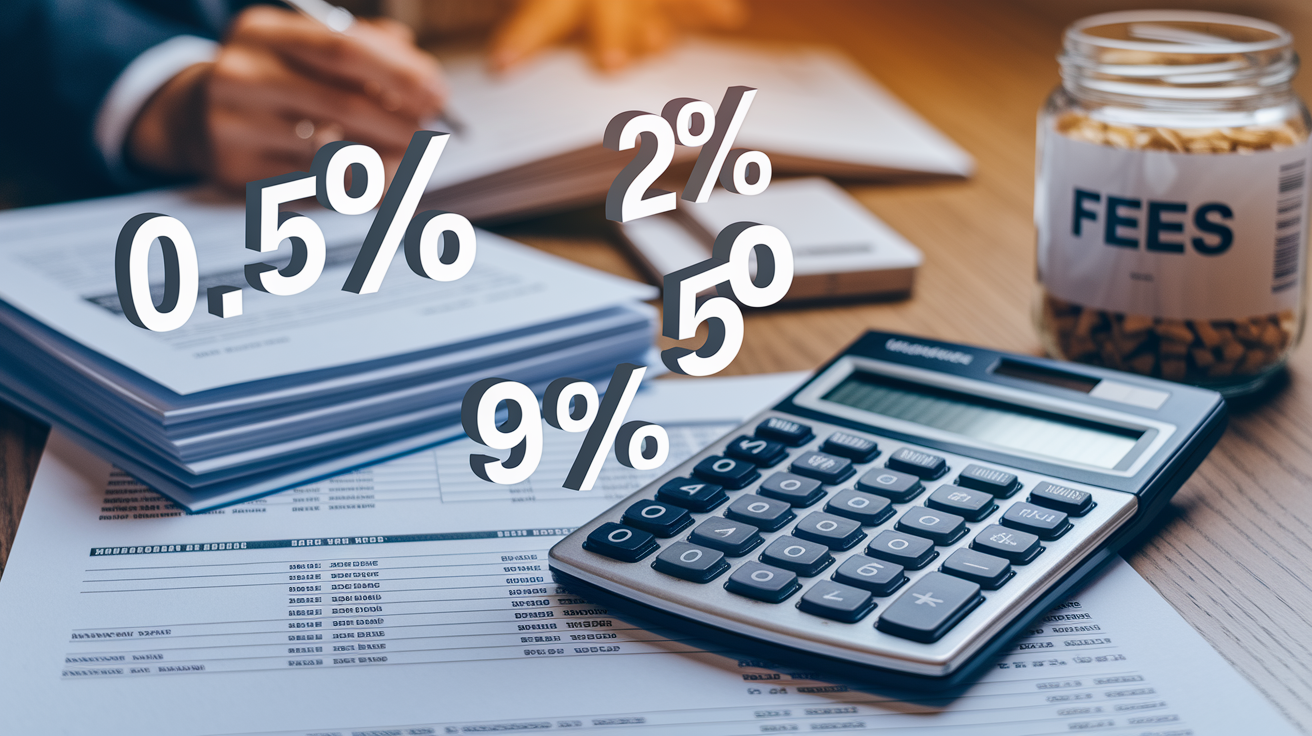
Invoice financing fees are usually expressed as a percentage of the invoice value per billing cycle or per period of time the advance is outstanding. A common range is 0.5 to 5 percent per invoice per 30 day period. If your customer pays in 30 days and the fee is 2 percent, you’ll pay $2,000 on a $100,000 invoice. If that same customer takes 60 days, some providers charge another 2 percent for the second 30 day period, doubling your cost to $4,000. The advance rate, how much you receive up front, also matters. An 80 percent advance means you’re waiting for the remaining 20 percent plus whatever the fee eats into that reserve.
Short-term working capital loans use traditional interest rates, factor rates, or a combination. APRs typically range from 7 to 50 percent for term loans from online lenders. Merchant cash advances and some alternative products carry effective APRs that can exceed 40 to 200 percent when you account for daily repayment and factor rate structures. Origination fees add another 1 to 5 percent of the loan amount at closing. For example, a $100,000 loan at 12 percent APR repaid over 12 months generates roughly $6,600 in interest, bringing your total repayment to around $106,600. A one time origination fee of 3 percent would add another $3,000, pushing the all in cost higher.
The main cost drivers to watch are these:
Advance rate and reserve holdback: In invoice financing, the lower your advance rate, the more working capital is tied up until the customer pays. That reserve also absorbs the fee, reducing your net realized cash.
Frequency and duration of financing: Invoice financing fees compound if invoices age. Factoring a 90 day invoice at 2 percent per 30 days costs 6 percent total, assuming three full cycles. Short-term loans with daily or weekly repayment can strain cash flow even if the APR looks manageable.
Recourse versus non-recourse: Non-recourse invoice financing, where the provider assumes the risk of customer non-payment, typically costs 0.5 to 2 percent more than recourse arrangements.
Origination, maintenance, and early repayment penalties: Short-term loans may charge upfront origination fees, monthly servicing fees, and penalties if you pay off the loan early. Read the fee schedule carefully and calculate the total dollar cost over the expected term.
Pros and Cons of Each Option

Invoice financing delivers immediate liquidity tied directly to sales without creating traditional debt on your balance sheet. The advance happens fast, often within 24 to 72 hours, and scales automatically as your invoicing volume grows. Approval is driven by your customers’ creditworthiness, not your own, which makes it accessible to startups, businesses with weak credit, or companies recovering from a rough quarter. There’s no fixed repayment schedule to manage, so you’re not locked into weekly or monthly payments that might pinch cash flow during a slow period. The financing is tied to real revenue you’ve already earned. You’re simply pulling future receivables forward in time.
The downsides center on cost, control, and customer relationships. Fees can add up quickly, especially if invoices age beyond 30 days. A 2 percent monthly fee sounds modest, but if you’re continuously financing receivables, that’s effectively a 24 percent annualized cost before compounding. Many invoice financing arrangements involve the provider collecting directly from your customers, which can surprise or concern clients who weren’t expecting a third party in the payment loop. You also lose control over the collection process, and any disputes or delayed payments directly affect when you receive the reserve. Not all invoices qualify. Providers cherry pick based on customer credit, invoice size, and industry, so you may not be able to finance your entire receivable portfolio.
Here are the key pros and cons for invoice financing:
Pro: Funding in 24 to 72 hours with minimal documentation compared to traditional loans.
Pro: Qualification based on customer credit, not your own balance sheet or credit score.
Pro: Scales with sales. The more you invoice, the more you can access.
Pro: No fixed debt repayment obligation. Cash flow impact is limited to the fee and reserve holdback.
Con: Fees of 0.5 to 5 percent per cycle can be expensive, especially for invoices with long payment terms.
Con: Provider may handle collections, which can affect customer relationships and perception of your business stability.
Con: Reserve holdback ties up 10 to 30 percent of invoice value until the customer pays.
Con: Selective approval. Not all customers or invoices will qualify, limiting total available funding.
Short-term working capital loans provide flexibility in how you use the funds. There’s no requirement to tie the loan to specific invoices or receivables. You get a lump sum that can cover payroll, inventory, equipment repairs, marketing campaigns, or any operational need. The repayment schedule is predictable, which makes budgeting easier. If you repay on time, you can build business credit and potentially qualify for larger loans or lower rates in the future. Unsecured options exist, meaning you don’t have to pledge receivables or hard assets as collateral, though you’ll likely need to provide a personal guarantee.
The downsides are cost, repayment pressure, and stricter qualification. Interest rates on short-term loans are higher than long-term loans because the lender assumes more risk over a compressed timeline. APRs can run from 7 to 50 percent or higher, and alternative products like merchant cash advances can carry effective rates well above 100 percent annually. Fixed repayment schedules mean cash leaves your account every week or month regardless of revenue fluctuations, which can strain operations during slow periods. Qualification is tougher for businesses with weak credit, short operating histories, or inconsistent revenue. And because these are true loans, they add debt to your balance sheet and create a repayment obligation that, if missed, can damage credit and trigger default clauses.
Here are the key pros and cons for short-term working capital loans:
Pro: Lump sum funding that can be used for any business purpose without restrictions.
Pro: Predictable repayment schedule makes cash flow planning straightforward.
Pro: You retain control of customer relationships and collections.
Pro: On time repayment can improve business and personal credit profiles.
Con: Higher interest rates than long-term loans, often 7 to 50 percent APR or more.
Con: Fixed repayments can strain cash flow, especially during revenue dips.
Con: Stricter qualification requirements: revenue minimums, credit scores, and time in business.
Con: Creates a debt liability on your balance sheet with legal repayment obligations.
Best Use Cases for Each Financing Option

Invoice financing makes the most sense when you have a steady stream of B2B invoices with payment terms of 30 to 120 days and customers who are creditworthy. Think wholesale distributors shipping to national retailers, staffing agencies waiting on corporate clients to pay, or manufacturers selling to large buyers on net 60 terms. The gap between delivering the product or service and getting paid creates a cash crunch that invoice financing fills immediately. If your invoices are tied to government contracts or Fortune 500 clients, approval is fast and rates are often lower because the provider views the risk as minimal.
A marketing agency that invoices a mix of small and large clients is a practical example. One client represents 40 percent of revenue but recently extended payment terms to 90 days. The agency needs to cover payroll and software subscriptions every month, so waiting three months for that one large payment isn’t workable. By submitting the invoice to an invoice financing provider, the agency receives 85 percent of the invoice value, say, $85,000 on a $100,000 invoice, within 24 hours. When the client pays at 90 days, the provider releases the remaining $15,000 minus a fee. The agency keeps operations running without taking on a loan with fixed repayments, and the cost is a known percentage tied directly to that one invoice.
Short-term working capital loans are ideal when you need a lump sum for a specific, time limited expense and your cash flow can handle regular repayments. A retail shop restocking inventory ahead of the holiday season, a contractor buying materials for a three month project, or a restaurant replacing a walk in cooler that failed are all scenarios where a fixed loan amount and a fixed repayment schedule make sense. You know exactly how much you’re borrowing, what the monthly or weekly payment will be, and when the loan will be paid off. If your business has predictable revenue and decent credit, the structure and cost are manageable, and you keep full control over your customer relationships and receivables.
Decision Framework: Which Option Should You Choose?

Choosing between invoice financing and a short-term working capital loan comes down to five practical questions. Start with what’s driving the need. If the cash gap is directly tied to unpaid invoices, customers owe you money but won’t pay for 30, 60, or 90 days, invoice financing is purpose built for that. If the need is broader, payroll, rent, inventory, equipment, and not tied to specific receivables, a working capital loan gives you a lump sum you can deploy however you need.
Next, evaluate timing and approval likelihood. Invoice financing can fund in 24 to 72 hours if your customers are creditworthy, even if your own business credit is weak or you’ve only been operating a few months. If speed matters and your receivables are solid, invoice financing is often faster and easier to qualify for. Short-term loans require more documentation and underwriting of your business, which takes longer but may offer lower cost if your credit and revenue are strong.
Here’s a five step guide to walk through the decision:
1. Identify the funding purpose and timeline. Is the cash needed to bridge a receivables gap (favor invoice financing) or to cover a one time operational expense (favor working capital loan)? Do you need funds in 24 to 72 hours (invoice financing) or can you wait one to two weeks (online loan) or longer (bank loan)?
2. Assess your invoice volume and customer creditworthiness. Do you have at least $10,000 to $50,000 in monthly receivables from customers with solid payment histories? If yes, invoice financing is accessible. If your invoices are small, inconsistent, or tied to customers with poor credit, a working capital loan may be your only option.
3. Calculate total cost for the expected duration. For invoice financing, multiply the fee percentage by the number of cycles (30 day periods). For a loan, calculate total interest and fees over the full term. Compare the all in dollar cost. A 2 percent monthly factoring fee for three months is 6 percent total. A 12 month loan at 12 percent APR costs roughly 6.6 percent in interest. Run the math for your actual amounts and timelines.
4. Evaluate cash flow capacity for repayment. Can your business handle weekly or monthly loan payments without stress? If revenue is lumpy or seasonal, fixed loan repayments can pinch. Invoice financing has no fixed repayment calendar, so it won’t squeeze cash flow the same way. If you need breathing room, invoice financing may be safer.
5. Consider operational and customer relationship priorities. Are you comfortable with a third party contacting your customers to collect payment? If customer perception and relationship control matter, a working capital loan keeps collections in house. If that’s not a concern and speed is critical, invoice financing is the faster path.
Final Words
You can turn unpaid invoices into cash right away with invoice financing, or take a lump-sum short term working capital loan to cover payroll, inventory, or a one-off expense.
They differ in speed, who underwrites the deal, how you repay, and the total cost—invoice advances often tie to customer credit; short-term loans depend more on your business financials.
Match the choice to how your money actually comes in. Weigh invoice financing versus short term working capital loans and pick the fit that keeps your cash flowing.
FAQ
Q: What are the disadvantages of invoice financing?
A: The disadvantages of invoice financing are higher fees, reliance on customer credit, reduced control over collections if factoring, and only advancing a percentage of invoices, leaving a funding gap until customers pay.
Q: Is invoice finance working capital?
A: Invoice finance is a form of working capital because it converts unpaid invoices into cash you can use for daily operations, though funding depends on invoice quality and customer payment.
Q: What are the 4 types of credit?
A: The four common types of business credit are revolving lines (credit you reuse), term loans (fixed lump sum), invoice or accounts receivable financing, and asset-based lending (secured by inventory or equipment).
Q: What is the difference between a short-term loan and a working capital loan?
A: A short-term loan is a fixed lump sum repaid over a set short term (often 3–18 months). A working capital loan is meant for daily operations and can be short-term or a revolving line tied to cash flow.