


Need cash for payroll tomorrow while waiting on invoices?
A short-term working capital loan is temporary financing that covers your day-to-day operating expenses when cash coming in doesn’t match cash going out, and it’s usually repaid within 12 months.
This quick guide shows when these loans make sense, how repayment schedules work (daily, weekly, or monthly), the typical costs to expect, and what lenders look for so you can pick a solution that fits your cash flow instead of making things worse.
Clear Explanation of Short-Term Working Capital Loans for Business Owners

A short-term working capital loan is temporary financing that covers your day-to-day operating expenses when cash coming in doesn’t line up with cash going out. Most of these loans get repaid in under 12 months, though some lenders stretch terms to 14 months. They’re built for businesses that need cash now to keep operations moving while waiting on revenue to catch up.
The core purpose is bridging timing gaps in your cash flow. You might have receivables sitting in accounts for 30, 60, or 90 days, but payroll hits Friday and rent’s due next week. Short-term working capital fills that space. It’s not funding for expansion or new equipment. It’s the cash you need to stay open and operating until your own money flows back in.
Repayment cycles on these loans can be daily, weekly, or monthly, depending on the lender and product. Daily payments work if you process sales every day, like a retail shop or restaurant. Weekly or monthly schedules fit businesses with less frequent revenue. The structure is designed to match how cash actually moves through your business, so repayment doesn’t choke you while you’re still waiting on invoices or seasonal sales to clear.
Core Features of Short-Term Working Capital Financing

Short-term working capital loans typically carry repayment terms between 3 and 12 months. Payments can be scheduled daily, weekly, or monthly, and the principal amortizes over the life of the loan. Each payment covers a portion of what you borrowed plus interest. Some lenders pull payments automatically from your bank account or revenue stream, especially on daily schedules. The shorter the term, the higher the monthly or weekly outflow, but the faster you’re clear of the debt.
Interest rates and total cost vary widely by lender type, creditworthiness, and structure. Traditional bank loans to well qualified borrowers may run 3% to 9% APR. Online lenders, who move faster and accept more risk, commonly charge 8% to 30% APR. Merchant cash advances and similar revenue based products use factor rates instead of APR. When you convert those to an annualized percentage, they can hit 30% to 200% or higher. APR (annual percentage rate) includes interest and fees, spread over a year. A factor rate is a flat multiplier on the amount you receive, so a 1.3 factor on $50,000 means you repay $65,000 total, regardless of how long it takes.
Rate depends on your credit, how long you’ve been in business, your monthly revenue, whether you pledge collateral, and which lender you choose.
| Feature | Typical Range | Notes |
|---|---|---|
| Loan term | 3–14 months | Most under 12 months; some lenders offer up to 14 |
| Repayment frequency | Daily, weekly, monthly | Matches cash flow pattern; daily common for high volume businesses |
| APR range (bank/online) | 3%–30% | Varies by credit, collateral, lender; MCAs much higher |
| Typical loan amounts | $10,000–$2,000,000 | Wide range; most small business products $50K–$250K |
Eligibility Requirements for Short-Term Working Capital Loans

Lenders check a handful of core factors to decide if you qualify and what rate you’ll pay. They want to see steady revenue, a track record of being in business, a reasonable credit profile, and proof you can handle the repayment schedule without running out of cash. The stronger your revenue and the longer you’ve been operating, the easier approval and the better the rate. Newer businesses or those with inconsistent deposits face tighter scrutiny and higher costs.
Most lenders look at your personal and business credit scores, monthly revenue or bank deposits, time in business (often at least 6 to 12 months, sometimes longer), and existing debt load. If your credit’s above 600 and you show consistent monthly revenue, say $20,000 or more coming through your business account, you’re in the ballpark for many online lenders. Banks may want higher credit scores, longer operating history, and collateral. Some short-term lenders don’t require collateral, but they’ll compensate with higher rates or tighter revenue requirements.
Here’s what lenders typically ask for during the application:
- Completed loan application with business and owner details
- Last 3 years of business tax returns
- Last 3 years of business financial statements (profit & loss, balance sheet)
- Last 3 years of personal tax returns for all owners
- Recent bank statements (usually 3 to 6 months)
- Cash flow report or projection showing how you’ll handle repayment
- List of current debts, outstanding expenses, and monthly obligations
Underwriting comes down to repayment ability. Lenders run the numbers on your revenue, subtract your fixed costs and existing debt payments, and see if there’s enough left to cover the new loan without squeezing you. If the math works and your credit isn’t a red flag, you move forward. If revenue’s lumpy or you’re already stretched thin, expect tighter terms or a decline.
Common Business Uses for Short-Term Working Capital Loans

Short-term working capital loans fill gaps that show up in normal operations. Times when expenses land before revenue does. The most common trigger is waiting on receivables. You invoiced a client 30 days ago, payment isn’t due for another 30, but payroll is Friday and you don’t have enough in the account. A short-term loan bridges that stretch.
Businesses use short-term working capital for:
Payroll and wages when cash is tight but payday can’t wait. Rent or mortgage payments on your location or warehouse. Utilities, insurance, and other recurring monthly bills. Inventory purchases, especially before a seasonal spike or to lock in supplier discounts. Seasonal hiring to staff up for busy periods. Emergency repairs or equipment replacement that can’t be delayed. Marketing campaigns or advertising pushes tied to a specific window. Accounts payable coverage to avoid late fees or damaged supplier relationships.
Timely funding keeps the lights on and operations running. If you can’t make payroll, employees leave. If you can’t stock inventory, you lose sales. If a critical piece of equipment breaks and you can’t fix it, revenue stops. Short-term working capital isn’t about growth or nice to haves. It’s about preventing disruptions that cost you more than the loan itself.
Differences Between Short-Term and Long-Term Working Capital Loans

Short-term and long-term working capital loans serve different needs and operate on different timelines. Short-term financing runs a few weeks to about 12 or 14 months and focuses on immediate operating expenses. Long-term financing stretches multiple years and funds projects like expansion, major equipment purchases, or building improvements.
Short-term loans are meant for expenses that cycle through your business quickly. Inventory you’ll sell this quarter, payroll you’ll cover with next month’s revenue, supplies that turn into sales within weeks. Long-term loans fund assets with useful lives beyond one year, like machinery, vehicles, or real estate. The distinction matters because the repayment structure has to match the life of what you’re funding. You don’t want to repay a five year asset in six months, and you don’t want to stretch a two week cash gap into a three year loan.
Short-Term Working Capital Overview
Short-term working capital is “circulating” capital. Cash, accounts receivable, inventory, and raw materials that move in and out of your business during normal operations. You buy inventory, sell it, collect payment, and repeat. Short-term loans replenish that cycle when timing doesn’t line up. Repayment is fast, usually within a year, because the use is temporary. Once receivables clear or seasonal sales hit, you pay it back and move on.
Long-Term Working Capital Overview
Long-term working capital covers “fixed” assets and multi year projects. Think equipment that lasts five years, a building renovation, or financing a major expansion. These loans carry terms of multiple years, sometimes up to 10 or more, with monthly payments spread to match the asset’s productive life. The focus is sustainability and growth, not keeping the doors open this quarter. Long-term financing often requires collateral, detailed financials, and stricter credit standards because the lender is committing capital for years.
| Category | Short-Term | Long-Term |
|---|---|---|
| Time horizon | Few weeks to 12–14 months | Multiple years (3–10+ years) |
| Typical use | Payroll, inventory, rent, receivables bridge | Equipment, expansion, real estate, fixed assets |
| Asset type | Current/circulating (cash, AR, inventory) | Fixed (machinery, buildings, long-term investments) |
| Repayment cycle | Daily, weekly, or monthly over <12 months | Monthly over multiple years |
Comparing Short-Term Working Capital Loans to Related Financing Products

Short-term working capital loans sit in a family of similar products, each with different mechanics. A term loan gives you a lump sum up front and you repay it in fixed installments. A line of credit is revolving. You draw what you need, repay it, and draw again, up to a limit. A merchant cash advance (MCA) isn’t technically a loan. It’s a sale of future receivables, repaid through a percentage of daily sales or fixed daily debits. Invoice financing lets you borrow against outstanding invoices. Purchase order (PO) financing funds supplier payments so you can fulfill large orders without tying up your own cash.
Here are five common alternatives:
Business line of credit: Revolving access up to a set limit. Borrow as needed, repay, reuse. Often $50,000 to $1,000,000. Good for ongoing, variable needs.
Term loan: Fixed lump sum, fixed schedule, terms up to 24 months or longer. Good for one time projects or larger capital needs.
Merchant cash advance: Fast cash repaid via daily sales or debits. Factor rate pricing that translates to very high APR. Use only for true emergencies.
Invoice financing or factoring: Unlock cash tied up in receivables. You get paid now, lender collects from your customer later.
Purchase order financing: Lender pays your supplier so you can fulfill a big order. Repaid when your customer pays you.
Use a line of credit if you need flexible, recurring access and can manage a revolving balance. Use a term loan if you need a one time chunk for a specific purpose with a predictable payoff. Avoid MCAs for repeated funding. They’re expensive and can create a cycle of dependence. Invoice financing makes sense if your cash is locked in slow paying receivables and you can’t wait. PO financing works when you land an order bigger than your cash reserves can handle.
Cost Considerations and Risks of Short-Term Working Capital Loans

Short-term working capital loans cost more per dollar borrowed than long-term loans because the lender takes on more risk in a compressed timeline. You’ll often pay an origination fee (a percentage of the loan, typically 1% to 5%), possible closing or administrative fees, and interest that accrues daily or monthly. If the loan has a variable rate, your cost can rise if the benchmark (like prime) moves up. Payment frequency matters, too. Daily debits can feel like a constant drain on cash flow, even if the math works on paper.
High cost products like merchant cash advances can create serious pressure. A factor rate of 1.3 on a $50,000 advance means you repay $65,000. If that’s paid back over three months through daily debits, the annualized cost can exceed 100% APR. Stack two or three of those and you’re spending more on repayment than you’re bringing in from operations. Short repayment windows amplify the strain. If your revenue dips even briefly, you can fall behind fast.
Default triggers fees, collections, and potential legal action, though many lenders will try to restructure before going that route. If you pledged a personal guarantee, the lender can pursue your personal assets. If you used receivables or inventory as collateral, they can seize those. The real risk isn’t just the cost. It’s using expensive short-term debt to patch a structural cash flow problem. If you’re borrowing every month to cover the same gap, the loan isn’t solving anything. It’s masking a bigger issue with revenue, pricing, or expenses.
Industry Examples and Ideal Use Cases for Short-Term Working Capital Loans

Retail and e-commerce businesses use short-term loans to stock up before peak seasons. Think a toy store buying inventory in September for the holiday rush, or an online apparel shop funding a flash sale. Revenue is lumpy, concentrated in a few months, but inventory has to be purchased and paid for weeks or months in advance. A short-term loan bridges that gap, and seasonal sales clear the debt.
Construction and manufacturing companies face long payment cycles. A contractor finishes a job, invoices the client, and waits 60 or 90 days to get paid, but materials, labor, and equipment rentals can’t wait. A short-term working capital loan covers those costs until the receivable clears. Manufacturers deal with similar timing. They buy raw materials, build product, ship to distributors, and wait on payment while payroll and supplier invoices keep coming.
Hospitality and service businesses like restaurants, salons, gyms, event companies use short-term loans to manage staffing and supply purchases during slow periods or sudden demand spikes. A restaurant might need cash to hire seasonal staff and stock the kitchen before a busy summer, or a salon might fund a renovation knowing client bookings will pay it back within months. These are businesses with predictable revenue patterns but uneven cash flow, where a few months of funding keeps operations stable.
Improving Approval Odds for a Short-Term Working Capital Loan

Lenders approve borrowers who show they can repay on schedule without running out of cash. The cleaner and more complete your financials, the faster approval and the better your rate. Strong revenue, healthy profit margins, manageable debt, and solid credit all signal low risk. If your financials are messy, inconsistent, or incomplete, lenders either decline or price in the uncertainty with higher rates and tighter terms.
Six steps to improve your approval odds:
Organize and update your financial statements. Accurate P&L, balance sheet, and cash flow reports for the last 12 to 36 months.
Gather required tax returns early. Business and personal, for the last 3 years.
Prepare a clear use of funds plan. Explain exactly what the money will pay for and how it generates cash to repay the loan.
Clean up your credit profile. Pay down revolving balances, correct errors on your credit report, avoid new inquiries right before applying.
Show consistent bank deposits. Lenders pull bank statements to verify revenue. Make sure deposits match what you report.
Reduce existing debt or consolidate it. Lower your debt to income ratio so the new loan fits comfortably.
Strong financial presentation tells the lender you run a tight operation and understand your numbers. That confidence translates to better rates, higher approval amounts, and faster decisions. If you walk in with six months of clean statements, a solid credit score, and a clear plan, you’re negotiating from strength. If your books are a mess and you’re already maxed out on other debt, expect a harder conversation.
Short-Term Working Capital Loan Examples and Typical Terms
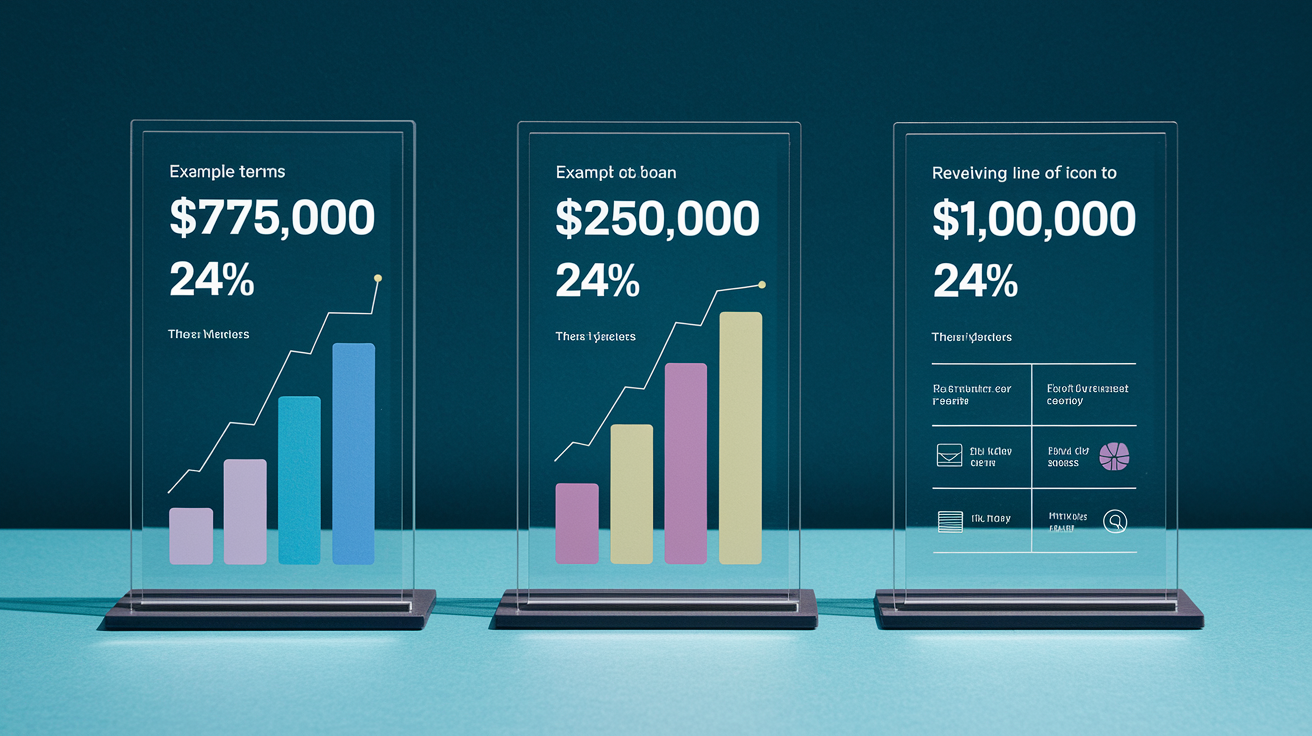
Short-term working capital products from online lenders often range from $10,000 to $2,000,000, with terms up to 14 months and repayment schedules that can be daily, weekly, or monthly. A business with $50,000 in monthly revenue might qualify for $75,000 over 12 months at a rate around 18% APR, with automatic weekly payments pulled from their bank account. A higher revenue business with strong credit might access $500,000 at 12% APR over the same period.
Term loans, structured differently but often used for working capital, commonly run $50,000 to $250,000 with terms up to 24 months. Payments are fixed and automatic, weekly or monthly, and the loan amortizes over the full term. Lines of credit provide revolving access, typically $50,000 to $1,000,000, with interest charged only on what you draw. You might pull $100,000 in month one, repay $50,000 in month two, and draw another $75,000 in month three, paying interest on the outstanding balance each day.
Applications for short-term products are fast. Around 10 minutes to submit basic information and upload documents. If you’re approved, funding often hits your account within 3 business days, sometimes faster. Refinancing short-term debt is common when rates drop or your credit improves. You take a new loan at better terms and pay off the old one, lowering your total cost or monthly outflow.
| Product Type | Typical Amount | Typical Term |
|---|---|---|
| Short-term working capital loan | $10,000–$2,000,000 | 3–14 months |
| Business term loan | $50,000–$250,000 | Up to 24 months |
| Business line of credit | $50,000–$1,000,000 | Revolving; no fixed term |
Final Words
In practice, short-term working capital loans give quick cash for payroll, inventory, or bridging late receivables. They typically run under 12 months with daily, weekly, or monthly payments.
The post broke down features (repayment cycles, APR vs interest, fees), eligibility (revenue, time in business, bank records), and real uses like seasonal stock and emergency repairs.
If you still wonder what is a short term working capital loan, think: short, targeted cash to keep payroll and bills paid. Use it only if the repayment fits your cash coming in and going out. It can keep your business moving.
FAQ
Q: Are working capital loans a good idea?
A: Working capital loans are a good idea when they solve a short-term cash gap and the repayment schedule fits your revenue; they work well for payroll, inventory buys, or bridging receivables.
Q: Can you get a loan on SSDI?
A: People on SSDI can get a loan, but approval depends on stable income, credit, and lender rules; you may need proof of benefits, a co-signer, or alternative documentation.
Q: How are working capital loans paid back?
A: Working capital loans are paid back with set repayments—daily, weekly, or monthly—using fixed payments, amortized schedules, or a percentage of sales until principal and fees are repaid.
Q: Is it hard to get a working capital loan?
A: Getting a working capital loan isn’t always hard; approval often hinges on time in business, monthly revenue, bank statements, and credit—online lenders tend to be easier than banks.