
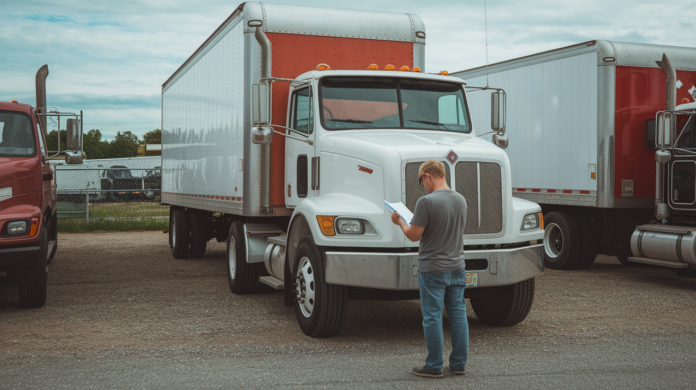

Think all truck loans are the same? Not even close.
If you’re buying or leasing vans, box trucks, or Class 8 rigs for a fleet, the right financing can cut monthly cost or protect cash coming in and going out.
This post lays out typical rates (what you’ll pay), loan and lease types (what you get), term lengths (how long you pay), and who usually qualifies.
We’ll show the real tradeoffs so you can pick funding that fits your fleet’s cash pattern, not a one-size deal.
Core Commercial Vehicle Financing Options Explained
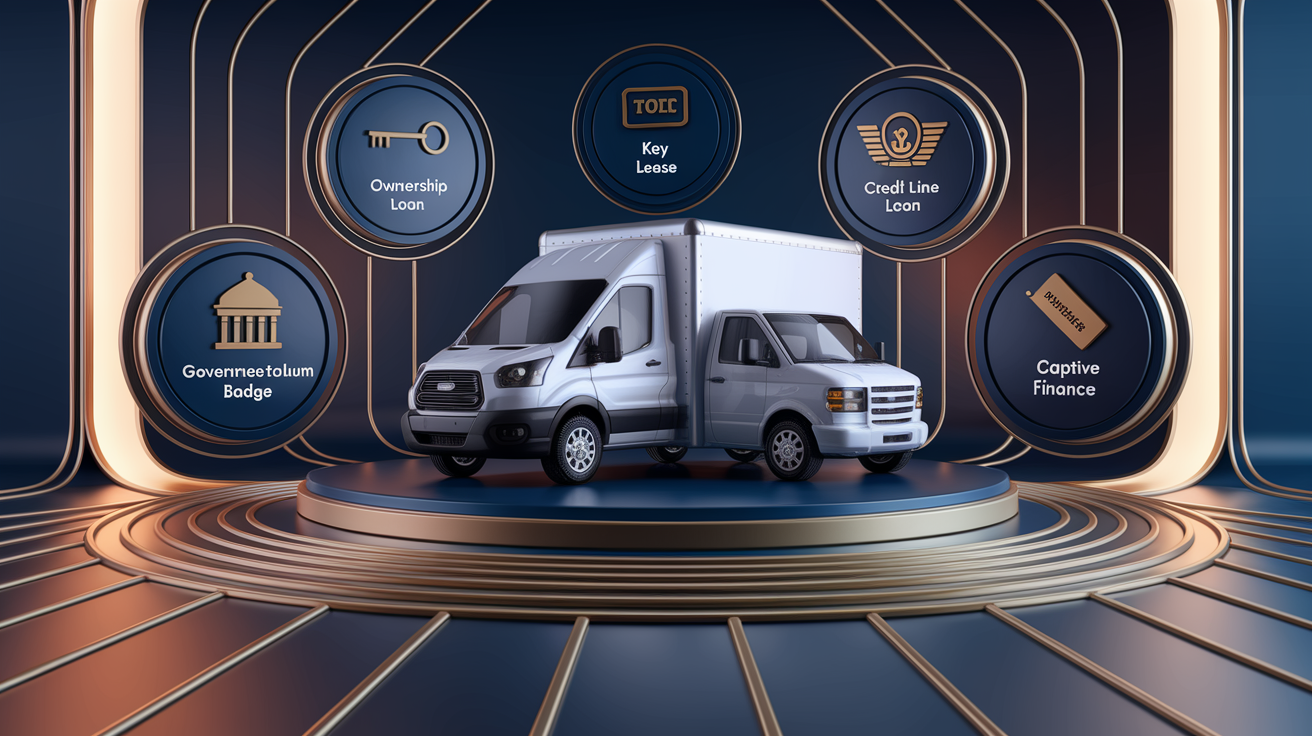
You can finance cars, vans, trucks, trailers, and specialty gear with secured term loans, capital leases, operating leases, revolving lines of credit, or SBA-backed loans. Each one fits a different cash flow situation and ownership goal.
Term loans give you full ownership. The lender files a UCC-1 lien, you make payments, and when you’re done the title is yours. Capital leases work almost the same way: you build equity and own the vehicle at the end. Operating leases let you use the truck without owning it. Monthly payments are lower because you’re only covering depreciation, not the full price. Lines of credit give you revolving access to capital for short-term purchases or seasonal fleet bumps, but they carry variable interest and you’ve got to stay on top of repayment. SBA 7(a) and 504 programs can cover vehicles as part of a bigger equipment package if your use meets SBA rules. You’ll get longer terms and better pricing if you’ve been around a while.
APR usually runs 4 to 8 percent if your credit is above 720, 8 to 15 percent for near-prime (650 to 719), and 12 to 25 percent or more for subprime. Loan terms depend on the truck: 24 to 72 months for light-duty vans and pickups, 48 to 84 months for medium-duty box trucks, and 60 to 120 months for Class 8 tractors and heavy equipment. Down payments range from zero (promotional captive deals) to 25 percent for used vehicles or weaker credit. Fleet buyers and contractors with steady revenue usually get better terms because lenders spread risk across multiple assets.
When to pick which option:
Loan works when you want full ownership, plan to drive high miles without worrying about penalties, and can handle higher monthly payments to build equity.
Lease makes sense for fleets that replace vehicles every few years, businesses that need lower monthly outlay, or when cash flow is tight and residual value is strong.
Line of credit fits seasonal businesses or fleets with variable inventory needs. You draw and repay flexibly, keeping monthly overhead variable.
SBA loan is right for longer-term financing when you need a big amount (up to $5 million), have time for underwriting (4 to 12 weeks), and want competitive fixed rates.
Captive/dealer finance can beat outside lenders when promotional APRs (sometimes 0 to 3 percent) are available, even if the negotiation price is less flexible.
Loan Structures and Cost Mechanics for Business Vehicle Financing

Commercial vehicle loans are amortizing installment notes secured by the vehicle title. The lender advances the principal, you make monthly payments of principal plus interest, and the debt drops to zero over the term. Interest accrues daily or monthly on the unpaid balance. Earlier payments carry more interest, later payments hit the principal harder. If you default, the lender can repo and sell the asset to recover the balance.
APR is your main cost number. It rolls the interest rate and most origination fees into a single annualized percentage. Prime borrowers (credit 700 and above) typically see 4 to 8 percent APR on new commercial vehicles. Near-prime (650 to 699) expect 8 to 15 percent. Subprime (below 650) may face 12 to 25 percent or higher, depending on vehicle age, down payment, and lender appetite for risk. Down payment expectations vary: zero to 10 percent for strong credit on dealer promotions, 5 to 25 percent for standard underwriting, and 10 to 30 percent for used vehicles or limited operating history. Higher down payments shrink the principal financed, which cuts monthly cost and total interest.
| Vehicle Class | Typical Term Range |
|---|---|
| Light-duty vans and pickups | 24–72 months (commonly 36–60) |
| Medium-duty box/service trucks | 48–84 months (often 60–84) |
| Heavy-duty tractors (Class 8) and specialty | 60–120 months |
| Refrigerated units and custom builds | 60–96 months |
Payment examples: a $50,000 loan at 6.0 percent APR for 60 months yields a monthly payment around $965, with total interest near $7,900. An $80,000 loan at 8.5 percent APR for 72 months runs about $1,443 per month and total interest close to $23,900. Longer terms reduce monthly outlay but inflate total cost because interest piles up over more periods. Shorter terms flip that: higher monthly payment, less total interest.
Eligibility Criteria for Commercial Vehicle Funding
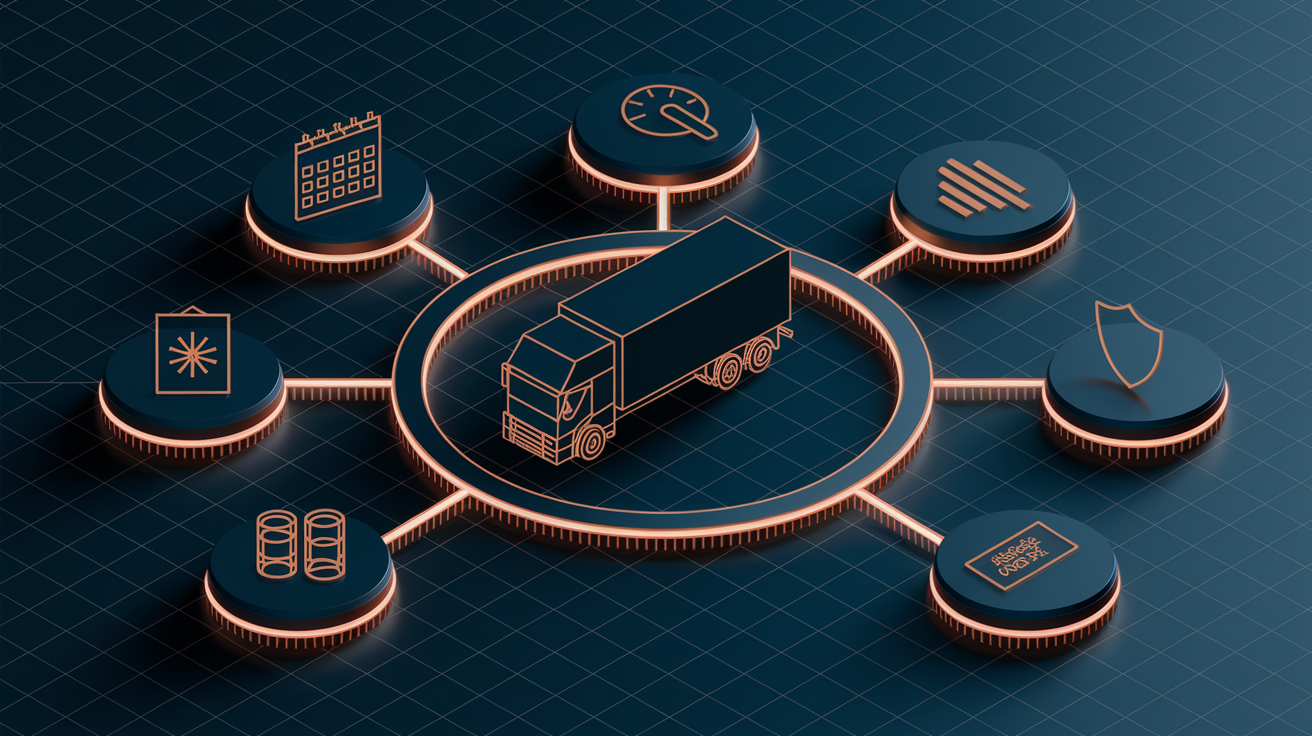
Lenders look at five things: time in business, annual revenue, credit score, collateral quality, and personal guarantees. Most traditional lenders want at least one to two years of operating history and annual revenue above $50,000 to $100,000. Startups can qualify through alternative programs but expect higher rates, bigger down payments, and stricter personal guarantees.
Credit scoring drives pricing. Borrowers with scores 700 and above get the best APRs and may lock in full financing with minimal down payment. Scores between 650 and 699 land in mid-tier pricing. Rates jump two to five percentage points, and down-payment expectations usually hit 10 percent or more. Scores 600 to 649 push into higher-rate territory. Borrowers below 600 enter subprime programs that may charge 15 to 25 percent or more. Lenders also pull business credit reports when available, checking payment history on existing equipment loans, lines of credit, and vendor accounts.
Collateral is straightforward: the vehicle secures the note, and depreciation matters. New trucks hold value better and justify longer terms. Used vehicles depreciate faster, so lenders shorten terms and raise down-payment floors. Cash flow review involves recent bank statements (three to six months), profit and loss statements, and balance sheets. Lenders want to see consistent deposits that cover operating expenses, existing debt service, and the proposed vehicle payment with room left over. Personal guarantees tie the owner’s assets to the loan, common for LLCs and startups where business financials are thin or volatile.
Top underwriting factors:
Time in business (typically 1 to 2 years minimum for standard programs, shorter for specialty lenders)
Annual revenue and recent monthly cash flow (lenders check for stable or growing deposits)
Personal and business credit scores (separate inquiries when business credit exists)
Debt to income and debt service coverage ratios (can you repay all obligations from operating cash?)
Down payment and vehicle collateral value (lower loan to value improves approval odds and pricing)
Required Documentation for Commercial Truck and Van Financing

Lenders need a complete financial picture to price risk and confirm you can repay. Documentation requirements are pretty standard across banks, credit unions, fintech platforms, and equipment finance companies. You’ll gather business tax returns for the previous one to two years, personal tax returns for all guarantors, and recent bank statements covering the last three to six months. These confirm revenue, profitability, and cash flow patterns.
The lender also requests a current balance sheet and profit and loss statement (year to date), a voided business check or bank letter, and purchase order or dealer invoice showing vehicle VIN, make, model, and price. You’ll need proof of commercial auto insurance meeting lender minimums for liability, comprehensive, and collision coverage. If the vehicle requires a CDL, the lender wants copies of licenses for all drivers. For used vehicles, provide the current title or registration. Lenders may run a lien search to make sure no existing loans or judgments attach to the VIN. The lender files a UCC-1 financing statement to perfect its security interest, holding the vehicle title until the loan is paid in full.
Typical document checklist (8 items):
- Business tax returns for the previous 1 to 2 years (IRS Form 1120, 1120-S, or 1065)
- Personal tax returns for all owners or guarantors (previous 1 to 2 years)
- Business bank statements (last 3 to 6 months, all pages)
- Year to date profit and loss statement and current balance sheet
- Voided business check or bank letter confirming account
- Purchase order, dealer invoice, or sales contract with vehicle VIN
- Driver’s license copies and CDL if applicable
- Proof of commercial auto insurance (binder showing required coverage limits)
Commercial Vehicle Financing Application Process and Timelines
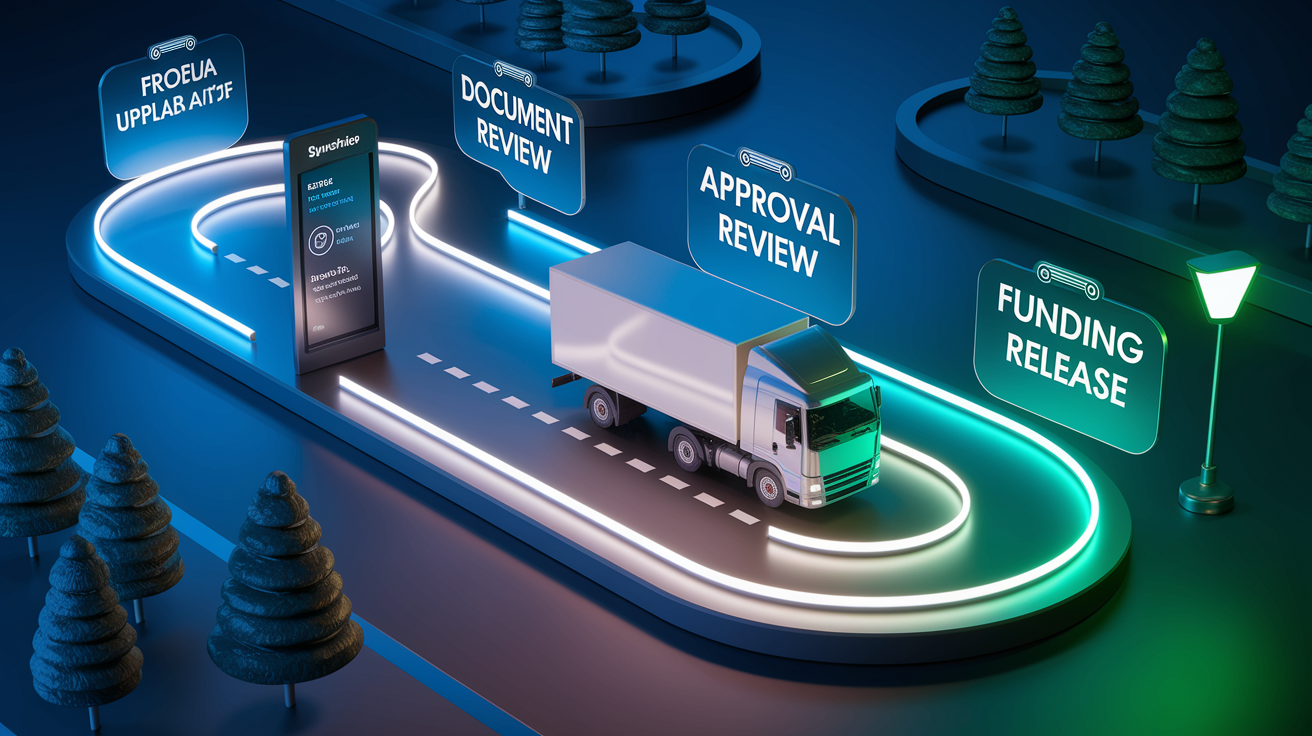
The application starts with pre-qualification. You provide basic info: business name, revenue, time in operation, estimated credit score, vehicle price, and down payment. Most online lenders and fintech platforms return a preliminary decision within minutes to one business day, showing estimated APR, term, and monthly payment. This soft inquiry typically doesn’t affect your credit score and lets you shop without commitment.
Formal underwriting begins when you submit the full documentation package. The lender verifies tax returns, bank statements, and financial statements, runs hard credit inquiries on personal and business credit bureaus, and may call trade references or ask for more info. Banks and credit unions commonly take one to three weeks for underwriting and approval. Fintech and online lenders move faster, often one day to one week, because they use automated underwriting engines and lighter documentation requirements. SBA 7(a) loans take the most time, typically four to twelve weeks, because the lender must package the file for SBA review and wait for guaranty approval.
Once approved, you review and sign the loan agreement, promissory note, and security documents. Funding usually happens one to seven business days after signing, depending on the lender’s process and whether the vehicle is already on your lot or being delivered from a dealer. Dealer transactions may close faster because the lender wires funds directly to the seller and files title paperwork immediately. For used vehicle purchases from private sellers, expect title transfer delays if the seller holds a lien or the title is out of state.
Application stages (5 steps):
- Pre-qualification: Submit basic business and vehicle info. Receive soft pull estimate within minutes to 1 day.
- Documentation: Upload full financial package. Lender reviews and may request clarifications (1 to 5 business days).
- Underwriting and credit review: Hard credit pull, verification of revenue and cash flow, collateral appraisal if needed (1 to 14 days depending on lender type).
- Approval and terms: Final loan agreement with locked APR, term, payment, and any fees. Borrower reviews and signs.
- Funding and title: Lender disburses funds to dealer or seller. Files UCC-1 and holds title. Vehicle is released for use.
Lease vs Loan Analysis for Commercial Vehicles
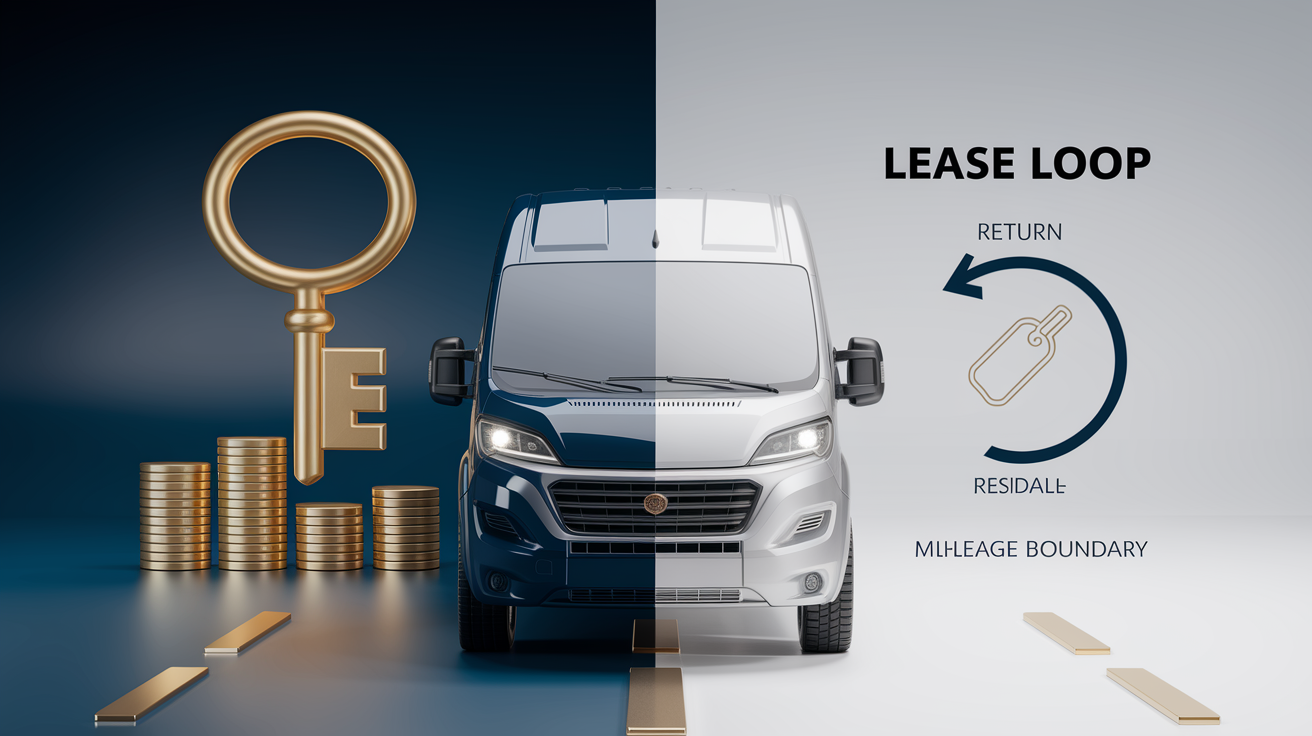
The lease versus loan decision comes down to ownership goals, cash flow, mileage patterns, and tax strategy. A loan builds equity with each payment. Once the note is satisfied, you own the asset outright and can run it indefinitely or sell it for residual value. A lease gives you lower monthly payments because you fund only depreciation (the difference between capitalized cost and residual value) plus a lease finance charge (often expressed as a money factor). At term end, you return the vehicle, purchase it for the predetermined residual, or trade it for a new unit.
Operating leases are common for fleets that refresh vehicles every three to five years. Lease terms typically run 24 to 60 months. Lessors build in a residual value between 30 and 60 percent of MSRP, depending on make, model, and lease length. Longer leases reduce the residual percentage because depreciation speeds up. Monthly lease payments are lower than loan payments on the same vehicle, which makes leases attractive when cash flow is tight or when you want to put capital elsewhere. The tradeoff? No ownership and often strict mileage caps, commonly 12,000 to 15,000 miles per year for light-duty vehicles and negotiated mile allowances for commercial trucks.
Residual Value and Mileage Rules
Residual values estimate what the vehicle will be worth at lease end, based on manufacturer data, market conditions, and expected use. Higher residuals mean lower depreciation charges and smaller monthly payments. Mileage penalties kick in when you exceed the agreed annual cap. Overage fees run 10 cents to 30 cents per mile, which can add thousands of dollars if you drive significantly more than the allowance. Some lessors offer high-mileage leases with higher monthly payments but larger mile caps, good for delivery fleets or service routes with predictable high usage.
End of Term Options
When the lease expires, you’ve got three choices: return the vehicle and walk away (subject to condition inspection and any excess wear charges), purchase the vehicle for the residual amount stated in the lease contract, or trade it toward a new lease. If the market value beats the residual, buying and reselling can capture that equity. If depreciation was steeper than projected, returning the vehicle may be the better move because you’re not underwater on a loan.
Lease vs loan comparison (5 points):
Ownership: Loan builds equity and ownership. Lease doesn’t.
Monthly payment: Lease typically lower. Loan higher because you’re financing the full price.
Mileage: Lease imposes caps and penalties. Loan has no restrictions.
Flexibility: Lease limits modifications and early termination can trigger fees. Loan allows any use or sale.
Tax treatment: Operating lease payments are often fully deductible as operating expense. Finance lease and loan split deductions between interest and depreciation.
Fleet Financing Structures and Multi‑Vehicle Programs

Fleet financing scales commercial vehicle loans and leases to cover multiple units under a single agreement or master line. Lenders often extend fleet discounts when you finance three or more vehicles at once, cutting APR by 0.25 to 1.0 percent and sometimes waiving origination fees. Fleet leases bundle maintenance packages, roadside assistance, and replacement vehicle programs, simplifying operations and budgeting for transportation-dependent businesses like delivery services, contractors, and logistics companies.
Multi-vehicle underwriting considers the entire fleet’s cash flow and collateral pool. A contractor adding five service vans may qualify for better terms than financing one van at a time because the lender spreads risk and administrative cost across the portfolio. Fleet agreements typically allow rolling renewals. As you pay down one vehicle, you can add or swap units without re-underwriting from scratch. This works well for businesses that cycle trucks every few years to manage maintenance costs and keep equipment under warranty.
Trade-in strategies get more efficient with fleet programs. When a lease or loan matures, you can trade the outgoing vehicle toward the next unit, applying any equity or negotiating a fleet replacement rate. Some lessors offer guaranteed residuals or buyback programs for high-volume customers, cutting end-of-term uncertainty. Electric vehicle incentives and alternative fuel credits often amplify for fleets. Federal and state programs sometimes offer per-vehicle rebates or tax credits when you purchase multiple EVs or clean diesel trucks in a single year, stacking savings across the fleet.
Fleet financing advantages (4 items):
Lower per-unit APR and reduced or waived origination fees for multi-vehicle purchases
Consolidated billing, maintenance packages, and centralized account management
Rolling renewal clauses that make adding or replacing units simpler without full re-underwriting
Access to manufacturer fleet incentives, EV rebates, and alternative fuel tax credits for bulk acquisitions
Tax Benefits and Accounting Rules in Commercial Vehicle Financing

Commercial vehicles used more than 50 percent for business qualify for accelerated depreciation under Section 179 and bonus depreciation rules. Section 179 lets you expense the vehicle’s purchase price immediately in the year placed in service, subject to an annual deduction limit ($1,160,000 for 2023) and a phase-out threshold starting at $2,890,000 in total equipment purchases. Bonus depreciation, historically 100 percent through 2022, stepped down to 80 percent for property placed in service in 2023 and continues to decline in later years under the Tax Cuts and Jobs Act schedule. Permanent 100 percent bonus depreciation (OBBA) applies to qualifying property acquired after January 19, 2025, restoring the immediate write-off for eligible assets.
Business use percentage matters. The IRS requires more than 50 percent business use to claim Section 179 or bonus depreciation in the first year. If personal use tops 50 percent, you must use straight-line depreciation over the vehicle’s MACRS recovery period (typically five years for cars and light trucks, three years for some over-the-road tractors). You can claim vehicle expenses via the standard mileage method (tracking business miles and multiplying by the IRS rate) or the actual expense method (fuel, maintenance, insurance, depreciation, loan interest). The actual expense method usually gives you larger deductions for financed vehicles because you add depreciation or Section 179 expensing plus loan interest to operating costs.
Lease vs Purchase Tax Treatment
Operating lease payments are typically fully deductible as a business expense on the income statement, simplifying accounting and avoiding depreciation schedules. Finance leases (capital leases) are treated like purchases for tax purposes: you capitalize the asset, claim depreciation or Section 179, and deduct the interest portion of each lease payment. Loan interest is always deductible as a business expense. Principal repayment isn’t deductible, but the vehicle depreciates over its useful life or is expensed under Section 179 or bonus depreciation rules.
| Deduction Type | Applies To | Key Requirement |
|---|---|---|
| Section 179 expensing | Purchase or finance lease (asset capitalized) | More than 50% business use in year placed in service |
| Bonus depreciation | Purchase or finance lease (new or used qualifying property) | More than 50% business use; phased schedule or 100% OBBA if acquired after Jan. 19, 2025 |
| Operating-lease payment deduction | Operating lease (not capitalized) | Reasonable and ordinary business expense; vehicle used in trade or business |
Monthly Payment Scenarios and Amortization Examples

Amortization spreads a loan’s principal and interest across equal monthly payments. Each payment covers accrued interest on the outstanding balance plus a chunk of principal. Early in the term, interest eats up the larger share. Later payments hit the principal harder. The standard formula is Payment = P × [r / (1 − (1 + r)^−n)], where P is principal, r is the monthly interest rate (APR ÷ 12), and n is the number of months.
Extra principal payments cut the outstanding balance faster, which lowers future interest charges and can shorten the term. Adding $100 to each monthly payment on a five-year loan can knock several months off the term and save hundreds in interest. Some lenders allow prepayment without penalty. Others charge early payoff fees, so check the note terms before making extra payments. Online amortization calculators and spreadsheet templates let you model different scenarios: longer or shorter terms, various APRs, and the impact of larger down payments or extra principal.
| Loan Amount | APR | Term (months) | Approx. Monthly Payment |
|---|---|---|---|
| $50,000 | 6.0% | 60 | $965 |
| $80,000 | 8.5% | 72 | $1,443 |
| $60,000 | 7.0% | 60 | $1,189 |
Specialty and Alternative Commercial Vehicle Financing Programs
Borrowers with credit scores below 600 or businesses operating less than a year often turn to subprime and specialty lenders who take on higher risk for higher pricing. APRs in this segment commonly run 12 to 25 percent or higher. Down payment requirements jump to 15 to 30 percent to offset default risk. These lenders focus on collateral value and may require weekly or bi-weekly payments tied to revenue cycles, GPS tracking on the vehicle, and personal guarantees from all owners.
SBA 7(a) loans provide an alternative path for established businesses needing larger amounts or longer terms. The SBA guarantees a portion of the loan, reducing lender risk and enabling loan amounts up to $5,000,000 with terms that can stretch 10 years for equipment and vehicles. Approval takes longer (typically four to twelve weeks) and documentation requirements are more extensive, but the tradeoff is competitive fixed rate pricing and flexible use of proceeds rules. SBA financing works well when you’re purchasing multiple vehicles, adding real estate or equipment, and want a single consolidated loan.
Specialty vehicle financing covers refrigerated trucks, tow trucks, dump trucks, custom service vans, and mobile medical units. These are assets that standard auto lenders may decline because of unique depreciation curves or limited resale markets. Equipment finance companies and niche lenders underwrite these vehicles by looking at the business’s operating cash flow and the vehicle’s utility. Expect personal guarantees, commercial insurance certificates showing higher liability limits, and sometimes maintenance escrows or performance bonds if the vehicle supports a critical revenue stream. Some programs bundle insurance, maintenance, and telematics into the financing package, simplifying fleet management for operators who lack in-house administrative staff.
Situations ideal for specialty financing (5 items):
Credit scores below 600 or thin business credit history (less than 1 year in operation)
Unique or custom vehicles (mobile medical units, food trucks, specialty construction equipment) with limited resale comparables
Startups or seasonal businesses that can’t meet traditional revenue or time in business thresholds
Need for SBA-backed longer terms and larger loan amounts (up to $5M) when conventional limits are too low
Fleets requiring bundled maintenance, insurance, and telematics as part of the financing package
Final Words
Need a truck now? This guide walked you through loans, leases, lines of credit, typical APRs and terms, eligibility, docs, timelines, and fleet and specialty options.
Match the choice to your cash coming in and going out: loans give equity but bigger payments, leases lower monthly cost but no ownership, and lines add short-term flexibility.
Commercial vehicle financing is manageable if you map the numbers and timeline. Pick the fit, prepare the paperwork, and you’ll be ready to roll.
FAQ
Q: How much is a monthly payment on a $70,000 truck? How much is $20,000 financed for 60 months? How much is the monthly payment on a $50,000 business loan?
A: The monthly payment on a $70,000 truck is about $1,356 at 6% APR over 60 months; $50,000 ≈ $965; $20,000 over 60 months ≈ $387. Payments change with APR and term.
Q: How hard is it to get a $1,000,000 business loan?
A: Getting a $1,000,000 business loan is often challenging. Lenders typically require 2+ years in business, strong cash flow and credit, collateral, and personal guarantees; banks and government programs underwrite more strictly.